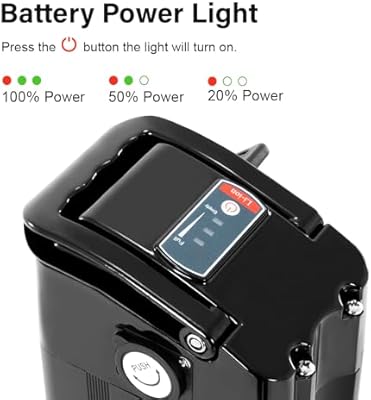
A battery built for one named bike takes the sizing guesswork out of a replacement, and that is exactly the promise this pack makes.
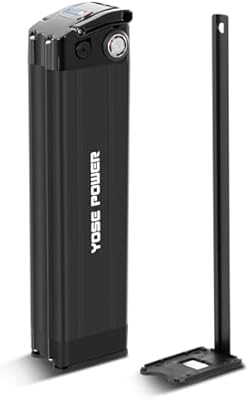
The ECOTRIC Hammer Fat Tire FAT20850C is a fat-tire commuter with a silver fish style battery bay, and Yose Power sells a 48V 15.6Ah pack that names that bike in the title, on the case and in the fitment bullet. Named fitment is the main reason anyone pays a premium over a generic triangle pack, because the alternative is measuring a bay and hoping.
The choice is harder than the title makes it look. The listing's own box list and its own bullets disagree about whether a charger ships, the spec sheet caps continuous current at a level that does not reach the advertised motor size, and the seller's own range card prints two numbers that disagree by a factor of more than three. The written record is four texts deep.
None of it is disqualifying on its own, but together it means the buyer has to verify three things the listing will not settle.
The Yose Power 48V 15.6Ah is a silver fish pack with an 18-month warranty, a one-month prepaid-return window for quality problems, and about 748.8 watt-hours of capacity at roughly 36 cents per watt-hour. That price puts it in the priciest tenth of the packs we track, which is the premium you pay for the named fitment.
Whether the fitment claim holds is the one thing the record cannot confirm, and the charger question is the one thing the listing contradicts itself on.
The Charger the Box List Leaves Out
Start here, because it is the difference between a working bike and a paperweight for a week. Our own data row for this pack carries the words Without Charger in its title, and the packing-list card in the listing images backs that up: it shows a battery pack, a mount rail, a discharge plug, a key and a user manual, and no charger anywhere on it.
Yet the fourth bullet promises that the charger fills the battery in just 7 hours, and the live listing title has quietly dropped the Without Charger words. Both cannot be true.
The arithmetic says the 7-hour claim was already optimistic. At the 2-amp charging rate Yose Power prints across its other packs, 15.6 amp-hours needs 7.8 hours before the taper near full, so seven hours only works with a charger above 2.2 amps. No charger amperage is printed anywhere on this listing, and if no charger ships, the question is moot until you buy one.
A 48V pack of this type runs a 13-cell series string, which means any replacement charger must terminate at 54.6V. Ask the seller which charger ships before you order, and check the label on arrival, because a 42V charger will never fill this pack and a 58.8V one will overcharge it.
What 10 Amps Buys You
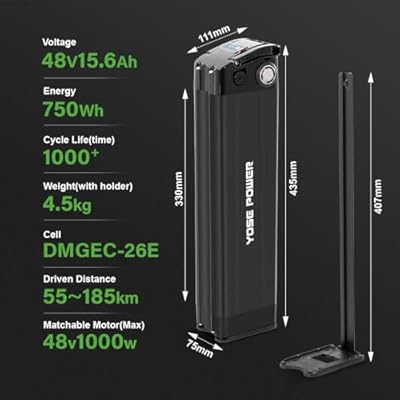
The parameters card and the data row both claim a maximum matchable motor of 48V 1000W, and the fitment bullet repeats it.
The first bullet also prints the number that matters more: standard discharge current of 10A. Ten amps at 48 volts is 480 watts of continuous supply. A motor that draws its full 1000W rating needs about 21 amps, more than double what the pack commits to as its standard output.
That does not make the pack useless with a big motor, but it moves the 1000W figure into the peak-claim category. Controllers pull bursts far above their continuous rating, so a 1000W motor might run short bursts without tripping anything, and it might not, because the listing prints a maximum discharge figure nowhere.
The honest plan number is 480W continuous, which covers the 350W motor in the seller's own range test with headroom, and covers most hub motors in the 500W class at a stretch. If your build pulls harder than that for long stretches, this is the wrong pack regardless of what the title says.
The Range Card Argues With Itself
One of the listing images is a test card, and it is the most useful single fact on the page because it prints its conditions: 20 degrees Celsius, a 70kg rider, a 48V 350W motor, pedal assist. Under those conditions it claims 50 to 55km in power mode and 180 to 185km in ECO mode. The second number is the marketing one, and the card's own arithmetic undercuts it.
Run the ECO figure through the pack's capacity. 112 to 115 miles from 748.8 watt-hours works out to roughly six and a half watt-hours per mile, which sits below the floor of what a pedal-assist system realistically consumes. Wikipedia's electric bicycle article notes that range depends on assist level, terrain, rider weight and wind, with typical pedal-assist consumption around 10 to 20 watt-hours per mile.
The power-mode figure tells the opposite story: 31 to 34 miles from the same pack implies about 22 to 24 watt-hours per mile, which is ordinary throttle-heavy riding. In other words, the card's realistic number and its fantasy number live on the same card, 125km apart.
Plan on the honest bands instead. On mid-level assist at 15 to 20 watt-hours per mile, this pack carries roughly 37 to 50 miles.
A throttle-heavy rider at 25 to 35 will see roughly 21 to 30. Cold weather, hills and cargo all pull those down.
One Detailed Buyer, and It Was Not the Advertised Bike
Sixteen buyers have rated this pack at 4.3 stars, and the histogram as printed runs 71 percent five stars, 15 percent four, and 14 percent one, with empty three-star and two-star bands. Those percentages do not reconcile cleanly to sixteen ratings, so I quote them as printed. Only four buyers have written anything, and all four carry purchase badges, which leaves twelve wordless ratings doing most of the scoring work.
The top-voted text, at three helpful votes, is the one every ECOTRIC owner should read twice, because the bike in it is not an ECOTRIC.
One owner has fitted this pack to a HeyBike Ranger, reports the installation took an hour with the guide post, and calls it a perfect retrofit. The listing never names HeyBike, so that is an off-list fit that worked, and it is also the entire positive case: the other positive text is one sentence about an extra kick.
The failures are thinner still. One text says only "Did not work on my bike," and it carries a four-star rating, a disagreement in miniature. The one-star text says only "Mal information," which rules nothing in and nothing out.
So the record cannot confirm the fitment the premium is paying for. What you can do is what the first bullet asks: measure the bay. The case is 75 by 107.5 by 434.6mm, and a silver fish rail mount is shared across enough brands that the HeyBike result makes sense, but a rail width a few millimeters off turns a perfect retrofit into a returned pack.
The Yose Power 36V 17.4Ah silver fish we rebuilt last week teaches the same lesson from its own fitment record.
Weights, Cycles and What the Name Costs
The listing prints two weights, and they are 0.8kg apart. The spec row says the battery weighs 3.7kg, and at 748.8 watt-hours that works out to about 0.20 kilowatt-hours per kilogram, mid-band for a lithium pack and entirely plausible. The parameters card says 4.5kg with the holder, which lands at the floor of the same band.
Neither figure is impossible, and the difference is probably the holder, but the two prints cannot both describe the same object, so weigh the box on arrival and compare.
The cycle story splits the same way. The bullet promises 70% capacity after 700 cycles, which is a modest, honest-sounding claim, since the usual convention quotes cycle life at 80% remaining capacity across a 400 to 1,200 cycle band. The parameters card instead prints 1000 cycles with an asterisk and no footnote anywhere on the card.
When a card carries a condition it does not print, the bullet's humbler number is the one to plan around.
At 269.99 for 748.8 watt-hours, you are paying roughly 36 cents per watt-hour, which puts this pack in the priciest tenth of the table. Part of that premium buys the named fitment and the 18-month warranty, which is longer than the 3-month terms on several generic packs we have rebuilt.
The one-month prepaid-return window for quality problems is the safety net that matters most, because it is the only exit if the fit is wrong or the pack arrives weak. The Yose Power 48V 13Ah downtube pack shows what the brand's variant pooling looks like from the inside, and it is worth reading before you assume this record belongs to one shell.
Frequently Asked Questions
Does it ship with a charger?
The box list says no and the bullets say yes, so treat it as unresolved. The packing card lists a battery pack, mount rail, discharge plug, key and manual. Ask the seller directly before ordering, and if you supply your own charger, it must terminate at 54.6V for a 13-cell 48V pack.
Will it fit my bike?
Measure the bay against 75 by 107.5 by 434.6mm before you order, because the record will not answer for you. The one detailed fit report on this listing is a HeyBike Ranger, not the advertised ECOTRIC, so the named fitment has not actually been confirmed in writing by anyone.
Is the 185-kilometer range real?
Treat it as a best-case ECO figure from the seller's own test card, printed next to a power-mode figure of 50 to 55km that implies realistic consumption. The honest expectation for most riders sits between those numbers, closer to the power figure the heavier the throttle hand.
Can it run a 1000W motor?
Only in bursts, if at all. The pack's printed standard discharge is 10A, which is 480W continuous at 48V, and a full 1000W draw needs about 21A. No maximum discharge figure is printed anywhere, so the 1000W claim rests on headroom the listing never documents.
What does the thin record mean for a buyer?
Twelve of the sixteen ratings are wordless, so the 4.3 average leans on very little written evidence, and all four written texts fit inside a year. Buy this pack for the fitment and the warranty terms, not for the star average, and use the prepaid-return month to verify capacity and fit on your own bike.