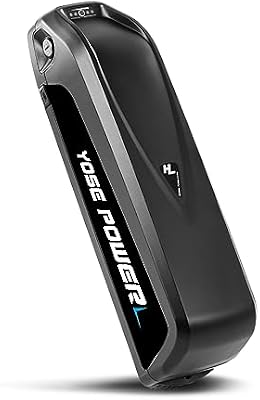
Downtube replacements are the stubborn end of the ebike battery market, because you are shopping for a shape that matches a bay some manufacturer stopped caring about years ago. Yose Power sells into that gap with a 48V 13Ah down-tube pack, and on paper it hits the usual wants: a USB port for phone charging, a keyed lock, a charge-level light, a 4-pin discharge port and a charger in the box.
Two things on this page are not on any spec sheet. The review record does not belong to this pack alone, and the listing cannot decide whether it is selling 13 or 15 amp-hours. Both change how much you can trust the page, so they lead this review.
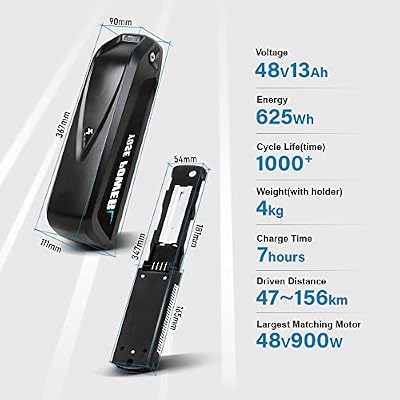
The Yose Power 48V 13Ah downtube battery sells for 219.99 from the brand's own storefront, and 48 volts times 13 amp-hours is 624 watt-hours. On our comparison table that works out to about 35 cents per watt-hour, which sits in the pricier third of the 301 packs we track. It is not a bargain. You are paying for the form factor and the brand, and the rest of this review is about whether those are worth the premium.
The review record sits on two listings
The page shows 4.0 stars from 13 global ratings, with a histogram that has no middle: 76 percent five-star, 24 percent one-star, nothing between. While reading the texts I noticed something I have not caught in this campaign before. The Yose Power 36V 13Ah pack we rebuilt in August carries the identical record, rating for rating and date for date. The same eleven texts, the same 4.0 average, the same empty middle bands.
Amazon pools reviews across variants of one parent listing, and these two packs are clearly siblings of the same family. The practical consequence is that no single review on this page can be attributed to the 48V downtube shell. A fit complaint might describe this pack, or the 36V one, or a third variant I have not seen. I treat the pool as brand-level evidence about Yose Power's downtube line, not as a verdict on the pack in the box.
What does the pool actually say? Fitment dominates it. Three of the eleven texts describe packs that would not mount, and two of those three are five-star reviews. One October buyer wrote that the battery looked great but did not fit the bicycle and had to be returned, then praised the seller for helping with the FedEx paperwork. A June buyer said they were not able to use the pack at all but would buy from the brand again.
The one-star version of the same story is blunter: a buyer who asked the seller whether the pack would fit, was told it would, and then could not return it for a refund. Read those together and the lesson is not that the battery is bad. It is that this listing's universal-fit claim is not a fitment guarantee, and the cost of being wrong is a return you may have to argue for.
The other failure in the pool is one dead pack. An April buyer wrote that after the first use the battery would not recharge, and that the return attempt turned into a loop, with Amazon saying to contact Yose and Yose saying to contact Amazon. A pack that refuses its first recharge points to a BMS lockout, a charger fault or internal cell damage rather than normal wear, and Wikipedia's lithium-ion battery article covers those failure modes in detail.
The review does not say which one occurred, so I will not guess. What I take from it is that the ping-pong happened at all, and that one buyer's 18-month warranty did not feel like protection while they were living inside the argument.
The rest of the pool is thin praise. Works as it should, working great, a one-word Nickel, a Spanish text praising service rather than the pack, and one useful detail from March: the buyer's motor connected easily because the package came with all possible connectors. Nobody gives a mileage figure, a bike model, or a capacity measurement, so the pool says nothing about range. For expectation-setting, the usual spread for pedal-assist riding runs 25 to 75 miles per charge depending on assist level, terrain and rider input, and Wikipedia's e-bike article sketches that spread. A 624 watt-hour pack sits at the low end of it, so plan around the twenties for mixed riding and treat anything more as a bonus.
The listing cannot settle on 13 or 15 amp-hours
Count the capacity claims on this page and you get three answers. The title says 13Ah. The spec table's Battery Capacity row says 15 amp-hours. A bullet splits the difference with the string 15Ah/13Ah and then repeats a promo sentence twice inside itself, which tells you the bullet was assembled from templates rather than proofread. The model number row reads battery AT48V13Ah, and the 13 in that code agrees with the title.
The gap is not cosmetic. 48 volts times 13 amp-hours is 624 watt-hours, and 48 volts times 15 amp-hours would be 720 watt-hours. Whichever row you believe changes the pack's energy by about an eighth, and it changes the price-per-energy math with it. I come down on the title's side, because two independent rows support it, but I would not stake a purchase decision on my reading. Ask the seller which pack ships, and when the box arrives, check the stamp on the case against the label you paid for.
The spec table also carries the junk rows this brand family shares with its siblings. Cell composition reads Lithium Metal, which no production ebike pack is, the Manufacturer Part Number row contains the words 4pins discharging port, which is a port description rather than a part number, and the vehicle service type says Scooter on a listing titled as an ebike battery. None of these rows is dangerous on its own. Together they tell you nobody audited this page, which is exactly why the capacity conflict above has not been fixed.
The 20-amp ceiling and the 1000-watt claim
The parameters bullet prints the honest numbers: 10 amps standard discharge, 20 amps maximum. Twenty amps times 48 volts is a 960 watt ceiling, and the highlight row claims motors from 200W to 1000W. A 1000W motor draws about 21 amps at full load, which is just over what the BMS allows. The claim is not fantasy, the way some of this month's listings were. It is one amp too optimistic.
The number I would plan around is the standard rating. Ten amps sustained is 480 watts of continuous draw, so a motor in the 500-watt class rides comfortably inside the pack's comfort zone, and something in the 750-watt class spends its climbs borrowing against the 20-amp maximum. Push past the maximum and the BMS does what it is designed to do, which is cut output. Losing power mid-ascent is startling the first time it happens, and on a busy road it is not just an inconvenience. If your motor is rated near or above 1000W, this is the wrong pack, and no amount of marketing changes the arithmetic.
Charging, weight, and what ships in the box
The charger prints 54.6 volts at 2 amps, and 54.6 is 13 cells times 4.2, which is correct charging math for a 48V pack. At 2 amps, refilling 13 amp-hours takes at least six and a half hours, so the listing's claim of a 7-hour full charge holds once you allow for the taper near the top. This is an overnight charger, not a lunch-break one.
The printed weight of 8.8 pounds, about 4 kilograms, is the rare figure that survives checking. Bare cells for 624 watt-hours need roughly 2 to 4 kilograms at the densities real cells come in, which leaves room for a case, a BMS and wiring inside a 4-kilogram total. Several packs I rebuilt this month printed weights that could not physically contain their claimed energy, so a plausible number here is worth a sentence of credit.
The Included Components row lists the pack, charger, keys and manual, which puts the charger in the box. Half the listings I covered this month ship without one and leave you to match a connector on your own, so this is a real convenience, and the March buyer's comment about all possible connectors backs it up. The warranty row reads 18 months on kit and battery, which is the longest coverage I have seen on any pack rebuilt this month. One dead-pack review does not erase that, but it is a reminder that a warranty row and a smooth claim are different things.
Where this pack lands on price
At the title's 13Ah reading, 219.99 for 624 watt-hours is about 35 cents per watt-hour, in the pricier third of the 301 packs we track on the comparison table. If the capacity row's 15 amp-hours were the truth, the price per energy would improve to about 31 cents, and that still would not reach the cheaper half of the table. The specs box on this page renders the live position as prices move.
The sibling comparison is worth one blunt sentence. The 36V version of this pack prices near 40 cents per watt-hour, among the most expensive tenth of everything we track, so the 48V downtube is the cheaper of the two Yose shells. Cheaper, though, is not cheap. You are paying a premium for a downtube form factor that the market no longer stocks widely, and if your frame can accept a more common shark or hailong shell instead, the table will show you packs with a third more energy for the same money.
Common questions before you order
Will it fit my frame?
Measure first, because the spec table prints the case at 90 by 111 by 367 millimeters. Fitment is the most common failure in this listing's own review pool, including two five-star texts that are really return stories. Compare those millimeters against your bay or your old pack before you order, not after.
What motors can it run?
The highlight claims 200W to 1000W. The BMS allows 20 amps maximum, a 960 watt ceiling, and 10 amps sustained. The honest bracket is motors up to about 500 watts for continuous riding, with headroom to the mid-900s for peaks, and nothing at or above 1000 watts.
How long does a full charge take?
Plan on seven hours from empty with the included 2-amp charger, which is overnight. The listing's own claim and the charging arithmetic agree on that number.
Is the 18-month warranty worth anything?
It is the longest coverage on any pack I have rebuilt this month, and it covers the kit as well as the battery. The caveat comes from the pool: one buyer's dead pack turned into a support loop between Amazon and the brand. Buy knowing a claim may take persistence.
Why do the same reviews appear on two Yose listings?
Amazon pools reviews across variants of one parent listing, and this pack shares its record with the 36V version. Read the pool as evidence about the brand's downtube line, judge this specific pack on its spec rows and case stamp, and check the current price and listing on Amazon before you commit.