A battery that sells for 79.99 and claims 48 volts at 20 amp-hours should set off alarms before anything else on the page gets read, because that price is roughly a third of what the middle of the market asks for the same rated capacity. It's the cheapest pack we track on our battery table, and not by a small gap. So the question I brought to this listing wasn't whether it is good value. It was what the price buys and what it leaves out.
The YLuBik 48V 20Ah pack is aimed at DIY builders first. The title names electric bicycles, ATVs, scooters, solar storage and more, the connector is universal, and no bike brand appears anywhere on the page. This is a pack you wire in, not one that drops into a shaped bay.
I went in expecting the usual inflated range claims. What I found instead was a listing that cannot agree with itself on what is actually inside the case, and a parameter card that looks borrowed from a different pack entirely.
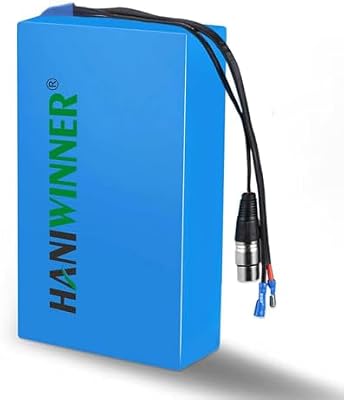
The Cheapest Pack We Track, and the Record Behind It
Value this far outside the band needs the smallest print checked first, so I started with the page's own signals. The listing was in stock at 79.99 when I scraped it, sold by YLuBik Battery, sitting around 182,000th in Sports and Outdoors. The page shows a 4.5 star value, and the rating count sits inside page code that never loaded for my scrape, so I can't tell you how many buyers stand behind that star.
I want to be straight about that gap. A star without a visible count is a stand-in, not evidence, and I treat it that way. What I can verify is the printed record on the page, and that record is full of contradictions for a listing this cheap.
The API data behind the listing adds one oddity. Amazon files it under the product group Toy, on a battery, under an Electronics binding. That's a listing-quality signal rather than a cell-quality one, and I file it with everything else this page can't keep straight.
The Pack Cannot Agree What Is Inside It
Cell configuration is the first place the listing splits into three stories. The title, the first bullet and the parameter card each describe the pack differently, and the differences are not cosmetic.
The first bullet says the specification is ST 13S8P. Decode that and it closes perfectly. Thirteen cells in series at 3.7V nominal gives 48.1V, and eight strings in parallel at the 2.5Ah cells this pack almost certainly uses gives 20Ah. The arithmetic lands exactly on the advertised rating, so the bullet's story is a real 48V 20Ah setup.
The parameter card in the gallery tells a different story. It reads 10S3P, which is a 36V setup, and at 2.5Ah cells it would hold 7.5Ah, not 20. No reading of 10S3P produces a 48V 20Ah pack, so that line can't describe this one. My best explanation is duller than any scandal: the card was recycled from a 36V sibling in the same product family, and nobody checked it.
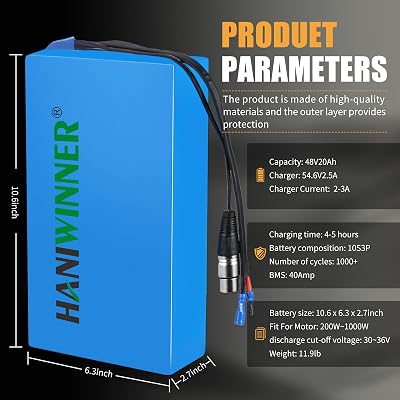
The card's own voltage lines side against it. It prints a discharge cut-off of 30 to 36V, which matches a 13-cell string and makes no sense for the 10-cell string it names. Somebody copied two cards into one and kept the voltage row from the real pack.
Brand names multiply the same way. The listing brand is YLuBik, the card prints a trademark reading Haniwinner, and the API manufacturer field reads Shenzhen Hani Energy Technology. The Hani in the manufacturer name probably connects the other two, but a buyer counting names on this page gets three.
Forty Amps or Thirty, and the Charge Time Neither Supports
Current ratings are where the contradictions start costing real money, because the BMS number decides what the pack can safely feed. The title advertises a 40A BMS. The fourth bullet says the pack is equipped with a 30A BMS protection board with a maximum discharge current of 30A. The parameter card goes back to 40Amp.
Two prints say 40, one says 30, and the buyer can't resolve this from the page. My working assumption is the conservative one. A 30A board at 48.1V is about 1,440W of continuous power, which still covers the title's 1,000W motor ceiling with room for peaks, so even the smaller number fits the pitch. But if you were counting on 40A for a heavy build, plan around 30 until proven otherwise.
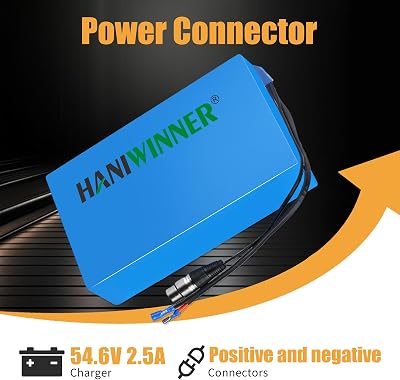
The charge story has the same shape. The card promises charging in 4 to 5 hours, and the same card prints the charger the box ships: 54.6V at 2.5A. Twenty amp-hours divided by 2.5A is an 8.0 hour floor before the taper even starts, so the card's own charger cannot meet the card's own estimate. The 4 to 5 hour line would need a 4 to 5A charger, which the listing does not offer and the card's charger-current row does not describe.
One more print worth flagging. The first bullet says the pack suits 100-1000Wh motors, and I believe that's a typo for watts, because the title says 100-1000W and the card says 200W to 1000W. Three motor ranges, three sources, and the card is the most conservative of them.
The Weight Test the Price Has to Explain
Physical plausibility is the test I run on every cheap high-capacity listing, and this one passes it only barely. The bullet prints 5.4kg, the card agrees at 11.9lb, and 960 watt-hours at 5.4kg works out to about 178 watt-hours per kilogram at pack level.
That number sits at the very top of what finished packs achieve. Wikipedia's lithium-ion overview puts ordinary 18650 cells at 240 to 260 watt-hours per kilogram, and a finished pack loses a slice of that to the BMS, wiring and case. Budget DIY packs usually land between 130 and 160 at pack level, so 178 means these would have to be premium high-energy cells in a very light build.
At 79.99, that's the central honesty question of the whole listing. Either the weight is accurate and the cells are better than the price suggests, or the capacity is optimistic and the weight is where the truth leaked out. I can't resolve it from the page, and no independent test data exists for this pack. What I can say is that the two printed numbers don't sit comfortably together, and a buyer should treat the 20Ah figure as the claim most likely to fall short.
What It Fits, and What the Care Instructions Admit
Fitment is the other side of the DIY pitch, and here the listing is honest by omission. No bike brand is named, no compatibility list is offered, and our data row carries no compatible models for that reason. You measure your bay against the printed 10.63 by 2.76 by 6.3 inches, you match the universal connector, and the seller will change interfaces if you ask.
The brand's other packs we have decoded are shaped cases for standard bays. The 18.2Ah YLuBik sells at 229.99, roughly three times this pack's cost per watt-hour, and the 13Ah silver fish targets drop-in replacements. This one is the raw brick of the family, and the brick is where the price advantage lives.
The waterproof story deserves the same caution. The third bullet headlines water-proof performance and describes a PVC outer layer, but no IP rating appears anywhere on the page, and IP codes are the printed standard those claims are held to. Then the same bullet tells you to put the pack in a packaging bag or box when using it, which is not the care instruction a confidently waterproof pack needs.
The after-sales plan is Amazon messages with a promised solution inside 24 hours, and the range claims are absent entirely, which I count as a small mercy. A card that printed an eco-mode distance would have failed the arithmetic the way most do, since real-world draw on an e-bike runs 15 to 35 watt-hours a mile depending on assist level and terrain.
Frequently Asked Questions
Is the BMS 30A or 40A?
The title and the parameter card say 40A and the fourth bullet says 30A, and the page offers no way to settle it. Plan around 30A, which is about 1,440W continuous at 48V and still covers a 1,000W motor with headroom.
How long does charging take?
Eight hours at minimum with the included 2.5A charger, because 20Ah divided by 2.5A is an 8.0 hour floor before the taper. The card's 4 to 5 hour estimate would need a 4 to 5A charger the box does not ship.
Will it fit my ebike?
Only if you measure. The pack is a generic 10.63 by 2.76 by 6.3 inch unit with a universal connector, no named bike compatibility and no mounting hardware story. DIY builders, ATV and scooter conversions and solar projects are the intended buyers.
Can I trust the 20Ah rating at this price?
Treat it as the claim most likely to fall short. The printed weight implies premium-level cell density that the price doesn't support, the cell-count card describes a different pack, and no independent test data exists. Buy inside the return window and test the capacity early with the charger's own timing as your first rough check.