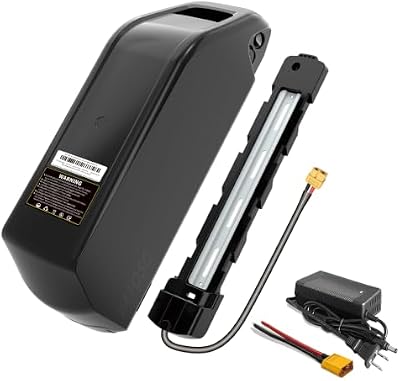
A bigger pack is the usual answer when a 48V ride keeps cutting out on long hills, and 25 amp-hours is a lot of answer: 1,200 watt-hours, enough for a serious distance between charges. The listing for this VATOSO 48V 25Ah battery promises that capacity with a 40A battery management system, an XT60 connector and a mounting base in the box. On our price-per-watt-hour table it sits in the cheaper third of everything we track, which for that much capacity is a fair deal on paper.
Paper is where the certainty ends. The page argues with itself about which protection board actually ships, the printed weight does not survive a chemistry check, and the written record is two texts deep, with the failure account carrying the same five stars as the praise. I decoded the parameter card, checked every printed number against the chemistry it claims, and read both owners. Here is what the page really commits to.
The record is two texts, and the badged one is the failure
Two reviews sit behind the five-star average, and they tell opposite stories. The purchase-badged text, posted in late August, describes a pack that died on the third ride after covering seven miles, and would not take a charge afterward. The same owner has updated the review to say the seller is sending a replacement, so the support story ended better than it started.
The other text carries no purchase badge and reads like the listing. It praises the casing quality, the wire gauge, the connector and the cell balance down to hundredths of a volt, then calls it great value. Nobody can prove who wrote it, but a review that recites the spec sheet that precisely, without one word about an actual ride, is the shape Amazon promotional text usually takes.
So the honest read of this record is narrow: one owner has reported an early failure with a replacement on the way, and one unbadged account speaks well of the box it came in. That is not a durability verdict in either direction. It is a reason to treat the first weeks as a test window and to keep the return path open, which matters more on a pack this cheap per watt-hour than on one with a hundred ratings behind it.
One board, two answers, and a charger the box list forgets
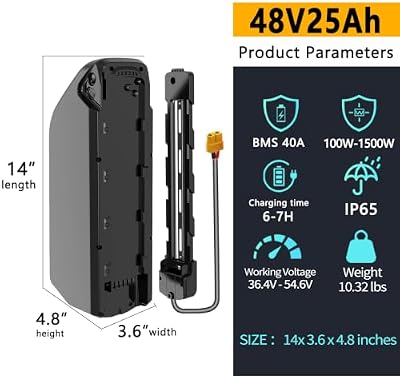
The title says built-in 40A BMS. The parameter card says 40A. Then bullet two says 30A smart BMS, and it opens with a typo that drops the first two letters of built-in. Three mentions, two answers, and the page never resolves which board is inside the case you would receive.
The planning math is where the two answers separate, and not the way you might hope. A 1500W motor, the top of the card's range, draws about 31A at full power at 48V, which is just over a 30A board's continuous ceiling and comfortably inside a 40A one. So the bullet's own number only works if the title's board is the one that ships. The difference between the two answers is not whether your motor turns, it is whether the pack lets it keep turning on a long climb. Only the seller can settle which board is inside, so ask before you order, and keep the reply.
The printed weight cannot close
Here is the number I would not take to the bank. The card prints 10.32 pounds, which is about 4.68 kilograms, for a pack claiming 1,200 watt-hours. That works out to roughly 256 watt-hours per kilogram at the finished-pack level.
Ordinary lithium-ion chemistry is a poor fit for that figure. Wikipedia's lithium-ion page states 160 to 300 watt-hours per kilogram at the cell level, before a single gram of case, board, nickel strip or connector gets added. A finished pack always lands well below cell-level density, and packs that finish above about 200 are already near the top of what mass-produced cells allow. This one claims 256 with its packaging on, which needs cells at the very top of the band and packaging that weighs almost nothing.
The chemistry question underneath is worth settling too, because the card's own working voltage does the settling. It prints 36.4V to 54.6V, and those are exactly thirteen cells at 2.8V and thirteen cells at 4.2V, the arithmetic of an ordinary 13-series lithium pack rather than phosphate chemistry. We decoded the same pattern on the 20Ah sibling, whose card printed the identical voltage window.
Weigh the box when it arrives. If it comes in far under about five kilograms, the capacity claim is in doubt, and metering the pack before your return window closes is the only check that means anything.
The card claims charging takes 6 to 7 hours. For 25 amp-hours that implies a charger around 4 amps, since a 4A unit finishes in about 6.3 hours and a common 3A charger needs about 8.3 before the taper. The listing never prints the charger's amperage anywhere, so you cannot check the card's promise against the equipment in the box.
You also cannot check that there is equipment in the box. Bullet four says fast charging happens through standard 54.6V charging equipment, included. The details table lists one included component, and it is the battery. One of those statements is wrong, and given that a 54.6V charger matches the card's 13-series voltages exactly, the chemistry is consistent even when the box list is not. Confirm the charger ships before you order, because a pack without one is a pack you cannot use on day one.
What the 25th amp-hour actually buys
VATOSO sells this capacity in steps, and we have reviewed the 20Ah 40A shell and the older 30A 20Ah pack separately. The value comparison is narrower than the capacity gap suggests. This 25Ah pack works out to about 23.3 cents per watt-hour, and the 20Ah 40A sibling lands at about 22.8, so the five extra amp-hours cost you roughly the same rate as the first twenty. You are buying range, not value, and the two packs share the same unresolved board question and the same 13-series voltage story.
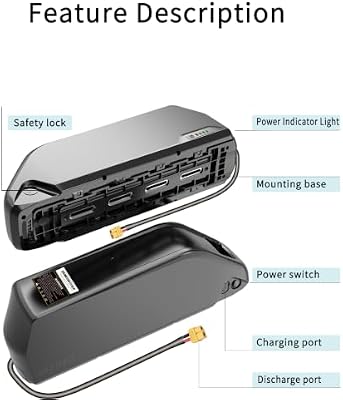
Our full battery table sorts every pack we track by price per watt-hour, and the specs box beside this review renders the live figures for both shells. On fitment, the card gives you the numbers the bullets leave out: 14 by 3.6 by 4.8 inches, an XT60 discharge connector, a mounting base, a power switch and a safety lock. No bike brand appears anywhere on the page, so match the connector and measure the case yourself.
Frequently Asked Questions
Is this really a lithium iron phosphate pack?
Nothing on the page supports that chemistry, and the card's voltages argue against it. 36.4V to 54.6V is thirteen series cells at lithium-ion voltages, while a true 16-series phosphate pack charges to 58.4V. Use the matched 54.6V charger and never substitute one sold for phosphate packs.
What motor can it run?
Plan around 1500W, which the title and the card both state. That draws about 31A at 48V, over a 30A board's ceiling and inside the 40A one, which is exactly why the bullet's typo matters. A 2000W build needs more than 40A at 48V, and no mention on this page supports it.
How long does charging take?
Plan on 8 hours with the common 3A charger and about 6.3 if the included charger turns out to be a 4A unit. The card's 6-7 hour claim is only reachable with equipment the listing never names.
Can I trust the weight and capacity?
Treat both as unverified. The printed 10.32 pounds implies a pack density above what finished 13-series packs achieve, and the only owner whose account carries a purchase badge reported a failure, not a capacity test. Weigh and meter on arrival.
Buy it for the range, verify it on the bench
The case for this pack is simple: 1,200 watt-hours at a price per watt-hour in the cheaper third of the table, with a mount, a switch and a connector most 48V builds can use. The case against it is everything the page cannot settle: which board ships, whether a charger ships, and whether the weight math survives a scale. One owner has already reported the pack dying inside three rides, and the seller has answered with a replacement rather than a dispute. Order it if the range is what you need, ask the two questions first, and keep the delivery scale next to the bike.