A dead OEM pack and a thin budget decide most replacement-battery purchases, and that is exactly the corner this SHEWAIHE 48V 15Ah Hailong pack is built for. The listing promises 720 watt-hours in a Hailong case with a safety lock, a USB output and an LED level gauge, and it asks you to match it against a 100-1000W motor. On our price-per-watt-hour table it sits in the cheaper third of everything we track, which is a fair place for a no-name shell with this spec sheet.
Cheap and fair are not the same thing, so I took the page apart the way I do for every pack we rebuild: card by card, number by number, against the chemistry the listing claims. Most of the arithmetic closes here, which puts this listing ahead of several siblings we have checked this month. The parts that don't close are the protection board, which the page states two different ways, and a written record exactly two sentences deep. What follows is everything the page actually commits to.
A record two sentences deep
The five-star average rests on one global rating and one written text, and I could fit the whole record on a fortune cookie. The review appeared on September 19, 2026, carries no purchase badge, and reads in full: I am surprised by the power of this battery. This is a very good battery, I recommend it. There are no helpful votes, no history of other reviews, and not one word about range, fit or how long it lasts.
A record this thin can't prove anything in either direction, and I want to be plain about that. Nobody on the page has reported a failure, which beats the listings where a badged owner documents an early death, but one unverified sentence of praise isn't evidence of durability either. Treat your first weeks as the actual test window, keep the packaging until you have cycled the pack a dozen times, and remember that the listing carries a three-month warranty, which is among the shortest coverage we see on the packs we track.
The scarcity counter adds its own pressure. The page printed only 8 left in stock when I captured it, which is a stock figure, not a quality signal, and I wouldn't let it hurry a fitment check.
Two BMS numbers, two size sets
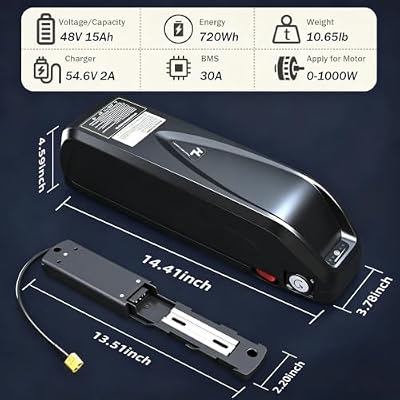
The protection board is the one spec the page states two ways. The parameter card prints 30A in its spec row, and the fitment card tells you to match it against a controller rated at 30A or less. Then the feature bullet says the pack suits a controller with a rated current up to 40A. Two mentions against one favor the 30A reading, and the difference isn't cosmetic: 30A at 48V is a 1440W ceiling, while 40A would allow 1920W.
Your motor decides whether the gap matters. At the top of the claimed 0-1000W range, a full-power draw is about 21A at 48V, comfortably inside either board, so a 1000W build runs the same either way. The gap only opens for somebody planning to overdrive the rating or upgrade later, and for that buyer the honest advice is to ask the seller which board is inside the case and keep the reply. I'd also treat the bullet's 40A with suspicion for a second reason, because this listing carries the template habits we keep finding on budget packs, including one feature bullet that prints the same BMS sentence twice, word for word.
The dimensions argue with themselves too. The bullet gives the case as 14.41 by 4.59 by 3.78 inches, and the fitment card prints 14.47 by 3.74 by 3.5 inches. The length agrees, but the width differs by more than three quarters of an inch, and the height by a quarter. On a Hailong pack that difference decides whether the case drops into a downtube mount, so measure your bay against the smaller numbers and treat the larger set as the optimistic one.
The arithmetic that checks out
The charger math is where this listing earns back some trust. The card prints a 54.6V 2A charger, and 54.6 is exactly thirteen cells at 4.2V, which is correct 13-series arithmetic for a 48V nominal pack. Listings in this price bracket get that number wrong surprisingly often, printing 58.8V chargers on 13-cell packs, so a matched figure is a real quality signal and not a trivial one.
The weight closes too, and after the packs we checked earlier this month that printed impossible figures, a believable weight is worth naming. The bullet and the card agree on 10.65 pounds, about 4.83 kilograms. Wikipedia's lithium-ion page states 160 to 300 watt-hours per kilogram at the cell level, so 720 watt-hours of bare cells needs between 2.4 and 4.5 kilograms before any case, board or wiring is added. The printed pack weight sits just above that bare-cell range, which leaves the shell, the 30A board and the hardware a thin but real share of the mass, exactly where a finished pack should land.
Charge time follows from the same numbers. Fifteen amp-hours into a 2A charger is a minimum of about seven and a half hours, and the taper at the top of the curve stretches that a little, so plan on an overnight charge rather than a lunch break. The card's own charge row agrees with the charger it names, which the pattern on budget packs this month suggests isn't guaranteed.
What you get, and where it fits
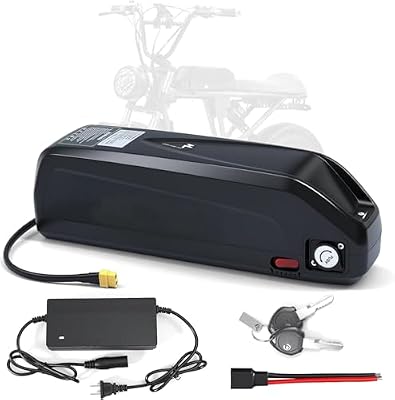
The feature set is wider than the price suggests. You get a key lock, an LED gauge, a pre-installed 5-pin base and a USB socket that delivers 5V at 1A for topping up a phone, all confirmed on the parameter card rather than just the bullets. The discharge side runs through a female XT60 cable, and the box list adds the battery holder, an XT60 male head and two keys.
Fitment is on you, because no bike brand or model appears anywhere on the page. The fitment card gives a checklist instead: a 48V controller, a rated current at or under the board's ceiling, and a motor between 0 and 1000W. That's a reasonable way to buy a replacement pack, but it puts the measuring work in your hands, and the two conflicting size sets make measuring the case non-optional. Our full battery table sorts the whole market by price per watt-hour if you want to compare this shell against named-brand alternatives before committing.
Waterproofing gets one vague sentence, casing that reduces damage to the battery, with no IP code printed anywhere on the page. That wording covers a rain shower better than a puddle, and I wouldn't plan to ride this pack through sustained wet weather without extra covering over the base, where the 5-pin connector sits.
Value, and the sibling behind it
Per watt-hour this pack lands in the cheaper third of the 324 batteries we track, and the specs box beside this review renders the live figure against every other 48V shell. The brand story has a wrinkle worth knowing: SHEWAIHE already sells a 48V 15Ah universal pack we reviewed earlier, whose listing has since died, and this Hailong shell is a separate live listing at the same voltage and capacity. If you came from that older review, you are looking at a different case with a different mounting, not a restock of it.
The 20Ah silver fish shell we checked from the same brand carries a bigger ladder of its own, and between the two I'd pick by shape first and price second, because a battery your frame can't hold is worthless at any price. Within the Hailong shape, this pack's combination of matched charger math, plausible weight and a wider feature set than its price implies makes it the stronger SHEWAIHE option of the two we have measured.
Frequently Asked Questions
How far will 720 watt-hours take me?
Range depends on assist level, terrain, rider weight and speed far more than on the pack alone, and honest estimates for a 48V system of this size run from about 20 miles at full throttle to well past 40 with steady pedaling. The listing prints no range claim at all, which I count as a small honesty point, because a made-up range number is the hardest claim on any battery page to verify.
Is the 40A bullet or the 30A card the real board?
The page never settles it, and I won't pretend to know. Two of the three mentions, including the card that tells you how to match a controller, say 30A, so that's the number I'd plan around. Either board carries a 1000W motor without strain, so most buyers lose nothing by assuming the lower figure.
Can I trust a five-star rating backed by one review?
Not as a verdict, and I wouldn't call this pack proven in any direction. One unverified text tells you nothing except somebody's first impression. The specs are where this listing earns confidence, and they mostly close, which is a better basis for a budget purchase than a histogram full of one-line five-star texts.