A dead pack on a budget bike forces an uncomfortable bit of arithmetic. The bike itself might be worth two or three hundred dollars secondhand, and an official replacement pack can cost more than that. Third-party sellers fill the gap, and the cheapest of them cut a corner nobody expects until the box is open.
The Shewaihe 48V 15Ah was a corner-cutter of that kind, and it said so in its own box list: battery, mounting holder, a connector, two keys, and no charger. It put 720 watt-hours on the table at a price that sat in the cheaper third of our comparison data, and its listing claimed to suit motors from 100 to 1000 watts. Sometime after August 2026 the listing disappeared.
That leaves a record with an interesting shape. The price was the best thing about the pack, and the box contents were the worst. Its specifications cover capacity, weight and connector, but the one number that decides whether a 1000W motor runs safely was never printed anywhere.
The Shewaihe 48V 15Ah ebike battery recorded 720 watt-hours for 155, which works out at about 0.22 per watt-hour and puts it in the cheaper third of the 324 packs on our ebike battery comparison table.
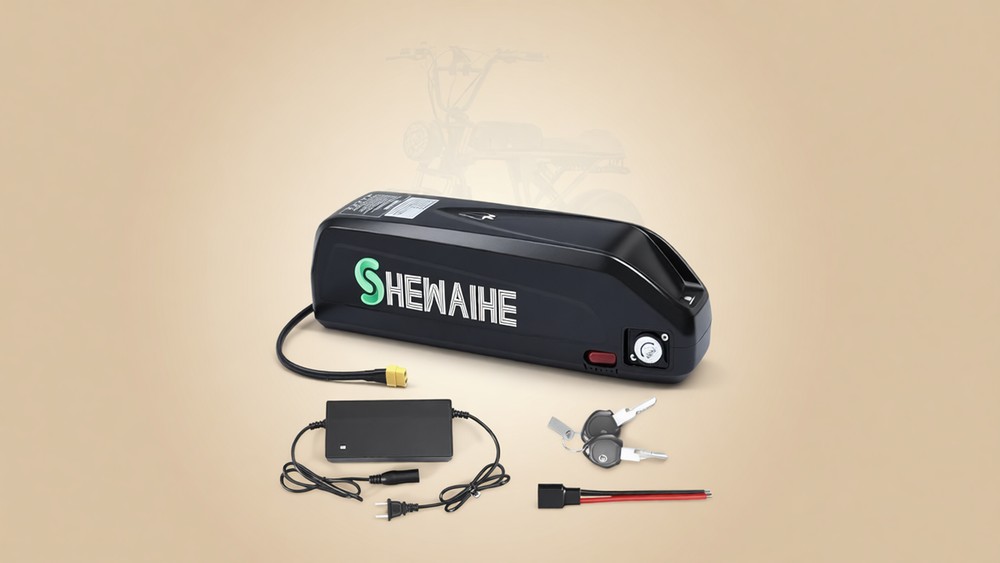
The catch was printed on its own box list: battery, 5-pin holder, XT-60 male connector, two keys, and no charger. A buyer also never got the pack's BMS amp rating in writing, even though the title claimed suitability for motors up to 1000W. The listing has since died, and this article works from the recorded data and stored images.
The cheapest-looking pack in the table, minus one box
Both probes fail now. The listing page stopped rendering a product when checked on 2026-11-02, and Amazon's catalog API rejects the ASIN as invalid, the same two-way death signature other budget sellers left behind this year. Affiliate links here point at a live Amazon search for 48V 15Ah replacement packs rather than a dead page.
The only review signal ever recorded is a count. The old version of this article noted three early positive reviews in August 2026, with no text captured, and our data row never recorded a rating or a review count at all.
Three early reviews on a budget pack says the installs worked and nothing more, because none of those buyers had owned the pack long enough to say how the cells age. Treat the count as a data point, not a verdict.
The box list deserves a second look because it was honest. Battery, 5-pin holder, XT-60 male connector, two keys, and that is the whole inventory. Everything else a working ebike battery needs, most obviously the charger, arrived on a separate receipt or not at all.
What the record holds, and the number it never printed
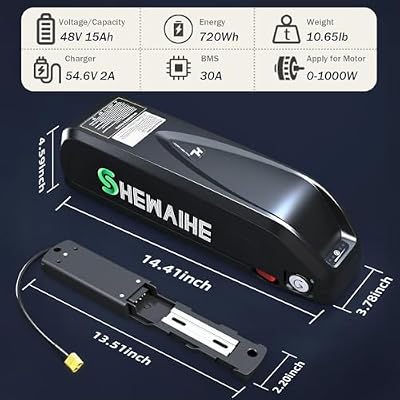
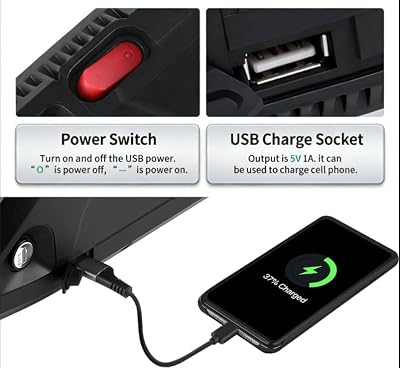
The recorded sheet: 48V nominal times 15Ah gives 720Wh, in a rectangular case bolted to a tray-style bracket. A key-operated lockout switch cuts power on and off, the sealed housing was described as splash resistant, and the pack weighed about 4.8kg. No IP rating was ever stated, so the housing gets credited with weather resistance only, never with submersion.
The missing number is the BMS current limit. The title claimed suitability for 100-1000W systems, and a 1000W motor at 48V draws about 20.8A, but nothing in the recorded data says how much current the BMS was designed to allow. That gap matters more on this pack than most, because a BMS is a protection layer rather than a power source: it can block overcharge, deep discharge and shorts, but it cannot make damaged cells or undersized wiring safe.
Any buyer looking at the current 48V 15Ah class should treat a printed BMS rating as the first question to the seller.
One correction from the old article's spec box: it claimed the BMS controlled 6 cells. A 48V nominal lithium pack runs 13 cells in series, since 13 times 3.7V lands near 48V, so the six-cell line was a listing artifact and it does not survive this rebuild. Also never recorded: a cell brand, a cycle-life figure, and any warranty terms.
Fitting a universal block to a bike built for something else
This was sold as a universal pack, and the recorded data backs only a narrow version of that. Our data row lists no compatible bikes, and the old article's claim that it suited virtually every ebike system is dropped as unverifiable. What is recorded is electrical and physical: an XT-60 male connector on the discharge side and a 5-pin holder for the mount.
So fitment is a matching exercise. Check that your bike's existing plug matches the XT-60 or that you have the adapter the seller should be naming, confirm the 5-pin holder pattern against the bracket on your frame, and measure the space the old pack occupied, because the rectangular case needs the tray to hold 4.8kg securely.
Check the controller's rated current too, since it should sit under the replacement's BMS limit, and that limit is the number the original listing never printed.
The wrong audience for a tray-mount block is anyone with an integrated battery. A pack hidden inside a downtube has its own case, connector and lock, and a bolt-on rectangle cannot replace it. This class of pack suits bikes that were designed with an external bracket, or riders replacing a like-for-like external pack.
Range on 720 watt-hours, hot days and cold ones
This pack matches the em3ev 48V capacity table row for 720Wh exactly, which makes the range estimate unusually clean: 22 to 28 miles on throttle alone, or 35 to 45 miles with light pedal assist. Those figures assume a flat-ish route and an average rider, and the denominator matters.
Hills, cargo and cold weather all pull the real number down, and heavy throttle use holds it near the bottom of the band. The old article's 30 to 40 miles on moderate assist carried no riding regime, and it is gone.
Charging rhythm depended on the charger you added, because the box had none. A 15Ah pack takes about 7.5 hours from empty on a 2A charger and about 5 hours on a 3A unit, and any charger for a 48V lithium pack needs to be a 54.6V model. That makes the charger a real purchase decision rather than an accessory.
A buyer who commutes daily and wants a lunchtime top-up should price the faster unit into the comparison.
Cold weather shrinks the range on every lithium pack, cheap or premium, because internal resistance rises as the temperature falls. The practical takeaway is to size a commuter pack against the coldest week of the year rather than the best day of summer, and 720Wh gives most short-range commuters room to absorb that seasonal drop.
Budgeting the whole purchase, not the sticker
The 155 sticker was never the whole purchase. Add a 48V 54.6V charger, because the box shipped without one, and the real cost rises by whatever the local market asks for a charger of the right amperage. That arithmetic is the lasting lesson from this pack: the cheapest cost per watt-hour on the table can stop being the cheapest purchase once the missing pieces are priced in.
Buyers shopping the current 48V 15Ah class should hold every listing against five printed details: a BMS amp rating on the page, the charger included or its absence priced in, an IP rating stated as a number, warranty terms written down somewhere enforceable, and clear photos of the connector and holder. The Shewaihe listing offered none of those, which is why its low price needed so much trust.
Even so, the value case was real. At about 0.22 per watt-hour, the pack sat in the cheaper third of everything we track, and the current search results for 48V 15Ah packs show what today's market asks for the same capacity. A slightly dearer pack that prints all five details can be the better buy on real cost, and our comparison table makes that difference visible instead of theoretical.
Frequently asked questions
Can you still buy this exact pack?
No. The listing page stopped rendering a product and the Amazon API rejects the ASIN, both probed on 2026-11-02. Equivalent 48V 15Ah packs from other sellers appear in the tagged search results, and they change often enough that the printed-details checklist matters more than any single listing.
Did it come with a charger?
No. The recorded box list named the battery, a 5-pin holder, an XT-60 male connector and two keys, and no charger. A buyer needed a 54.6V charger for the 48V lithium cells, bought separately, and a 2A unit needs about 7.5 hours from empty on this 15Ah pack.
What motors could it run?
The recorded title claimed suitability for 100-1000W systems, and a 1000W motor at 48V draws about 20.8A. The pack's BMS current limit was never printed, so the honest answer is that the top of that band rests on an unverified assumption. Confirm the BMS rating with any seller before pairing this class of pack with a 1000W motor.
Was the price actually good?
On capacity alone, yes. About 0.22 per watt-hour put it in the cheaper third of the 324 packs on our comparison table. The honest total is higher, because the charger was a separate purchase and the listing skipped the printed details that let a buyer judge the rest.