The small end of a battery ladder is where budgets go to die. You need a compact 36V pack for a small build, you find the Shewaihe 36V 8Ah lithium battery pack, and the price looks right until you divide it by the watt-hours. This is the 8Ah rung of a three-pack ladder, and it is the most expensive rung per watt-hour of the three.
I read the listing, the gallery cards and all three written reviews. The record here is three purchase-badged one-sentence reviews that say almost nothing, and the single useful fact in the whole pool is a fitment complaint. That makes this a review about checking size before you pay, and about which rung of the ladder actually deserves your money.
Three one-line reviews, and the one thing they say
The rating reads 4.5 out of 5 from 5 global ratings, and the printed histogram shows 75 percent five-star and 25 percent three-star with empty bands between. Those percentages do not divide cleanly into 5 ratings, so I quote them as printed. The written total on the reviews page reads 3, and all three texts are one sentence long.
All three carry purchase badges and all three award five stars. The newest, from mid-August, says the pack kept a charge and came with a good charger, and then lands the only substantive note in the record: it did not fit what the buyer had bought it for. That text also holds the only helpful vote in the pool, so Amazon's own readers have ranked the fitment warning above everything else here.
The other two texts say the pack works and that it is a battery, in about those words.
Nobody has reported a metered capacity, a range figure, a successful install on a named bike, or a failure. Nobody has owned one in writing past August. The record neither praises nor damns this pack in any detail, and the honest reading is that the pool is too thin to carry the 4.5 average on its own.
What the record does do, accidentally, is agree with the listing's own advice. Bullet five tells you to check the battery size before placing an order, and the one buyer who says anything specific reports a pack that did not fit their application.
The smallest rung of a three-pack ladder
This 8Ah pack shares its model number, sd36, with the 15Ah DIY sibling we reviewed earlier this month, and the ladder holds a 20Ah rung, also reviewed, above that. Same brand, same DIY framing, three sizes.
The value math runs the wrong way as the packs get smaller. This rung sells 288 watt-hours (36 volts times 8 amp-hours) for 87.99, which works out to about 31 cents per watt-hour.
The 15Ah rung sells 540 watt-hours for about 25 cents per watt-hour, and the 20Ah rung sells 720 watt-hours for about 21. The pattern is plain: every step up the ladder buys each watt-hour for less money. If your project has the physical space for a bigger brick, the smaller rung is the expensive way to buy capacity.
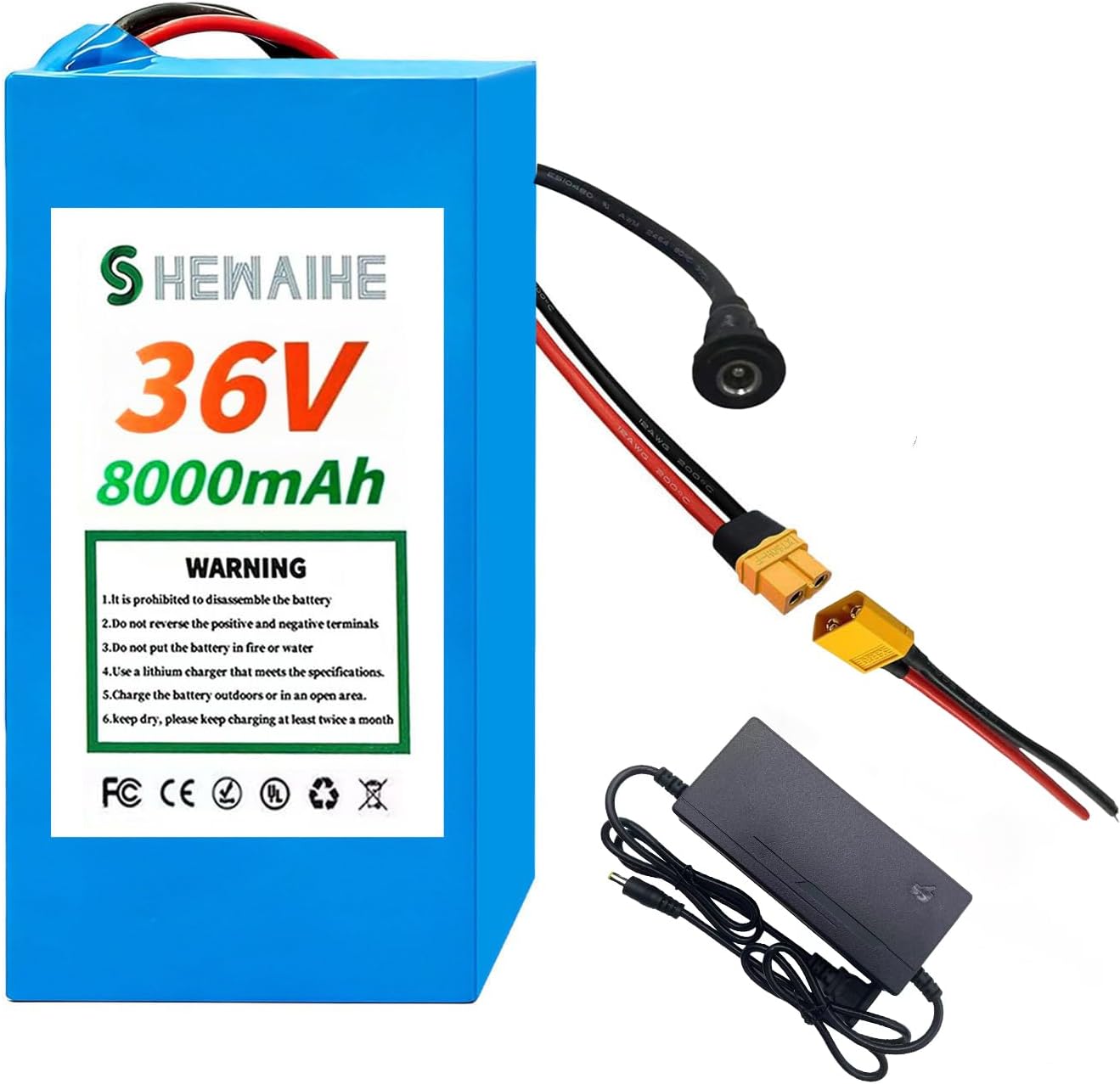
This pack does not appear in our 324-row price-per-watt-hour comparison table, because Amazon files it under cordless tool battery packs rather than e-bike batteries, and the ladder math above is the honest value frame instead. The gallery carries warning-label cards reading 38000mAh and 20000mAh, and those belong to other rungs of the family, not to this 8Ah pack. The card that describes this pack is the one printing 36V8Ah.
A 30-amp board with honest headroom
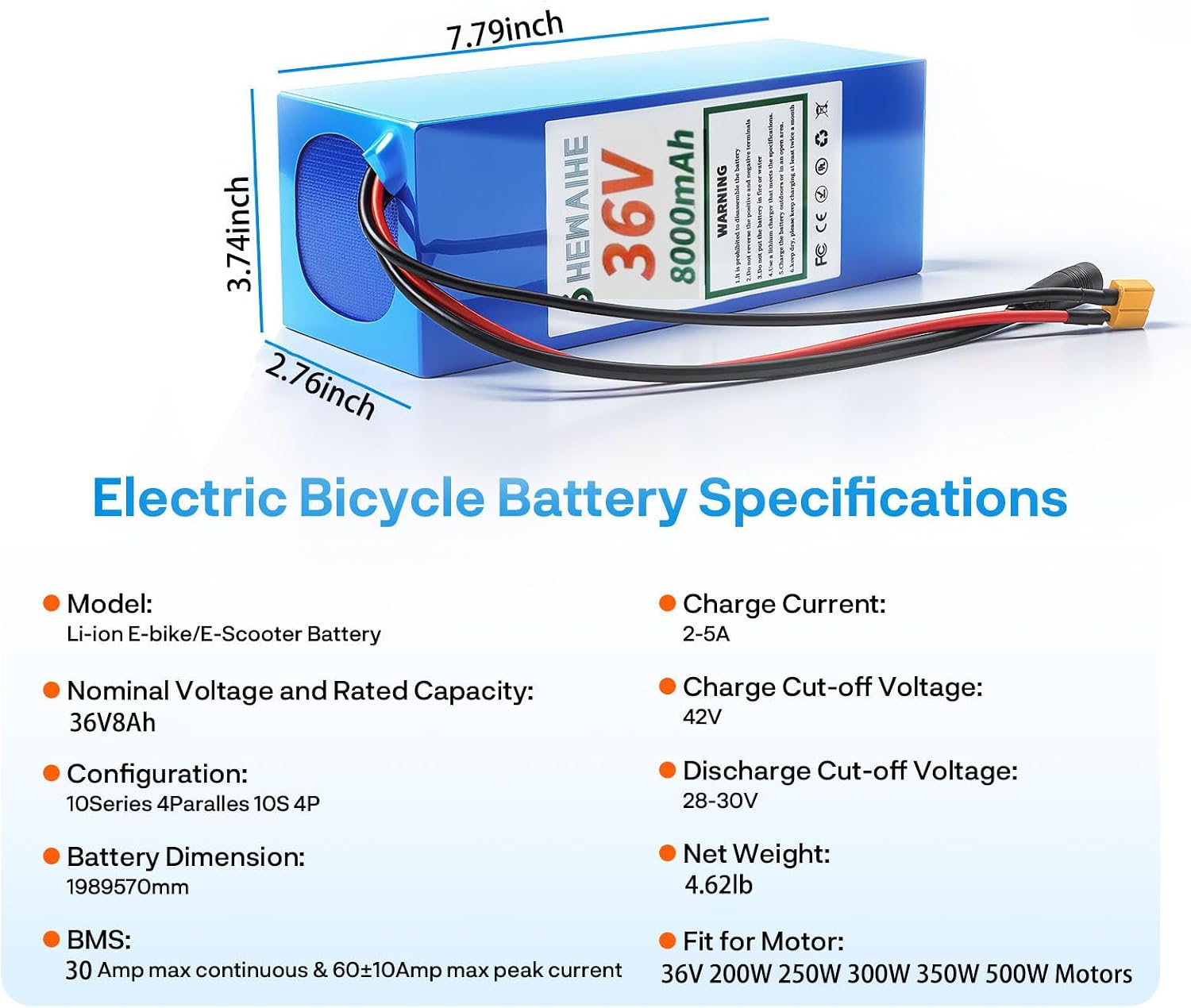
The parameter card prints a 10S4P configuration, a 30A maximum continuous board with 60A peak, and a motor fit list running from 200W to 500W. The arithmetic here is unusually friendly. A 30A board at 36V caps at 1080W, and the largest motor the card claims is 500W, which draws about 14 amps and leaves the board barely working.
That is the opposite of the pattern we keep catching on budget packs, where a title promises 1000W or 1500W over a board that cannot deliver it. This listing undersells nothing.
The bullet names the same 30A figure the card does, the protection list covers overcharging, overdischarging and short circuits, and any 36V motor from 250W to 500W fits inside the limits with room to spare. If you need more than 500W continuous, the card is telling you this is not your pack.
The charger argument
The title says 2A charger. The bullets say 2A charger twice.
The details table says 2A charger. One gallery card shows a 3A fast charger with a 36V output, and the card's own charge-current row allows 2 to 5A. The listing cannot settle on its own charger.
The practical difference is small but real. An 8Ah pack at 2A needs about 4 hours from empty, and at 3A it needs about 2.7. Read the label on the brick when it lands and plan your charging around that.
The package lists also disagree at the margins: the card adds an AC cable that neither the bullet nor the details row mentions, so do not count on extras until the box is open.
The weight closes, the cycle claim does not
The card prints a net weight of 4.62 pounds, about 2.1 kilograms, for a 288 watt-hour pack. Wikipedia's standard band for lithium-ion cells states 160 to 300 watt-hours per kilogram, so the bare cells alone need between about 1.0 and 1.8 kilograms, and a 2.1 kilogram assembly leaves sensible room for the case, the board and the wiring.
The pack-level figure works out to about 0.14 kilowatt-hours per kilogram, which sits below the cell band exactly where a finished pack should. Nothing here asks you to disbelieve the scale.
The details table keeps its own junk. The Voltage row reads 12 volts on a 36V pack, which is row filler, and the 10-pound Item Weight figure is the boxed gross, not the pack. The Battery Weight row at 4.5 pounds agrees with the card closely enough.
The cycle claim is the weak number. The first bullet promises over 80 percent capacity after 1500 deep charge-discharge cycles. Wikipedia's band for the chemistry runs 400 to 1,200 cycles, so the claim sits well above what is typical, and the listing prints no cell model and no test conditions behind it.
Treat it as marketing until your own meter says otherwise, and judge the pack on the one-year warranty instead.
Who this small rung makes sense for
The decision this listing forces is narrow. If you need exactly a small 36V brick, about 7.8 by 3.7 by 2.8 inches, for a 200W to 500W build, this is the only rung of the ladder that size, the board math is honest, the weight arithmetic closes, and the record says the pack holds a charge.
Check your bay against 198 by 95 by 70 millimeters first, because the one complaint in the record is a pack that did not fit.
If you have the space, buy the bigger rung instead. The 15Ah and 20Ah siblings cost less per watt-hour, they carry the same model family and the same DIY framing, and capacity you can use beats capacity you paid a premium to avoid. Whichever rung you pick, the XT60 connector has to match or be adapted to whatever your project already speaks.
Frequently Asked Questions
Will the Shewaihe 36V 8Ah fit my bike or project?
Measure first. The card prints 198 by 95 by 70 millimeters, and the listing's own bullet tells you to check the size before ordering. The one buyer who left a useful review found the pack did not fit their application.
The XT60 connector also has to match your existing wiring or reach it with the included extension cord.
How long does the 8Ah pack take to charge?
Between about 2.7 and 4 hours from empty, depending on which charger ships: the listing text says 2A and one gallery card says 3A. At a 2A brick the job takes about 4 hours, at 3A about 2.7, and the card's charge-current row allows up to 5A either way.
Is 8Ah enough capacity?
At a typical 15 to 25 watt-hours per mile, 288 watt-hours delivers roughly 11 to 19 miles of riding, and less at full throttle on a heavy bike. That is enough for short commutes or a small build, and it is why the 15Ah and 20Ah rungs exist.
Does the 1500-cycle claim hold up?
The chemistry's typical band runs 400 to 1,200 cycles, so 1500 cycles to over 80 percent is a promise above the norm with no test conditions printed behind it. Meter the pack when it arrives, keep an eye on range over the first months, and lean on the 1-year warranty rather than the cycle figure.
What warranty does this pack carry?
The details table reads 1 yr with no conditions printed beyond that. No text in the record describes a claim, so the window is untested. Run a full charge cycle and a fit check inside your return window either way.