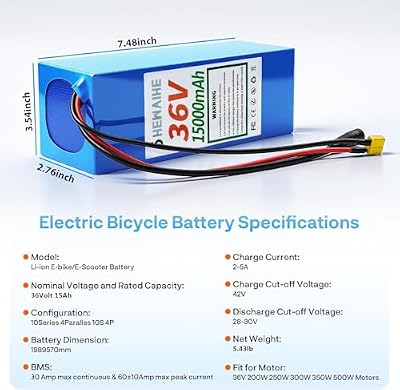
A builder wiring up a 36V motor needs bare capacity more than branding, and that is the buyer this SHEWAIHE 36V 15Ah DIY pack is aimed at. The listing offers 540 watt-hours in a plain brick with XT60 leads, a charger in the box and a ten-series, four-parallel cell layout printed right on the parameter card. On our price-per-watt-hour table it sits close to the middle of everything we track, which is an unremarkable but honest place to be.
Unremarkable pricing does not mean the page is tidy, and this one is not. The listing prints three different weights for the same object, names a 2A charger in three places while its own wiring card says 3A, and promises 1500 deep cycles from a chemistry it identifies only as lithium-ion. I worked through every printed number against the physics and the box lists, and the results split cleanly between claims that close and claims that float. The full picture follows.
A record one text deep
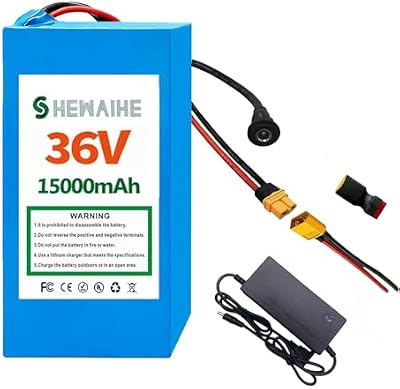
The five-star average rests on one global rating, one written text and nothing else. The text appeared on June 18, 2026, carries no purchase badge, and says in full: Battery quality and battery life is what is expected. Great value for your money. There are no helpful votes, no ride report, no capacity claim, and no follow-up from anybody else.
A single unverified text can't vouch for a battery, and I'd be misleading you if I dressed it up as more than a first impression. What makes this record worth watching is the contrast with its own brand sibling: SHEWAIHE's universal 36V 15Ah shell, which we checked earlier, has a record thirteen ratings deep with detailed owner texts, including one describing an early failure. This DIY pack sits beside that one at the same voltage and capacity with none of the history, so the two listings together show how much a record can differ inside one brand's lineup.
There is a full year of warranty behind this pack, which is better coverage than the three-month terms on several shells we have measured this month, and on a pack with an unproven record that coverage carries real weight.
Three weights and a physics problem
The weights are the part of this listing I would not take to the bank. The details table prints a Battery Weight of 4.5 pounds, an Item Weight of 10 pounds, and the parameter card gives a net weight of 5.43 pounds, all three describing the same 540 watt-hours of lithium-ion.
The physics has an opinion about which number can be true. Wikipedia's lithium-ion page states 160 to 300 watt-hours per kilogram at the cell level, so 540 watt-hours of bare cells needs between 1.8 and 3.4 kilograms before a single gram of case, board or wiring gets added, and a finished pack must weigh more than that.
The card's 5.43 pounds is about 2.46 kilograms, inside the bare-cell range with no room left for the shell and the board. The table's 4.5 pounds is about 2.04 kilograms, which needs cells at the top of the band and a case that weighs nothing. Only the 10-pound item weight, about 4.5 kilograms, leaves honest space for the hardware a real pack carries.
I wouldn't call the capacity fake on this evidence alone, because high-density cells exist and small bricks can be dense. I would call it unverified and checkable: weigh the box on arrival, and if it comes in anywhere near five pounds rather than ten, meter the pack before your return window closes, because the printed figures have already spent their trust arguing with each other.
One charger, two names
The charger story is a smaller contradiction but a revealing one. The title says 2A charger, the details row says 2A charger, and the box bullet lists a 2A charger, three mentions that agree. Then the wiring card prints 3A fast charger with an output current of 3A on the same page.
The practical difference is charge time, and it is easy to plan around. Fifteen amp-hours at 2A needs at least seven and a half hours, while the card's 3A figure would cut the floor to five. Whichever charger actually ships, plan on an overnight charge and read the label on the brick when it arrives, because the page has told you both answers already. The charge cut-off gives one solid anchor here: the card prints 42V, which is exactly ten cells at 4.2V and correct arithmetic for a 36V pack, so the charging system's voltage at least is matched to the cell count.
What the math confirms, and what it does not
The core electrical claims survive a check. Ten series, four parallel is a sensible layout for 36V and 15Ah, the nominal voltage row agrees with the cell count, and the discharge cut-off the card prints sits in the high twenties of volts, in line with a ten-series lithium pack. The protection board is rated at 30A continuous, which sets a hard ceiling near 1080W at 36V, and the card's own motor list, covering 200W through 500W motors, sits comfortably inside that ceiling. Nothing on the page overdrives the board, which is more than several listings we have measured can say.
The cycle claim is where the confidence ends. The bullet promises over 80 percent capacity after 1500 deep charge and discharge cycles, and the only chemistry the page names is lithium-ion. The 80 percent figure is the industry's standard end-of-life definition, so the promise is written in the right language, but Wikipedia reports a typical range of 400 to 1,200 cycles for the chemistry, and 1500 sits above all of it. A claim above the ordinary band needs ordinary cells above their usual performance, and the listing offers no cell model, no cycle-test condition and no third-party support for the number. Hold it as marketing until your own pack proves otherwise.
The waterproofing wording deserves a caution too. The card prints safety and waterproof near a glue-sealing note, and no IP code appears anywhere on the page, so I'd treat this as a dry-weather pack unless your build puts the brick in its own sealed enclosure.
Value, siblings, and who this pack fits
Per watt-hour the pack lands close to the middle of the 324 batteries we track, and the specs box beside this review renders the live comparison as prices move. The family context matters more than the ranking, though, because this listing is one rung of a small ladder: the same parent pool holds a 20Ah sibling we have already rebuilt and an 8Ah version we have not. The 20Ah costs more but lands lower per watt-hour, so if your build can carry and feed the bigger brick, it's the better value of the two.
Against its own 36V 15Ah sibling, the universal shell with the grown record, the choice is between history and packaging. The universal pack has thirteen ratings behind it and a finished case ready to mount, while this DIY brick has a two-sentence record, a full year of warranty and bare XT60 leads that make wiring simpler on a custom build. Builders should pick the brick, commuters should pick the case, and neither answer is wrong.
File this listing where Amazon does, under cordless tool battery packs rather than bike parts, because that tells you who it's for. No bike brand appears anywhere on the page, the card lists motor sizes instead of models, and the whole pitch assumes you already know what your build needs.
Frequently Asked Questions
How far will 540 watt-hours carry a 36V build?
Range depends on assist level, terrain and speed far more than on the pack, and honest expectations for this size run from about 15 miles at full throttle to past 30 with steady pedaling. The listing prints no range claim, so any figure you see attached to this pack in a comparison came from a table like ours, not from the maker.
Is this the same pack as the SHEWAIHE 36V 15Ah universal battery?
No, and the difference matters. The universal shell is a cased replacement pack with its own record, while this brick is a bare 10S4P assembly with XT60 leads aimed at custom builds, sold under a different model number and filed under tool batteries. They share a brand, a voltage and a capacity, and that is where the similarity ends.
Can I trust the 1500-cycle promise?
I wouldn't. The promise sits above the typical cycle range for the chemistry the listing names, with no test conditions and no cell spec behind it. The warranty gives you a year of protection regardless, and your own metering over the first months will tell you more about this pack's real lifespan than the bullet ever will.