Two riders settled on Sena's Spider RT1 face a fork the single listing never spells out, and the pair page turns out to be the cheaper side by the widest margin we have measured on any intercom this season.
The single page sells one low-profile mesh headset. The RT1 2-pack sells two of them in one box, carries the identical 529-rating record, and prints a spec table with a Bluetooth row that argues with its own bullet. This review walks the pair page: what the box saves, which rows to ignore, and what the owners say about rain, buttons, and bass.
The short version. The Spider RT1 pair is a mesh-only intercom for riders who stay inside Sena's ecosystem, and the box pricing is genuinely good even though the per-helmet cost still sits among the priciest two-rider units we track. We already read the RT1 single review line by line, and everything there about the rating pool applies here.
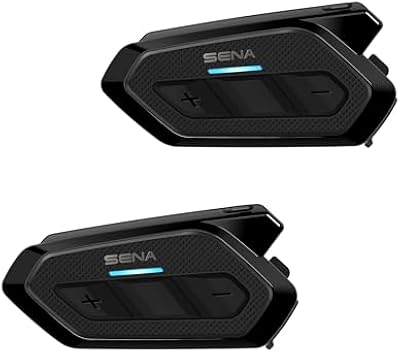
The widest pair discount we have measured
The rung math favors the box more than any pair we have priced this season, and we re-checked both pages on the same day. Two RT1 singles at the live 244.34 price come to 488.68. The 2-pack costs 399.99, so the pair saves 88.69, about eighteen percent off the two-single total.
That works out to 200.00 per helmet. Our intercom comparison table prices every row the same way, and the honest reading is that this pair still lands among the most expensive two-rider units of the 210 we track. Sena is a premium brand and the RT1 is its low-profile model, so the discount is real without making it cheap. The live position renders in the specs box on the table, next to every other mesh unit at every price.
One stock note belongs here. The pair page read only 14 left at capture time, and the ST1 single read 7 left the same day. Spider stock moves in small batches, so if the box pricing matters to you, check both rungs before deciding.
One record, six rungs
Amazon files the whole Spider family as variants of one listing, and the ladder on the pair page holds six rungs: RT1, ST1, and X Slim, each as a single and as a box of two. The RT1 single and the RT1 pair show the identical 4.2 average from 529 ratings, the same histogram, the same texts. That is variant pooling, and it means everything the single review says about the record applies to the box.
The identity rows argue with themselves in the usual places. Number of Items says 1 while Number of Packs says 2, on a page selling two headsets. A Unit Count row reads 1 Ounce, which is not a quantity of anything. An External Testing Certification row claims DOT certification, a motorcycle helmet standard, on a communication unit that clips to one. Read those rows as filler and weigh the owners instead.
Where the RT1 and the ST1 actually differ
The two Spider mesh models look interchangeable in the bullets, which are near word-for-word identical, but the spec tables split them in ways that matter.
The RT1 page's bullet says Bluetooth 5.2 connects your phone, and its own spec row says Bluetooth Version 5.1. One of those is wrong, and the ST1 page prints 5.2 in both places, so if the phone-link standard matters to you the ST1 is the consistent listing. The RT1's Bluetooth Range row says 100 meters for the phone link, which sits at the top of what typical Bluetooth reaches under clear line of sight according to Wikipedia's Bluetooth overview. Rider-to-rider range is a different claim on a different radio, so do not read the 100-meter row as the mesh limit.
The form factor split is real. The RT1 is the over-ear, low-profile unit, and the ST1 sits on-ear with a jog dial and a printed 12-hour battery row the RT1 page does not carry at all. The RT1's frequency row stops at 10,000 hertz where the ST1 claims the full 20-to-20,000 band, and the RT1's noise-control row says None where the ST1's claims active cancellation that no owner text mentions. Our ST1 2-pack review covers that rung's own record, and the X Slim review covers the third model.

What the owners praise, and what they send back
The top-voted text in the pooled record, at five helpful votes, comes from a long-time Sena owner who lays out the ecosystem rule plainly. Rider-to-rider talk runs on Sena's proprietary mesh, not Bluetooth, so it does not cross-pair with other brands or with older BT-only Sena units, and the phone link stays Bluetooth. The same owner calls the rider-to-rider sound far superior to the older Bluetooth systems, which is the trade in one sentence.
The praise cluster around it is consistent. Owners call installation easy, one reused the mic and speakers already wired into their helmet, and a Torc T15 owner reports a perfect fit. One rider has dropped the headset on the ground a few times with no damage, and the music-sharing with two friends works as advertised.
The complaints cluster tightens around the speaker hardware. A June 2026 one-star owner reports sound with high frequencies only, no mids or bass, a volume that wanders on its own, and replacement speakers that do not exist because the plugs are proprietary within Sena's own line. A January 2026 four-star owner found the buttons hard to feel with gloves on, with one-to-three-second holds for the important commands and two buttons just to pause. Another owner misses a voice assistant entirely, a feature the Spider line does not carry.
Rain is the open question on this rung
Both Spider pages print Water Resistant in the spec table, and the owner record is the reason to treat that row as a claim rather than a promise.
A May 2026 owner reports the headset stopped working after rain, and still rated Sena's sound and usability above other brands before buying a more water-resistant Sena model as the replacement. An April 2026 one-star owner describes a headset that freezes when a call comes in and mesh that would not work properly, with support that never resolved it. And a three-star text on this same pooled record makes the cross-rung comparison directly: the RT1 holds water, the same owner says, and the ST1 fills with it.
None of that settles how the RT1 behaves in a downpour, because the record holds both a rain death and owners who ride through weather without complaint. What it does settle is that the Water Resistant row is not the whole story. If you ride in wet country, buy from a seller with a clean return path and test the headsets in the first week.
FAQ
Is the RT1 2-pack cheaper than two singles?
Yes, by the widest margin we have measured. Two singles at the live price come to 488.68 and the pair costs 399.99, a saving of 88.69, about eighteen percent. We re-checked both prices on the same day.
Do the ratings on the pair page differ from the single page?
No. Both rungs show the identical 4.2 average from 529 ratings with the same texts, because Amazon pools the record across the family's variants.
Can the RT1 talk to a Cardo or a non-mesh Sena?
No. Rider-to-rider communication runs on Sena's proprietary mesh, which the top-voted owner text spells out. It does not cross-pair with other brands or older Bluetooth-only Sena units.
Is the RT1 waterproof?
The listing says Water Resistant, and the record is mixed. One owner reports a rain failure, others ride in weather without complaint, and one owner says the RT1 holds water where the ST1 does not. Treat the row as a claim and test early.
Should you buy the pair or two singles?
The pair, if both riders are committed, because it saves about eighteen percent and the rating pool is identical. Buy one single first only if one rider might want out, and check the ST1 and X Slim rungs if you want a newer Bluetooth row or a printed battery figure.