A rider buying two Sena Spider ST1 units at once gets the same pooled 832-rating record the single page carries, a seven percent saving, and one owner report about a box of two that would not talk to itself.
The single listing sells the on-ear ST1 with its jog dial. The ST1 2-pack sells the pair, prints a 2.12-ounce weight row that cannot describe the box, and holds the record's most useful pairing failure account. This review walks the pair page: the arithmetic, the rows worth ignoring, and what snowmobilers and a professional tree climber learned in the field.
The short version. The Spider ST1 pair is a mesh intercom with a verified one-mile field test in its own record, honest battery reporting from owners, and a real but modest pair discount. We read the ST1 single review in full earlier in the campaign, and the rating pool is identical on both rungs.
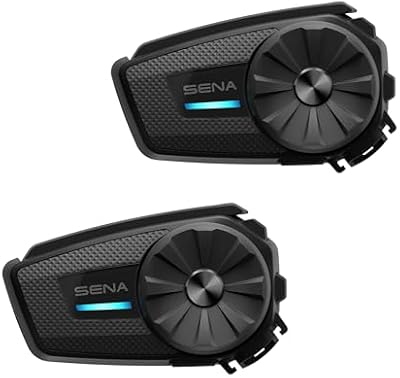
The pair math, re-verified the same day
The saving is real and smaller than the RT1's. Two ST1 singles at the live 235.99 price come to 471.98. The 2-pack costs 439.00, so the pair saves 32.98, about seven percent off the two-single total, and the single page read only 7 left in stock at capture.
That works out to 219.50 per helmet, and the honest reading is that this pair sits in the most expensive band of the 210 intercoms we track by price per rider. Our comparison table renders the live position in the specs box, so you can put it next to every other two-rider mesh unit before committing.
The same-day comparison is worth having. The RT1 2-pack, the low-profile sibling in the same Spider family, saved about eighteen percent against two singles when we priced both pages the same day. One owner in the ST1 record says it plainly: they found the RT1 about eighty dollars cheaper earlier in the day, came back when it had sold out, and bought the ST1 instead. Check both rungs before you pay the ST1 price.
The box argues with its own rows
The spec table carries the usual Sena filing noise, and one row that is flatly impossible.
Number of Items says 2, which is correct for a box of two, while Number of Packs says 1, the reverse of the contradiction on the RT1 pair page. The Item Weight row reads 2.12 ounces, which no two-headset box with clamps, speakers, and microphones has ever weighed. A Noise Control row claims active noise cancellation that no owner text mentions, and a Customer Package Type row prints a garbled choice between retail box and hard case.
The Bluetooth rows deserve their own read. The page prints Bluetooth Version 5.2 consistently, unlike the RT1's bullet-versus-row disagreement, and a Bluetooth Range row of 1.2 miles. That mileage figure sits far above what typical Bluetooth reaches, which Wikipedia's Bluetooth overview puts at under 10 meters typically and up to 100 meters at best, with the 5.0 class spanning 40 to 400 meters. The 1.2-mile row is a mesh-class range figure sitting on the phone-link row, so read it as the marketing number it is and weigh the owner who measured instead.
The battery rows are the credible ones. Battery Average Life prints 12 hours and charge time 2.5 hours, and the owner record below backs both figures.

The box that would not mesh with itself
The most useful text in the record for a pair buyer is a failure report, and it is specific to buying two at once.
An August 2026 owner reports that each unit worked fine with its own phone, music and calls included, but the mesh would not connect between the two devices in the same box, which was the entire reason they bought the pair. The same owner later revised the text to note that customer service stepped up and is sending a replacement, so the story ends better than it started. Still, the lesson stands: a two-unit box can ship with a pairing fault, and you will not find it listening to music in the driveway.
A September 2026 two-star text raises the quality-control question again from another direction. That box arrived without a main unit at all, the owner calls it a zero for quality control, and an exchange was initiated. Two of the ten most recent texts in the record describe opening the box to a problem.
The practical advice writes itself. Pair the two units to each other first, before you ride, and do it on day one while the return window is wide open. Mesh pairing on this family is otherwise reported as automatic once the units are powered on, which makes a failure easy to spot early.
Range and battery, measured by owners
The range story starts from a field test rather than a claim, and it is the hardest number in the record. A snowmobile owner riding in a group of four reports reaching one mile on an open lake in a straight line, which the listing's five-mile claim technically allows but which is the only measured figure any owner has published. Eight kilometers of claimed open-mesh range assumes ideal conditions that a lake at least approximates, and one mile is what it produced.
The battery record is unusually consistent for a listing whose own rows wobble. The snowmobile owner ran about eight hours with charge remaining, recharged to full in about sixty minutes, and ran another eight. A professional tree climber who wears comms in a climbing helmet reports eight-to-ten-hour days of loud music without ever taking the battery to zero. Those accounts sit comfortably inside the printed 12-hour row rather than straining it, and neither mentions the volume oscillation complaint the RT1 record carries.
Charging and updating come with one generational footnote. The climber's first ST1 set required a computer for its firmware update, and the second set updated over Bluetooth without one. If your pair arrives refusing the app, the computer route is the documented fallback.
Water is the weak point on both Spider rungs
Both ST1 pages, single and pair, print Water Resistant, and the record's most detailed owner account tests that row in the worst way.
The tree climber's first unit did not survive a strong rain storm, and the owner's verdict is that waterproofing this hardware would be child's play, an easy engineering win Sena leaves on the table. The same owner liked the comms enough to buy a second ST1 anyway and now keeps it out of the rain. Cross-rung, an RT1 owner states on the pooled record that the RT1 holds water and the ST1 fills with it, which is one rider's comparison rather than a measurement, but it points the same direction as the climber's loss.
The rest of the praise cluster is untouched by weather. Owners call the sound crisp and clear, report phone calls where the caller could not tell they were riding, and use the app's equalizer presets to tune the music. If you ride in dry country, none of this should slow you down. If you do not, the water row is the one spec on this page with a documented failure against it.
FAQ
Is the ST1 2-pack cheaper than two singles?
Yes. Two singles at the live price come to 471.98 and the pair costs 439.00, a saving of 32.98, about seven percent. We re-checked both prices on the same day, and the RT1 pair saved more, about eighteen percent.
How far does the mesh actually reach?
The listing claims up to 5 miles. The only measured figure in the record is one owner's verified one-mile test on an open lake in a straight line, which is the honest planning number until someone publishes a longer one.
What is the box that would not mesh report?
A pair buyer found each unit worked with its own phone but the two would not mesh with each other. Customer service sent a replacement. Pair the two units to each other on day one, inside the return window.
Is the ST1 waterproof?
The listing says Water Resistant. One owner's unit died in a strong rain storm, another owner says the ST1 fills with water where the RT1 holds it, and other owners ride in weather without complaint. Treat the row as a claim.
ST1 pair, RT1 pair, or two singles?
The RT1 pair if the discount matters most, the ST1 pair if you want the jog dial, the newer Bluetooth row, and a printed battery figure, and two singles only if one rider might want a different brand later.