Weight decides some battery purchases more than range does. A rider who carries a bike up stairs twice a day, or swings it onto a car rack at the start of every ride, feels each pound more often than a road feels each watt-hour. A pack that shaves real weight off a build can beat a bigger one on usefulness even when the range figure looks worse on paper.
The Ransyri 48V 12Ah box pack aimed straight at that buyer. The listing promised 576 watt-hours in a 5.95 pound external case, far under what complete packs of this size usually weigh, along with a 200W to 1000W motor band. Amazon has since pulled the listing, so what follows works from the recorded spec sheet and from what the numbers do when you check them.
The sections ahead put that headline weight against the physics, scale an honest range from published tables, and cover where an external box can actually mount on a bike that never came with one.
The RANSYRI 48V 12Ah universal power pack sold for 129.99, which put it in the cheaper third of the 324 packs in our battery comparison table at 22.6 cents per watt-hour. That price was fair. The weight claim is the part that deserves a scale and a suspicious eye.
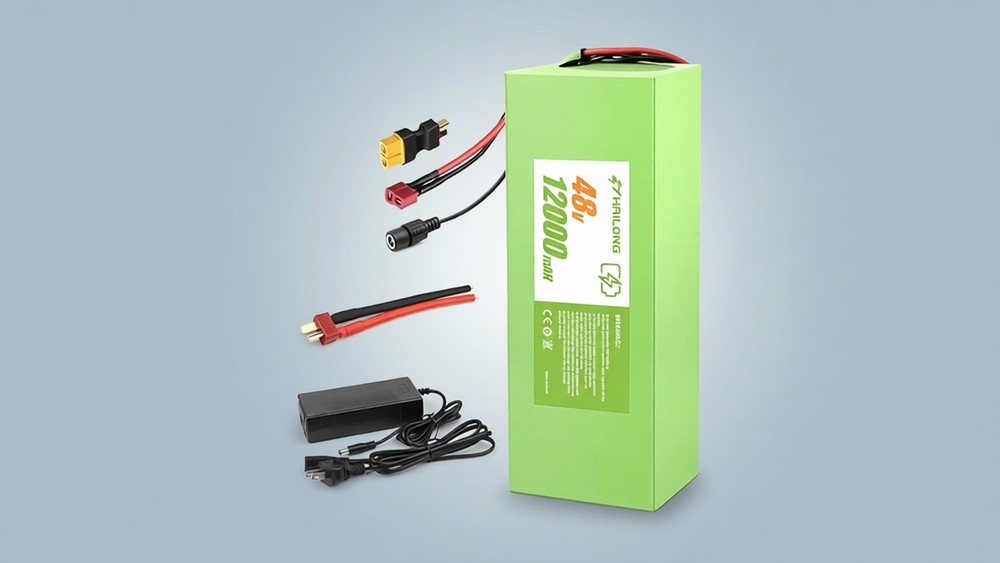
A weight the physics does not close
Five point nine five pounds converts to 2.70 kilograms. Carrying 576 watt-hours in 2.70 kilograms works out to 0.21 kWh per kilogram at the pack level.
That number sits in a gap the industry has not crossed. The Wikipedia lithium-ion entry puts standard cells at 0.16 to 0.30 kWh per kilogram, and that's the cell alone, before any case, BMS board, wiring or connector adds its share. Complete packs we have weighed and decoded on this site land between 0.13 and 0.16 at the pack level.
A 576Wh pack closing at 0.21 needs cells near the top of the band and a case made of air.
Two readings fit. Either the printed weight covered the bare pack without its case or hardware, or the figure was marketing from the start. There's no third reading where the pack weighs what the listing said and holds what it promised.
Buyers who caught one of these packs second-hand should weigh it on arrival, then meter a full charge through a ride they know. The two numbers together settle the question in an afternoon.
The pattern is not unique to this listing. We have logged the same tension on a 20Ah shell claiming 0.25 kWh per kilogram and on a LiFePO4 pack claiming 0.20, and the reverse on an alloy-shell pack whose weight only closes if its cells are the newest class. Light-and-cheap listings cluster around impossible densities, and the lightness that draws clicks is usually the first claim to fail a bathroom scale.
How far 576Wh actually goes
The em3ev range table puts a full-size 48V 20Ah tank of 0.96 kWh at 30 to 40 miles on throttle alone and 50 to 65 miles in low pedal assist. This pack holds six tenths of that energy, so the honest scaled bands are 18 to 24 miles on the throttle and 30 to 39 miles with light assist. Terrain, rider weight and tire pressure move both ends.
The old listing leaned on its 200W to 1000W motor band to imply a wide range of outcomes, but the capacity sets the range, not the motor. A 250W commuter and a 750W conversion draw from the same 576 watt-hours. The bigger motor just spends them faster, which the throttle band already prices in.
Charging time nobody printed
The listing never stated the charger's amperage, so the charge floor is arithmetic rather than a spec.
At a common 2A charger, 12Ah takes six hours from empty. A 3A charger cuts that to four. Anyone buying a replacement charger should match voltage first, 54.6V for a 13S 48V pack, then pick the amperage the BMS tolerates.

Where an external box pack mounts
The row in our data logs this pack's form factor as Other, and that's the honest label. An external box has no downtube rail and no Hailong-style base plate. Mounting options are a rear rack, a triangle bag, or a plate you fit yourself.
Rack mount or triangle bag
Each option changes the bike differently. A rack mount puts weight over the rear wheel, which steadies the steering but raises the center of mass. A triangle bag drops the pack low and central, where the frame wants its mass, and keeps wiring runs short to a mid-frame controller.
Front-mounted triangle setups work with light packs only, and at 2.7 real kilograms this one would sit at the heavy end of that rule even before the weight claim is doubted.
The upside of the format is flexibility. Any bike takes a rack or a bag, so the pack moves between bikes, and a buyer upgrading the bike keeps the battery. That's the genuine case for an external box over a frame-integrated shell.
The 200W to 1000W claim
The title ran from 200W to 1000W systems. The low end is trivial, since any pack can feed a small motor. The top end is where a number goes missing: the listing never stated the BMS amperage, and a 1000W motor at 48V draws roughly 21 amps continuously.
Most 12Ah packs in this class carry a 25A or 30A board, which would cover that draw, but most isn't a spec.
On a listing this loose, with the weight already failing its physics check, the safe assumption is that the board sits at the low end of the class. For contrast, the 30Ah pack from the same listing family printed a 40A BMS figure outright, which is what a credible version of this claim looks like. A buyer with a 750W or bigger motor has plenty of options in the comparison table that print their BMS figure plainly, and one of those is the safer spend.
What the rating record holds
Our record from February 2026 shows 41 ratings at 4.4 stars. No written review text was ever captured for this listing in our data, so the reasons behind the score are unknown, and nothing here invents them. The row now carries no rating at all, and the page itself is gone.
What survives is the spec sheet, the price, and the shape of the claims. The capacity math checks out. The connector was never identified.
The BMS was never stated. The weight was extraordinary. A buyer hunting a replacement for a bike this pack once powered should treat the recorded specs as a starting sketch rather than a checked sheet.

Frequently Asked Questions
Is the RANSYRI 48V 12Ah still available? No. The Amazon listing is gone, confirmed in November 2026. Links here go to Amazon search results for equivalent 48V 12Ah packs, which is where a replacement hunt starts now.
Can a 576Wh pack really weigh 5.95 pounds? The physics says no for a complete pack. Cells alone at the top of the standard density band would need nearly two kilograms, and the case, BMS and wiring add more. Treat the printed weight as a claim to verify with a scale, not a fact.
How far will 576Wh take me? Scaled from the em3ev range table, expect 18 to 24 miles riding throttle only and 30 to 39 miles in low pedal assist. Hills, cold weather and heavy loads pull the numbers down from there.
What motor can this pack feed? The recorded band ran from 200W to 1000W. The low end is safe on any pack. At 1000W the pack would need to sustain about 21 amps, and since the BMS amperage was never printed, that end of the band stayed unproven.
What should I look for in a replacement? Match the voltage, the capacity class, and above all the discharge connector on your controller. Then weigh whatever arrives, because the lesson from this listing generalizes: light claims in cheap listings deserve a scale before a first ride.