Range is the spec most riders want more of, and the cheapest way to buy it has been a big universal pack from a brand you haven't heard of. That trade is well understood. You give up a known name to get watt-hours at a lower cost per unit of energy.
What riders understand less well is how much checking a listing like this one hands back to you. The RANSYRI 48V 30Ah page has no feature bullets at all. Every fact about the pack lives in its title and a spec table, Amazon tags it for solar devices, and nothing on the page names a bike, motor or kit the pack will fit.
The written record is four reviews. Two are warm, one is a warning wearing five stars, and one describes the pack cutting out mid-use. Another pair of one-star ratings sits below the texts with no words attached, so there's no way to know what went wrong for those buyers.
Between the spec sheet and those four reports there is enough to decide, but only if you know which numbers to check first.
The RANSYRI 48V 30Ah universal power pack is one of the largest capacities in our battery table and one of the cheapest per watt-hour we track. Its 40A BMS genuinely covers the 1500W systems the title claims, which is rarer than it should be at this price band.
What the listing does not cover is everything else: no bullets, no named bikes, no water-resistance rating behind the word waterproof, and four written reviews in total. If you can verify fit and wiring yourself, the price per watt-hour deserves a look in the comparison table. If you want a listing to answer those questions for you, this is not the one.
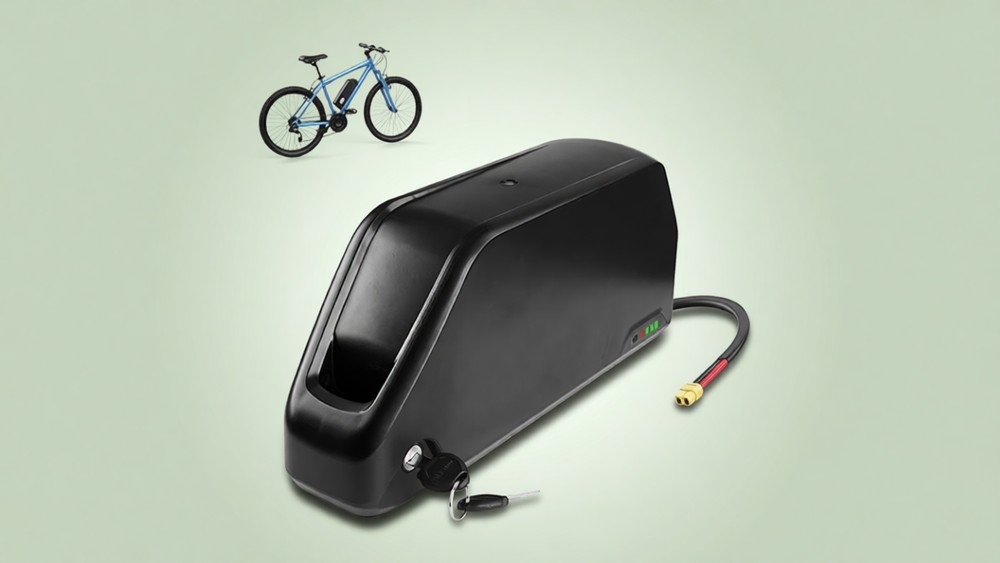
The whole listing is a title and a spec table
The model number is T-48300. Inside is a 48V, 30Ah setup with a 40A BMS, and the BMS is what makes the title's 200-1500W claim real. Forty amps at 48V is about 1,920W continuous on a fresh pack, so a 1500W system sits inside the ceiling rather than above it.
The price per watt-hour sits in the cheaper third of the 301 packs we track, but the listing never names the cell brand, the charger amperage, or a cycle-life figure.
The title promises a waterproof PVC case, and the page carries no IP code behind that word.
The IEC 60529 standard exists to give buyers tested numbers in place of vague terms like waterproof, and this listing offers only the vague term. Amazon's own product tags list the recommended use as solar devices. The seller never mentions a single bike, motor or kit that the pack fits.
What you do get in writing: dimensions of 11.76 by 6.1 by 3.07 inches, XT60 and T-plug connectors ready to go, and a one-year warranty. No charger amperage appears anywhere on the page, so a buyer cannot even compute a charge time from the listing.
For a pack this size that is not a small omission. It is the difference between planning an overnight charge and guessing at one.
What 1,440Wh means on the road
The 1,440Wh capacity works out to roughly 58 to 96 miles between charges at the 15 to 25 watt-hours per mile that moderate pedal assist on flat ground commonly takes. Rely on the throttle alone and the figure drops to about 48 miles, because throttle-only riding burns closer to 30 watt-hours per mile.
Those numbers sit well above the 25 to 75 miles per charge that Wikipedia gives as the usual band for e-bikes, and the honest conclusion is that capacity this size is how a rider stretches past that band on paper. Hills, rider weight, wind and cold all shave miles off. BMS reserves and cell aging shave more as the years pass.
What the number buys in practice is charge-free days. A rider with a ten-mile round trip runs most of a week between charges, and a weekend rider can ride both days without seeing a charger. No owner on the listing has posted a real range figure to check any of this against, so the arithmetic is the whole story until someone does.

Three warm reports, one shutdown failure, two silences
Four written reviews make up the entire record, and every one is tied to an actual order. The warm side: a buyer in August has written that the measurements were exact and the performance good, and an owner in April has called it an awesome battery that keeps a charge for a very long time. That April text is the closest thing the record has to a capacity endorsement.
The trouble starts with a July buyer who has reported that the energy cuts out and the pack shuts off, and who asked for help arranging a return.
It is the only failure report on the page, written in Spanish, and the seller's response is not visible. Then there is the March five-star text that reads in full as a complaint: the pack does not come with the case shown in the listing title. A warning wearing five stars is still a warning.
Behind the texts sit ten ratings, fifty-six percent five-star and thirty-one percent one-star. That works out to three one-star ratings, and two of the three carry no words at all, so there is no way to know what went wrong for those buyers. No reviewer has described a bike, a kit, a range figure or a charge time.
The record says nothing about how the pack holds up past a first month, and those questions stay open no matter how you read the stars.
Buy it when you can measure your own frame
A universal brick pack with no named fitment hands every compatibility check to the buyer.
Measure your mounting space against 11.76 by 6.1 by 3.07 inches and leave room for the wiring and the connector hood. Confirm whether your controller takes an XT60 or a T-plug, or budget for an adapter before the pack arrives. Then check that your controller's current draw sits under the 40A BMS ceiling under load.

The support reality matters as much as the fit. The warranty is one year, the seller's record here is four reviews deep, and a buyer who cannot tolerate a slow return process is the wrong buyer for an unproven listing. People who want a drop-in pack with documented bike fits and published charge times should skip it and buy from a brand whose listing answers those questions.
If 30Ah is more pack than your frame can take, the same brand's smaller 48V 12Ah brick follows the same universal approach at a fraction of the capacity. For everyone else, the comparison table shows where this pack's price per watt-hour sits among the 301 we track.
Frequently Asked Questions
Will it run a 1500W motor?
The 40A BMS allows about 1,920W continuous at 48V, so a 1500W system sits inside the ceiling on paper. Your controller sets the actual draw, and voltage sag under load brings the real figure down from the ideal.
Is the battery waterproof?
No rating on the page says so. The PVC case in the title is an enclosure, not a tested water-resistance code, so treat the pack as splash-protected at best and mount it away from road spray.
What bikes does it fit?
The listing names none. Match the 11.76 by 6.1 by 3.07 inch body to your mounting space and the XT60 or T-plug lead to your controller before you order.
How far will it go?
About 58 to 96 miles per charge at moderate pedal assist, or near 48 miles on the throttle alone, from the 1,440Wh capacity. No owner has posted a real range figure yet.
What warranty comes with it?
One year per the spec table. Weigh that against a seller record of four reviews before you commit.