A pack bolted to a go-kart, a mini trike or a homemade conversion lives a harder life than anything on a bike frame. It takes rocks off the trail, rain off the porch, and the occasional meeting with a garage floor. Riders who build these machines tend to pick a battery for toughness first and range second.
The Blwny 48V 21Ah LiFePO4 pack answered that brief with an alloy shell instead of the PVC wrap most aftermarket packs wear, plus 1008 watt-hours, a 30A BMS and an XT60 connector. Amazon has pulled the listing, so everything here works from the recorded spec sheet and from what the numbers do when you check them.
The sections ahead put the shell claim in context, test the weight against cell physics, run the power math, and cover where a box pack can actually mount on a DIY build.
The Blwny 48V 21Ah LiFePO4 battery sold for 259.99, which lands at 25.8 cents per watt-hour, close to the middle of the 324 packs in our battery comparison table.
Mid-band is the normal position for LiFePO4. The Battery University chemistry reference puts LFP cell cost near 580 per kWh against about 420 for NMC, so a safe-chemistry pack that matches the cheap packs on price per watt-hour has usually traded something else away.
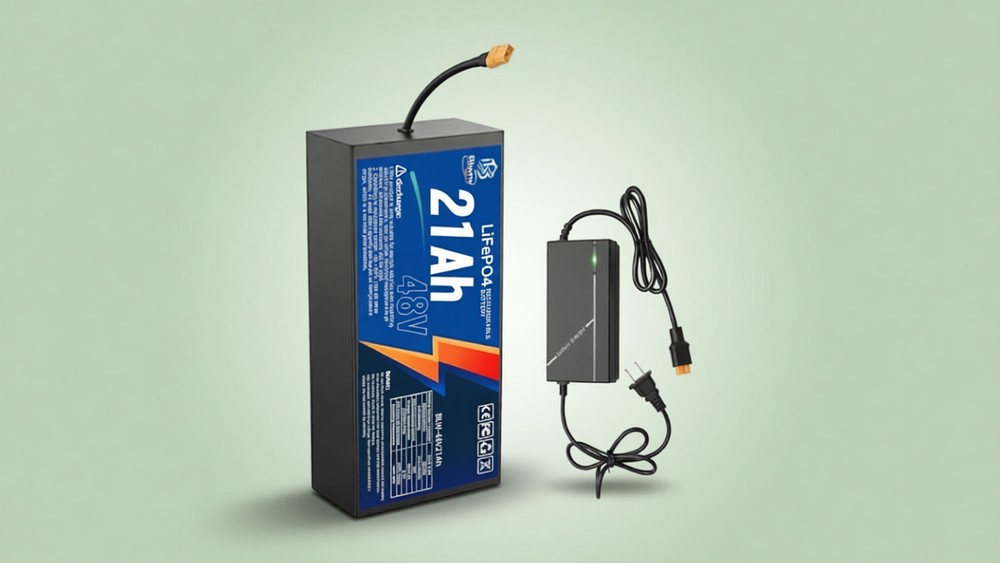
The alloy shell is the product
Almost every aftermarket ebike battery wears a PVC-wrapped plastic case, because plastic is cheap and light. The recorded Blwny listing claimed an alloy housing with a coating said to hold off rust, sold against cracking, moisture and dent damage. For a go-kart or a trike that slides across gravel, that argument has real force.
Two cautions belong next to it. No IP rating was ever printed on the listing, so the moisture case rests on the alloy itself and its coating, not on a tested seal.
No written buyer review was ever captured in our data, so the shell's real-world wear is a recorded claim, not a documented track record. The design intent is what survives, and the intent is sound.
The applications the listing named were DIY builds first: go-karts, balance bikes, mini trikes and custom conversions, with no mount interface of any kind.
A weight that only closes on the newest cells
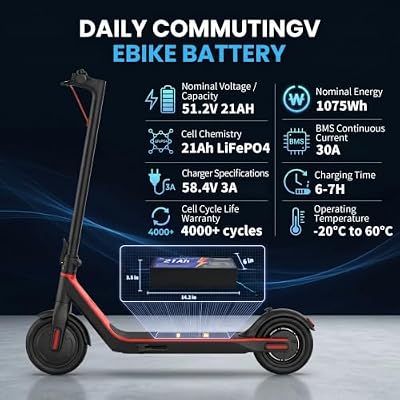
The spec sheet printed 18.5 pounds, which converts to 8.39 kilograms. Carrying 1008 watt-hours in 8.39 kilograms works out to 0.12 kWh per kilogram at the pack level.
That number lands exactly on the top of the bare-cell band. Battery University puts LiFePO4 cells at 0.09 to 0.12 kWh per kilogram, and that's the cell alone, before any case, BMS board or wiring adds its share. A complete pack closing at 0.12 with a metal shell still to house means the cells would have to sit above that band.
There's one honest reading. The Wikipedia LiFePO4 entry records the chemistry reaching 0.095 to 0.172 kWh per kilogram, with cells announced in late 2023 reaching 180 to 205 without a cost increase. If the "automotive-grade cells" in the title were that newer class, the arithmetic closes. If they were standard cells, the printed capacity or the printed weight was padded.
Anyone who caught one of these packs second-hand should weigh it on arrival, then meter a full charge through a ride they know. The two numbers settle the question in an afternoon.
We have logged the opposite fault on this site too: a 576Wh pack that claimed 5.95 pounds, a density no cell chemistry reaches. Too-light and too-heavy claims both deserve a scale.
Power math closes at 1440 watts
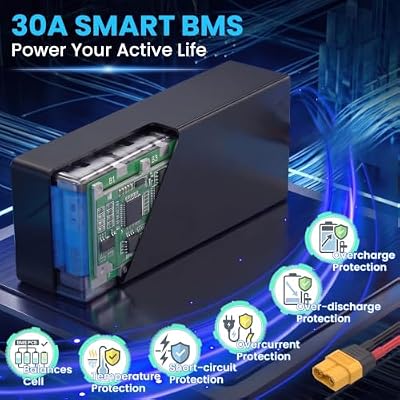
The 30A BMS sets the real ceiling: 30 amps times 48 volts is 1440 watts continuous. The recorded motor band ran from 250W to 1500W, and the top of that band is the same number rounded. That's the rare listing where the band top and the board agree.
The low end is trivial. At 1000W the pack draws about 21 amps, comfortably inside the board. At 1500W it would draw 31 amps, a hair over the limit, so 1440W is the honest plan-around figure for a builder sizing a motor.
The XT60 connector doesn't constrain any of this. It's the 60A connector class, worth about 2880W at 48V, so the weakest link stays the BMS where it belongs.
Charging a 21Ah tank, and mounting a box
The 3A charger in the recorded spec sheet fills 21 amp-hours from empty in no less than seven hours, because that's arithmetic: 21 divided by 3.
The em3ev charging guide puts a common 2A charger at roughly ten hours on a 20Ah tank, so a 2A brick would stretch this pack past ten and a half. Anyone buying a replacement charger matches voltage first, 54.6V for a 13S 48V pack, then picks the amperage.
At 8.39 kilograms claimed, this is not a light triangle-bag pack. A rear rack carries the weight over the wheel, a custom plate drops it low in the frame triangle, and straps or a purpose-built enclosure hold either. The upside of a box with no mount interface is that it moves: it travels between projects, and a builder who upgrades the kart keeps the battery.
What the rating record holds
Our record from July 2026 shows 5 stars from three reviewers. The data row now carries no rating at all, and no written review text was ever captured for this listing, so nothing here quotes a buyer, because no quotes exist in the record. The page itself is gone, confirmed in November 2026.
What survives is the spec sheet, and it holds up better than most. The capacity math checks. The ceiling math checks. The weight is the one claim that needs the newest cells to be true.
Frequently Asked Questions
Is the Blwny 48V 21Ah still available?
No. The Amazon listing is gone, confirmed in November 2026. Links here go to Amazon search results for equivalent 48V LiFePO4 packs, which is where a replacement hunt starts now.
Does the alloy shell make the pack waterproof?
No rating says so. The listing never printed an IP figure, and the shell's moisture resistance was a coating claim, not a tested one. Store and charge the pack under cover regardless of its case material.
How far will 1008Wh take me?
Scaled from the em3ev range table, which puts a 0.96 kWh tank at 30 to 40 miles on throttle and 50 to 65 in low pedal assist, this pack's band runs about 31 to 42 miles on throttle and 52 to 68 with light assist. Hills, cold and cargo pull both ends down.
What motors can this pack feed?
The 30A BMS sustains 1440W at 48V, and a 1000W motor draws about 21 amps with room to spare. Size the motor at or under 1440W rather than at the recorded 1500W band top.
What should I look for in a replacement?
Match the voltage, confirm a 13S charger at 54.6V, and match the discharge connector on your controller, XT60 in this case. Then weigh whatever arrives, because the weight was the one number on this sheet that needed the newest cells to be true.