A 50-amp continuous BMS on a 48 volt pack is not a spec the budget tier usually prints. Most 20Ah packs of this size run 30 to 40 amp boards, and Meaycoty put a 50A board in a 960Wh downtube shell with a USB port, a power switch and a safety lock, priced at 269.99.
The board was never the whole story. This pack mounts through a five-pin base, and the five-pin Hailong-class connector carries 25 to 30 amps, so the mount tops out well below the board behind it. Even the strongest motor the title named couldn't have pulled the full 50A through that base.
The listing is gone from Amazon now, and no buyer record ever attached to it, so what's left is the recorded spec sheet and what its own numbers admit. What follows is a read of the board-versus-base mismatch, the old range claims that didn't survive a check, and how to match a replacement that fits the same mount.
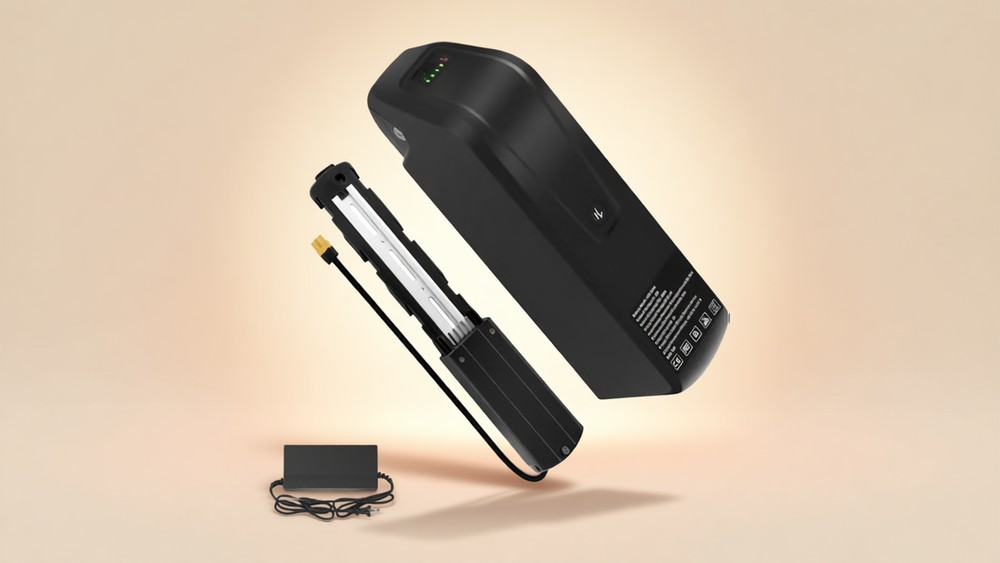
The board was bigger than the mount
The headline spec was real: a 50A continuous board with overcharge, over-discharge, over-current and short-circuit cutoffs, plus temperature monitoring, a fuse, reverse-polarity protection and an onboard balancer for the cells.
Fifty amps at 48 volts is 2,400 watts of continuous output, and our old page called that a theoretical peak figure. It isn't a peak. It's the ceiling the board can hold all day, and the mislabel made the board look more exotic than it was.
The base under that board tells a different story. The pack mounts through a five-pin Hailong-class connector, and the shop that sells those connectors grades them by amps: 4-pin carries 20 to 25, 5-pin carries 25 to 30, 6-pin carries 30 to 35. A 50A board behind a 30A-class base is a board that can never be fully used through its own mount.
What that means for a build
Work out the motor draws at 48 volts and the ceiling lands at about 30 amps, or 1,440 watts. A 1000W motor pulls about 20.8A and fits with room.
A 1500W motor pulls about 31.25A and sits just past the connector's class top. The 1800W motor the title advertised draws about 37.5A, which the board handles and the base does not. Anyone planning a build around this pack should plan around 1,440W and treat the board's 50A rating as spare that exists mostly on paper.
The price didn't match the old claim
Our old page called the cost competitive with other 48V 20Ah packs. Divided out, 269.99 for 960Wh is 0.28 per watt-hour, which lands this row in the below-average band of the 324 packs on our comparison table. The exact position renders in the specs box there, and it isn't a flattering one.
The old framing came from comparing sticker prices inside one capacity tier, which is how a 0.28 row reads as normal until you divide.
Rebuilt rows of the same size tell the contrast better than adjectives can. Our PowerVault 48V 20Ah review covers the same 960Wh tier at 0.24, and our Vatoso 48V 20Ah 40A review shows a 40A board priced mid-band. The extra ten amps on the Meaycoty board didn't come free through that base anyway.
The range claims didn't survive a check
Our old page assumed roughly 20 watt-hours per mile and printed 45 to 48 miles on throttle, 55 to 65 on pedal assist.
Twenty watt-hours per mile is a pedal-assist rate, and using it for throttle inflated the throttle figure by half again. The em3ev 48V battery guide carries the anchor we scale from now, and at 960Wh this pack sits exactly on it: 30 to 40 miles on throttle alone, 50 to 65 with a light pedal assist.
The charger rule nobody wrote down
No charger amperage was ever recorded, so no charge claim can be checked. The floors are simple: 20 amp-hours takes 10 hours from empty at the common 2A rate, and 3A brings the floor to 6.7 hours.
What the record does settle is voltage, because a 48V pack is a 13S build and its charger must print 54.6V. Any replacement charger should be bought against that number.

What the shell and features actually offered
The feature list ran longer than the price tier usually delivers: a USB port, a power switch on the five-pin base, a four-LED charge gauge, an anti-theft lock, and a waterproof shell with shock-proof padding. No IP rating was ever stated, so the shell deserves the honest reading. Splash and rain are fine, submersion and pressure washers are not.
The power switch mattered more than the marketing made it sound, because it cuts standby drain when the pack stays mounted between rides. The USB port's 10W draw is negligible against a 960Wh tank. The recorded warranty was 3 months for returns and 12 months for quality-defect repairs through Amazon messaging, which is standard for this tier.
What was never recorded matters as much: weight, dimensions and cell configuration are all missing, so the density check can't close and neither can a fit check. For scale, a complete 960Wh pack usually lands in the 10 to 12 lb class band. Anyone matching a replacement to the same mount needs to measure the old pack, because the row's own form-factor field says only Other.
A zero-record pack, and how to replace it
No rating and no count ever attached to this listing in our data, the July capture never recorded one, and the page now renders no rating at all.
The listing is currently unavailable on Amazon, so the record is frozen at zero and can never grow. One more drift is worth naming: the dead page's title now says 21Ah where our recorded row and the July capture both say 20Ah. The listing drifted at or near death, and everything above uses the recorded 20Ah figures.
Replacement shopping for this mount is mechanical. Match the five-pin base, because 4-pin and 5-pin baseplates don't interchange, confirm the case family against your mount, and keep the 54.6V charger rule. Current 48V 20Ah ebike batteries should be checked against each point before ordering, and the metering routine still applies to any replacement: full charge on arrival, a known distance, a second reading, all inside the return window.

Frequently Asked Questions
Could the 50A BMS actually deliver 50 amps?
Through the board, yes on paper. Through the pack's own five-pin base, no. The connector class tops out at 30 amps, so the practical continuous ceiling is about 1,440W regardless of the board.
Was the 2,400W peak claim real?
It was a mislabel. 50A times 48V is 2,400W of continuous board capacity, not a peak figure, and the five-pin base limits the practical draw below it.
How far did it go on a charge?
At 960Wh, expect roughly 30 to 40 miles on throttle alone and 50 to 65 with light pedal assist, per the em3ev range table. Hills, cold weather and high assist levels pull both bands down.
How long did charging take?
Nobody can say, because the charger's amperage was never recorded. The floors are 10 hours at 2A and 6.7 hours at 3A, and any replacement charger must print 54.6V.
Can you still buy this pack?
No, the listing is currently unavailable. Replacements exist, and each should be checked against the five-pin rule, the 54.6V charger rule and the metering routine above.
Was it good value?
Not by our division. 0.28 per watt-hour sits in the below-average band of our table, whatever the old page's competitive framing said.