Anyone replacing a small 36V pack runs into a wall that has nothing to do with batteries. The mount that fit the old pack is discontinued, the closest match looks identical to the other listings around it, and none of them carry enough ratings to trust. You end up buying on specifications and hope, which is exactly the position this pack put its buyers in.
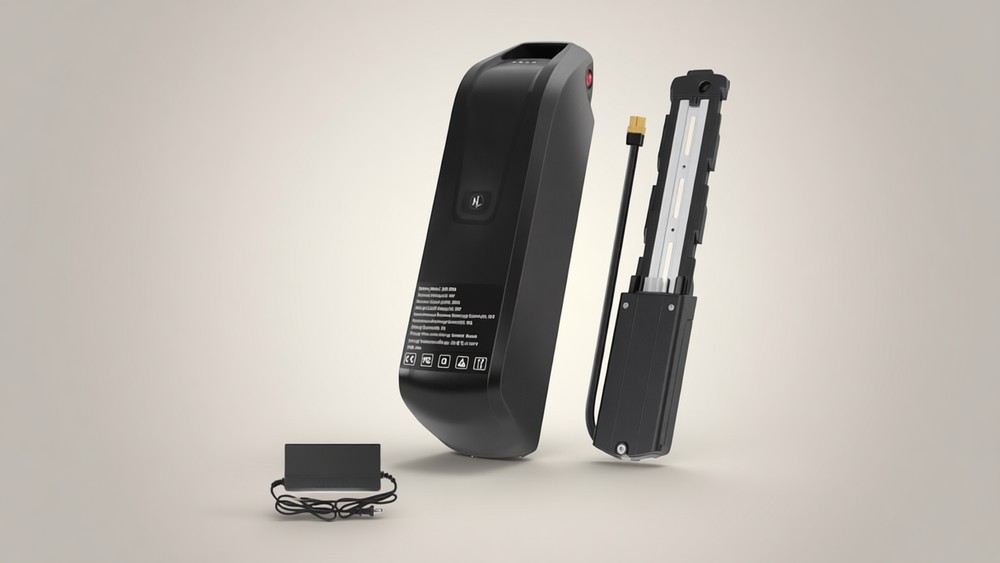
Meaycoty's 36V 10.4Ah battery carried a 30A board, a 4-pin base, a USB output, a power switch and a keyed lock, and it sold at 139.99 for a rated 374.4 watt-hours. On paper that is a complete feature checklist wrapped around the smallest tank in the brand's ladder.
Here's the strange part. Amazon carried this exact pack under two ASINs at the same time, with the same title, the same price and the same specification sheet. This page was one of them, and between the two listings the review record amounted to a single five-star rating.
The listing is gone now, so this rebuild is about what the duplicate tells you, what the board could really push, and what to check in a replacement.
Two listings, one battery
Our dataset carries the identical pack under a second ASIN, reviewed separately here, with a matching title, a matching price and the same 10.4Ah rating behind the same 30A board. Two pages, one product, and each page showed a fraction of whatever reputation the pack actually had.
That matters more than it sounds. A buyer reading this page saw a pack with essentially no review history, because whatever feedback existed was scattered across a second listing that search results ranked separately. Duplicate listings do that constantly on Amazon, and they punish exactly the packs that deserve a track record, because whatever ratings exist get split across pages, and each page reads as unrated on its own.
The warranty question gets murky the same way. A buyer who registered a problem had to route it through whichever listing they happened to click, and when one of the two dies, as this one did, the terms that were printed on it die with the page.
Both listings carried the same recorded terms, one year of free repairs plus a three-month window on quality issues, but those were the seller's words, not a verified policy, and there is nobody left to hold to them.
What the 30A board could and could not do
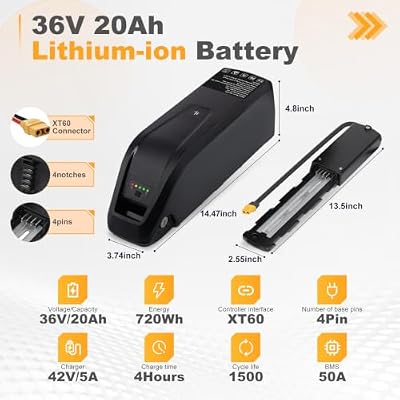
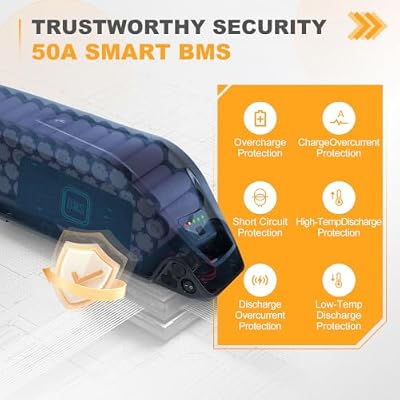
The recorded board rating is 30 amps, and at 36V nominal that is a 1080W continuous ceiling. The title claimed compatibility with motors from 0 to 750W, and a 750W motor at 36V draws about 20.8 amps, so the claim sat inside the board with roughly 9 amps in reserve.
The baseplate is where the room shrinks. Per batterydex's connector guide, a 4-pin Hailong-style baseplate class carries roughly 20 to 25 amps, which works out to about 720 to 900W at 36V. So the mount, not the board, was the practical limit on this pack, and anyone pairing it with a big motor was trading on the board's reserve that the baseplate could not safely deliver.
The rest of the checklist was real and mostly standard, with one exception. The charge indicator, the keyed lock and the USB output all show up across the budget shelf.
The power switch is the uncommon one, because budget boards leak a small standby current in storage and a pack that sits for weeks arrives weaker than it left, so a switch that isolates that drain is worth carrying into any replacement search. The old write-up also recorded the included charger at 2 amps, which puts a full recharge from empty near five hours before the balance tail.
The price problem the family exposed
At 0.37 per watt-hour, this pack sat among the most expensive positions in our whole comparison table, and the brand's own ladder is the clearest evidence that the premium bought size, not value.
The 15Ah Meaycoty rung, reviewed here, sold for about twenty more and delivered 540 watt-hours, which is 44 percent more energy for a fifth less per unit.
The same fixed costs, the case, the board, the lock and the USB module, spread over a bigger tank. Small packs always price this way, and it's not a scam, but a buyer who could physically fit the bigger rung had no reason to choose the small one except weight and space, and no dimension for either pack was ever recorded to quantify that trade.
For range, a 374.4 watt-hour tank delivers roughly 12 to 16 miles on throttle alone and about 20 to 25 with light pedaling, scaled from standard consumption figures. The full range breakdown in the sibling review covers the arithmetic, because it is the same tank behind both listings.
Buying a replacement when both listings are gone
Start with the mount, because it's the constraint that kills most replacement searches. Our records list this pack's form factor as unclassified, the twin listing's old write-up called it silver fish style, and the title's variant code reads 4-PIN, which is Hailong-case language. What the case actually was can't be answered anymore, so measure the tray on the bike instead of trusting any listing's label.
Then match four things in order: the tray dimensions, the 4-pin baseplate pin count and spacing, the discharge connector and charge port, and a 42V charger for any 10S 36V pack.
Per the em3ev 36V guide, the standard 36V ladder starts near this pack's size, so equivalents are easy to find. The feature checklist is the easy part to replace, and the power switch is the one line item worth insisting on. The fit items are the hard part, and they're where a replacement search lives or dies.
Frequently Asked Questions
Was the Meaycoty 36V 10.4Ah a good deal?
No. At 0.37 per watt-hour it sat among the most expensive packs we track, and the brand's own 15Ah rung delivered 44 percent more energy for about twenty more. The premium bought compactness and the feature checklist, not value.
Could the 30A board really run a 750W motor?
On paper, yes. A 750W motor at 36V draws about 20.8 amps against a 1080W board ceiling. But the 4-pin baseplate class tops out near 20 to 25 amps, so the mount was the real limit, and pushing toward the board's full reserve through that baseplate was never a comfortable margin.
Why did one battery have two listings?
Duplicate ASINs for an identical product are common on Amazon, whether from seller migrations, variant splits or relistings. The practical effect here was a split review record, a single five-star rating between two pages, and warranty terms that disappeared with whichever listing died first.
Is the pack still available?
No. This listing returns a page-not-found error as of November 2026, and the twin ASIN's listing is gone as well. The 36V section of our comparison table tracks live alternatives by price per watt-hour, and the tagged search links above point at current equivalents.