A 1040Wh pack at about 15 cents per Wh was the best value in the 52V tier, the early 4.6-star ratings supported it, and then the whole storefront vanished from Amazon. The pack itself was a strong buy on paper. What survives is the evaluation template for young-brand high-capacity packs: what to verify before the marketplace vouches for a seller, and what happens to your warranty when the storefront is gone.
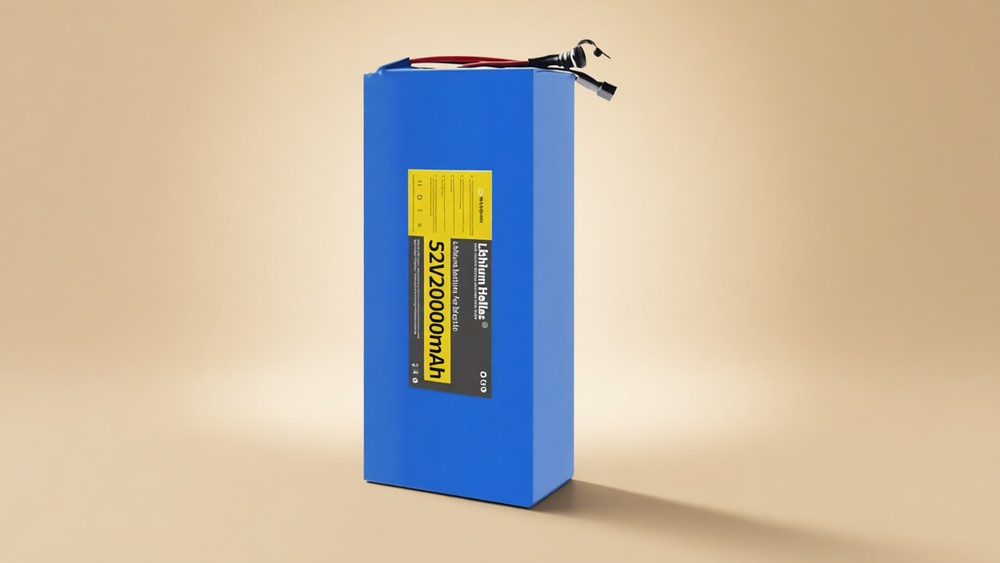
What 1040Wh delivers, with the math shown
Start with what you can actually spend. Multiply the 1040Wh total by an 85% usable depth of discharge and you get about 884 usable Wh. Now divide. Pedal assist at 15 to 25 Wh per mile gives you 35 to 59 miles. Throttle-only riding at 30 to 40 Wh per mile drops that to 22 to 29 miles. Either way, the daily gauge-watching stops, because this much energy covers most commutes for two or three days between charges.
Cold weather, heavy loads, and long climbs all push consumption toward the top of the band, but the buffer here is large enough to absorb that stress. That is the genuine appeal of a pack this size: you stop planning rides around the charge level and start planning them around the weather. Most sellers inflate range claims, so run this division yourself on any pack you compare, because the usable-Wh arithmetic takes two minutes and exposes inflated numbers fast.
The 52V question: compatibility rules you cannot skip
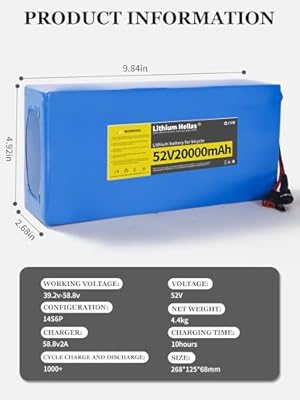
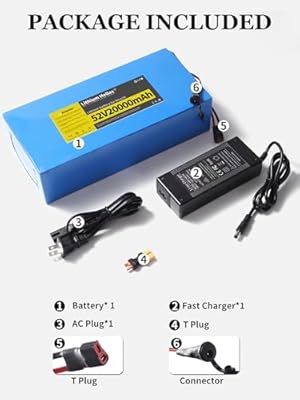
A 52V pack charges to 58.8V while a 48V pack stops at 54.6V, so a 48V charger can never fully charge a 52V pack, and the included 2A brick is not an optional accessory. You can often run a 52V pack on a 48V bike because many 48V controllers carry 63V-rated capacitors, but you must confirm your display reads the higher voltage, and the charger must be a 58.8V unit. The payoff for getting this right: the same power flows at lower amperage, which keeps wiring and connectors cooler on climbs.
The 30A BMS handles about 1560W of continuous draw, which backs the 1500W motor claim with real headroom instead of decoration. Discharge runs through a T-Plug connector, so XT60 or Anderson systems need an adapter or a solder swap. And the 2A charger takes seven to ten hours from empty, which makes a 3A or 4A upgrade the first accessory worth buying for this class of pack. As the em3ev 52V guide puts it, a 48V charger leaves a 52V pack unbalanced and weak, and there is no workaround for the voltage gap.
The cycle-life claim that nobody verified in time
The 1500-cycle claim sits above the common 800-1000 cycle band for generic packs, and that gap is exactly why it deserves suspicion. It is a marketing figure for a young brand, not a measurement. Confirming it would take three to four years of owner data, and the storefront died before any of that evidence accumulated. Treat the number as a promise about what a good pack might do, not a record of what this pack proved it did.
Charging habits matter as much as the claim. Lithium cells age fastest when they sit at full charge or run dead flat, so for storage between rides, park the pack somewhere near half. If you ride daily, normal cycling does the job on its own. And take the pack off the charger once it is full, because hours of trickle at 58.8V add heat, and heat is what shortens cycle life. None of this rescues an unproven claim, but it stops you from cutting whatever real lifespan the cells have.
This is the general lesson for cycle claims on any new brand: ask what the industry band is, ask what evidence would move the number from claim to fact, and discount the price accordingly. The 4.6-star early rating measured satisfaction out of the box, not longevity, and those are different things. A pack that sags after eighteen months costs more per real cycle than a proven 800-cycle unit at a higher sticker price.
What happens when a battery storefront vanishes
When the seller leaves the platform, the warranty dies with the listing, because the entity that would honor it no longer exists there. The hardware, however, is standard: common 18650 or 21700 cells and a generic BMS board, which means a local battery tech can still re-cell the pack or replace the board if it fails. You lose the support line, not the repairability.
If you are shopping for a replacement in this class, the checklist matters more than the reviews, because you may be looking at another young brand. Named cells or a UL standard, BMS amperage stated in writing, the correct 58.8V charger included or budgeted, and a connector that matches your controller. Ask each seller one spec question before you order and time the reply, because a fast exact answer predicts how a warranty claim will go.
Our battery comparison table sorts the current 52V field by price per Wh, and the 52V 20Ah search on Amazon shows what ships today. The same verification habit applies to the 48V 20Ah packs that sit one voltage class down. One more practical note: if you already own a Lithium Hellas pack, keep it, because the cells do not know the brand is gone, and a pack that cycles well today stays worth riding tomorrow.
Frequently Asked Questions
How many miles can I actually get with this 1040Wh battery?
You can expect between 35 and 59 miles using pedal assist, or roughly 22 to 29 miles if you rely entirely on throttle. These figures depend heavily on your weight and the terrain encountered.
Can I run this 52V pack on my existing 48V ebike?
The pack will usually work if your controller can handle up to 58.8V and your display can read those higher voltage levels. You must also use a specific 58.8V charger to avoid damage.
Can I use a standard 48V charger to charge this 52V pack?
No, a 48V charger stops at 54.6V which leaves the 52V pack running unbalanced and performing very weakly. This mismatch will eventually degrade the cells and shorten the total lifespan of the battery.
Is the 1500-cycle claim actually realistic?
This claim sits above the generic band for most packs, but it remains unproven for a young brand like this one. You should treat it as an optimistic estimate until more owner data accumulates over time.
What should I buy now that this specific pack is retired?
Nothing identical replaces this pack, so you must run a verification checklist on current listings and sort them by price per watt. Finding a compatible replacement requires careful checking of voltage ratings and connector types.