52V packs typically run higher priced due to the fact that the voltage increase is directly tied to more cells. That said, the Lithium Hellas 52V 20Ah battery changes that at 1040 Wh. It shares the same T-Plug connector, 30 Amp BMS, and included charger as the other models. If you're after some serious range without breaking the bank, this is your go-to model.
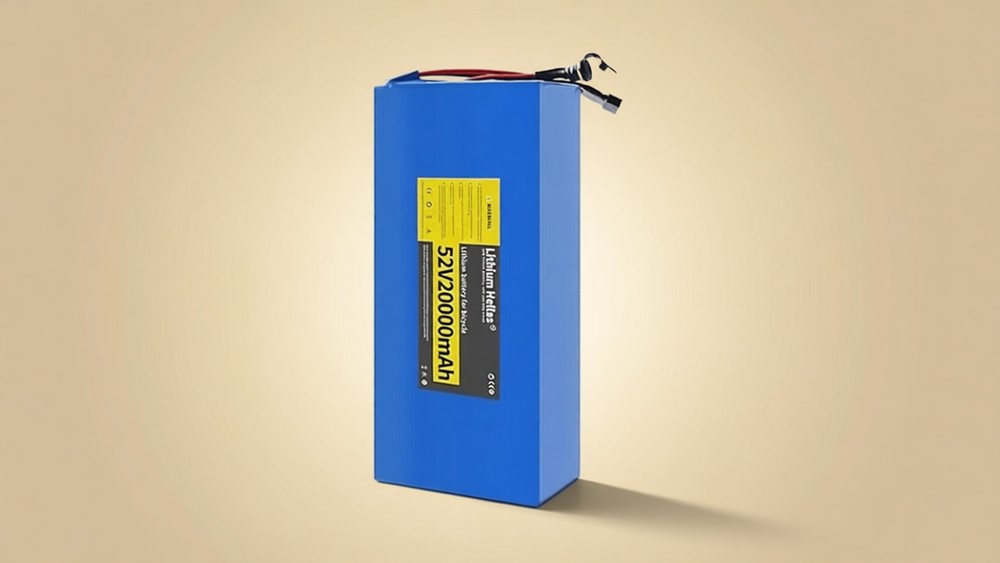
You don’t see many generic rectangular shape ebike batteries these days. No downtubes, no sharks/Hailongs, no rear rack mounts. That’s going to make a big difference based on what you’re planning to do with your build or upgrade, so let’s get that out of the way now before we move into specifics.
Specs and What You're Getting
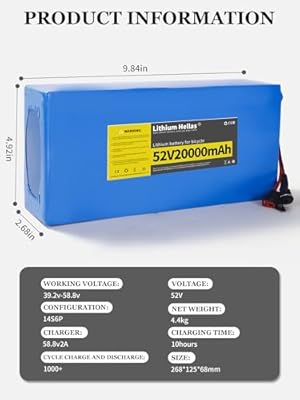
The basic specs are: 52 volts, 20 amp-hours, and 1040 watt-hours. That’s the math, 52 x 20 = 1040. The BMS limits continuous discharge to 30 amps, all but the most extreme of 52V applications from 750 watts up to 1500 watts or so (depending on the motor). If you’re consistently pushing over 30A continuous, you’ll want a bigger pack. otherwise, this will cover most all of your hub motor needs.
Charger & Connectors
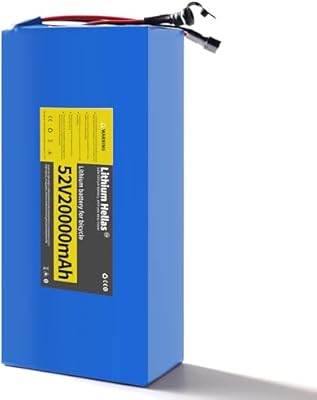
Included is a 58.8V / 2A charger. That’s the right charge voltage for a 52V Li-ion pack. But slow, two amps is very slow. With 20 Ah of capacity in a completely drained state, you can expect somewhere between 10 hours to fully recharge (or about seven/eight hours when recharging from about 20%). In reality, you’ll likely never get close to the max drain unless you’re constantly using throttle instead of pedaling.
If you need to recharge faster, you can purchase a different 5A or 10A charger that supports 58.8V. However, adding another piece of equipment increases overall costs.
Bms & Cycle Life
As expected the BMS protection includes:
• Overcharge • Overdischarge • Short Circuit • Temperature Cutoff • Reverse Polarity
Manufacturer claims 1500 cycles, much higher than most lithium-ion packs, in fact it’s even higher than the typical 700, 1000 cycle rate of most budget alternative packs. Don’t hold too tightly to manufacturer cycle claims however, especially regarding how often you charge/discharge your pack (in terms of % of total capacity) as well as storage habits when not being ridden.
The Form Factor: Know What You're Getting
This is an area you need to consider first if you’re buying. The Lithium simply slides down inside your downtube frame or clicks into a Shark/Hailong carrier. There are many other configurations, and it really comes down to what you’re building or replacing. As such, we'll start here before reviewing specifications.
What Amazon Reviewers Say
Buyers of this 1040Wh pack report the range estimate holds in real use.
Currently there are three comments, none of them were bad. All reviewers gave it five stars. One reviewer praised its value and real-world range: “Good battery for the money… Today we rode 9 miles at nearly full throttle the entire ride and she still had about 35-40 percent of her battery left. Recommend this battery for kids’ Razor builds on a tight budget.” Another reviewer focused more on the BMS protection and felt comfortable with their ability to safely handle long term reliability: “I’m impressed with the level of protection built into this BMS…. I think I’d be crazy to worry about safety in this application.”
In general, no one has posted anything bad about this battery as yet. That doesn’t mean there won’t be problems, it just means every single one of the initial purchasers were happy. Since this is a relatively new offering, you could say you’re part of the first group to buy it. So check back periodically and see how things turn out. It looks like it’s specced fairly well and the price is reasonable.Check Current Pricing on Amazon.
Real-World Range
One 52V 20Ah pack carries about 1040Wh. At a realistic 20Wh-per-mile draw, that is 40 to 50 miles of mixed riding.
Range-wise, on paper you’re looking at having a great deal of range with 1040 Wh. They list it as approximately 35, 50 miles, which is overly optimistic as always but not outlandish. Your upper limit is going to depend upon several factors including: how heavy you are, how steeply hilly your terrain is, how fast you ride, and how much throttle vs pedaling you do. A light rider with a flatter route at a moderate speed (about 15, 20 mph) with mostly pedal-assist will likely hit the top end. Conversely a heavy rider that does a lot of throttle on a hilly route will likely hit the bottom end.
That guy who ran it hot on his Razor build with a 650W motor and was pulling a 60 pound child at full throttle for nine miles still had over a third of the charge left. While certainly NOT a true range test, it does show that capacity can indeed exist. As mentioned earlier, at 1040 Wh you’ve got extra margin compared to most budget ebike batteries, which is important when your actual range ends up about forty percent below listed spec-sheet ranges.
Keep in mind as well with regards to 52V systems specifically: if you've got a 48V motor/controller then you can't use this battery. The nominal voltage difference between those two voltages appears trivial, but as noted previously, the actual charge voltage for a 52V pack (i.e., 58.8 Volts) is beyond safe operating parameters for virtually all 48V systems. Don't mix voltage streams!
FAQ
Does this fit in my standard ebike battery tray?
Probably not. This is simply an externally-mounted rectangular shape battery pack -- NO downtubes, sharks/Hailongs OR rack mounts. If your bike has a specific battery slot then you'll need to get a battery made for that exact slot.
What connector does this use?
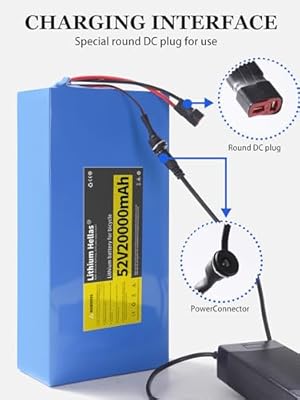
T-Plug (Deans) connector. This connector is somewhat more common in RC and DIY ebike builds … and less common in production ebikes. If your controller has an XT60, Anderson or similar connector then you'll need an adapter.
Can I use this on a 48V ebike?
No. As noted previously, a 52V pack charges to approximately 58.8 V. This exceeds safe operation for virtually all 48V controllers/motors. Use this on a 48V system and you risk damaging either/or.
How long will it take me to charge it?
The provided charger, which is a 58.8 V / 2 A unit, will take approximately eight to ten hours to recharge the pack from empty. Fast charging options include purchasing a second charger with the same output voltage (58.8 V) but a greater current (5A or possibly 10A). Please ensure any additional chargers are compatible with this battery configuration.
How many cycles should I expect?
Manufacturer estimates that this pack will yield approximately 1500 cycles, which is considerably better than most products within this price class. Manufacturer estimated cycle counts tend to vary significantly however. please keep in mind that actual performance depends greatly on charging habits (e.g., how deep do you allow your pack to discharge?) as well as storage habits (e.g., what percentage of capacity do you store the pack at for extended periods?).
Will I have enough range for my daily commute?
Most riders will have sufficient range, realistically anywhere from twenty-five to forty-five miles. At the upper-end of that range (forty-five miles) assume flat routes with moderate speeds (approximately fifteen-twenty mph). at the lower-end (twenty-five miles) assume hilly routes with greater throttle usage.
Browse more reviews and guides if you are still comparing packs.
Compare every 52V option on the full battery table.
Browse more reviews and guides.