Most of the packs you find scrolling past on Amazon tend to max out at 48V. The LOCKBUS 52V 20Ah ebike battery steps up a whole level from there and the difference shows up in ways you actually care about. 52V times 20Ah works out to 1040 watt-hours of stored energy packed into a ten pound box that is only ten inches long.
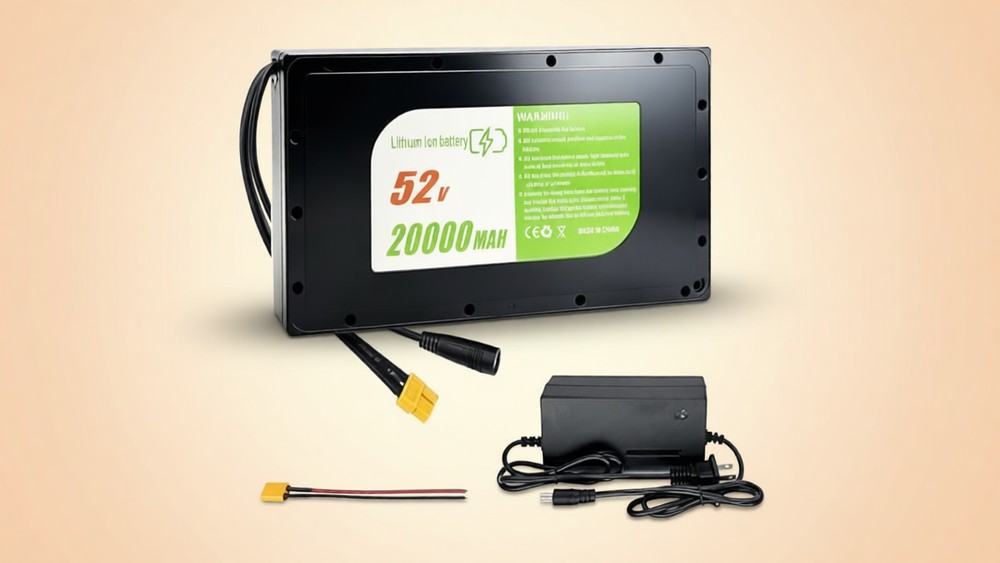
The company markets it to fit anything from 200W ebikes all the way up to 1400W systems and even scooters, ATVs and DIY projects. Does that overly broad compatibility claim pan out in the real world? Short answer: yes it does. The voltage really does most of the heavy lifting and the BMS and the case do most of the support work.
Specs and Build Quality
First start with the important numbers. 52V nominal, 20Ah capacity, 1040Wh total. The pack charges to 58.8V when fully charged. Those are the specifications LOCKBUS claims, and they match the chemistry. Using a built-in 30A BMS the continuous output is approximately 1560W at 52V nominal voltage. This matches the advertised motor range of 200W to 1400W with a bit of room left at the top.
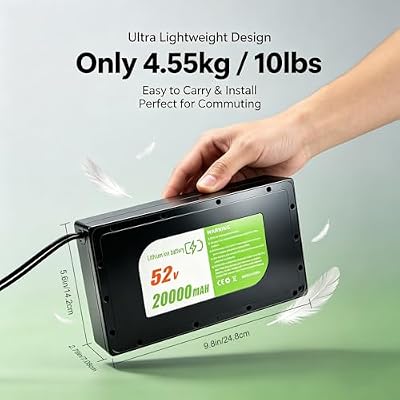
The physical size is another strong selling point. Approximately 9.8 inches long by 5.6 inches wide by 2.79 inches thick. The package weighs approximately 10 pounds, or approximately 4.55 kilograms if you prefer. That is very compact compared to a similar sized 1040Wh pack at 52V. As buyers have noted, the box fits into areas that larger 52V packs won't fit in, which is valuable when attaching to a rack or mounting to a custom frame bracket.
LOCKBUS touts Grade A cells and pure nickel plates. While difficult to verify via a picture in a product description alone, the weight is consistent with a quality-built 20Ah pack. Buyers who opened theirs reported good spot welding and no cell movement inside the housing.
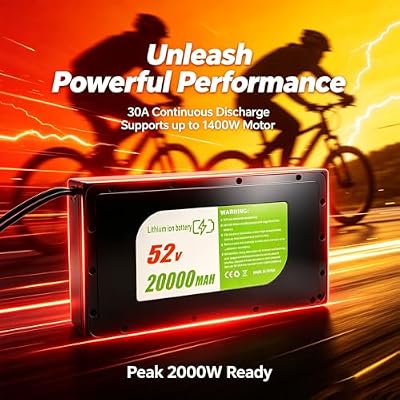
The hardshell gets its own paragraph. LOCKBUS describes it as "waterproof" and "shockproof". And the case appears to be a cut above the flimsy plastic shells many of us have seen used on cheaper packs. Sealed enclosures protect the cells from water and rain. However, please don't interpret this as a license to submerge it in water. But for bikes ridden outdoors or occasionally exposed to rain, it's reassuring. Several reviewers stated they rode through wet conditions with no problems whatsoever.
BMS Safety and Design Features
At this price point, we've seen plenty of cheap batteries paired with decent ones. The design features of a cheap battery vs a decent battery differ greatly in how each protects you from potential hazards. The BMS of the LOCKBUS pack protects you from overcharge, overdischarge, overcurrent and shorts. These four represent your basic safety net when using lithium packs. As such, they're not guaranteed at this price point.
As for the specifics of the 30A BMS, at 52V, 30A continuous equals roughly 1560 watts. This is within the limits specified by LOCKBUS for motors up to 1400 watts with some overhead available. If you're going to ride full throttle up steep hills continuously you'll likely come close to reaching the maximum current limits provided by the BMS. For normal riding and assisting with pedaling most people will never hit the upper bounds of the BMS.
In excess of 2000 cycles represents the claimed life expectancy based upon moderate discharging and proper behavior by your charger. Based upon buyer reports, capacity retention has been satisfactory for those who have owned them for multiple seasons or years. A 52V system maintains usable voltage longer than lower voltage systems, so your motor doesn't appear nearly as exhausted by the end of a charge cycle.
Included Charger and Connector
Included in the purchase are a 58.8V 2A charger, an XT60 connector, and instructions. Charging from completely dead to fully charged will take between eight and nine hours at 2A. If you require quicker turnaround between rides you can easily purchase a higher amperage (e.g., 5A) 58.8V charger for much less money, thereby reducing recharge time to approximately four hours.
The included XT60 connector is a good choice. It's an industry standard among DIY ebike builders, securely locks in place and can provide sufficient current for this pack. If your controller requires a different connector simply purchase an adapter cable for a couple of dollars. Be sure to confirm both the type and voltage of the connector prior to making your purchase, since adapters address connectors but not voltage differences.
Range and Real-World Performance
Your actual mileage depends far more on you than it does on the battery. You may expect to reach somewhere in the neighborhood of 45 to 50 miles on a single charge with assistance, depending on how lightly you weigh and whether your route is primarily flat or hilly. Throttle usage, wind resistance and additional weight will reduce that estimate accordingly. Reviewers indicate that daily mileage typically falls in the range of 30 to 40 miles when throttling and hills are factored into the mix.
You'll experience most of the benefits associated with using a 52V system during acceleration and high speeds. Because you maintain usable voltage longer than systems operating at lower voltages, you'll enjoy improved performance at higher speeds and your motor will seem like it has more punch until literally the end of a charge cycle.
Let me make one thing crystal clear. This is not a drop-in replacement for your stock 48V bike's battery. To utilize this battery you must also replace your stock controller with one that is designed specifically for operation at 52V. Installing a 52V battery onto your existing stock controller is essentially asking for fried components, and it is extremely ill-advised to do so.
If you're planning on creating a new 52V system from scratch or replacing an existing system with identical voltage requirements this battery will work perfectly fine. However, if you want an extra battery for your stock 48V commuter bike, this battery is entirely the wrong voltage, and I recommend checking our ebike battery review page and comparing values directly via our full battery comparison table page.
Who Is This Battery For?
DIY builders will be best suited for this battery first and foremost. Anybody that's building their own custom ebike, scooter or ATV utilizing a 52V electrical system will love having access to a compact case like this along with an XT60 connector and all required accessories including the charger and instruction manual.
This battery is ideal for anyone wanting more storage space without increasing their frame size or overall weight. They would be able to store up to twice as much as they could previously.
This is not the ideal battery option for everybody. If you are simply looking for an additional battery for your stock 48V bike then this battery is not suitable due to its excessive voltage rating relative to your bike. Additionally, if you are requiring an external USB charging port, flashing LED charge indicators or any sort of display functionality then this will be less appealing as well, because it offers none of these features as part of its design.
For those that only require raw watt-hours and nothing else, this is probably one of your cheapest options for getting as much capacity as possible in as small of a package as possible.
Price Point
The cost of this battery is currently priced similarly to many other options for purchasing similar amounts of storage capacity. To put it bluntly, you'll pay less per watt-hour than buying three separate packs at half the capacity, and this is particularly relevant for DIY builders that have no problem with assembling everything themselves.
Please visit our Amazon product page to view the current price and availability information regarding this product.
Frequently Asked Questions
What Does Using a Higher Nominal Voltage (switching from 48V to 52V) Actually Get Me?
With increased nominal voltage comes greater watt-hours of storage capacity per amp hour of capacity, and a greater amount of headroom before hitting low-voltage shutdown thresholds. Consequently this allows for better high speed performance and reduced sagging in usable voltage towards the latter stages of a charge cycle.
What Kind of Mileage Can I Realistically Expect on a Daily Basis Using This Pack?
Reviewers commonly report anywhere between 30 to 40 miles on average using assistance in mixed terrain riding. Those that are lighter and mostly ride in flat terrain have reportedly achieved upwards of 50 miles per charge.
Will This Handle a 1400W Motor?
At approximately 1560W continuous, the BMS will barely meet or slightly exceed specifications outlined for motors up to 1400 watts. Therefore, unless you intend on spending extended periods riding at full throttle up steep inclines, it's safe to say you'll rarely encounter limitations imposed by the BMS, assuming your controller can handle it.
How Long Does Recharging Take?
Recharging from empty to full will take approximately eight to nine hours at 2A using the supplied charger.
What Type of Connector Does It Ship with?
An XT60 connector is shipped with this pack. This connector style is widely used by DIY ebike enthusiasts and securely locks into place providing adequate current for this pack.