A single 1040Wh pack gets most riders through a day. Then one Sunday the ride doubles, or the commute picks up a detour, and the last five miles home run on ghost pedal. That's the moment a second battery starts to look like the cheapest upgrade on the shelf.
Lithium Hellas sold that second pack as a two-pack listing: two 52V 20Ah units with 1040 watt-hours apiece, T-plug connectors, US stock. We tracked it for months, and by early November the page itself returns Page Not Found. The listing is gone, but the decision a buyer faced isn't, because the same pair can still be assembled from the singles the brand still sells.
The hard part was never the price. Two packs only work together if their voltage platforms match, their charge states are close, and the wiring between them is built for the combined current. Get one of those wrong and the controller pays for it.
What follows is the spec sheet the pair printed, the pairing arithmetic a buyer should run first, and where the value actually landed in our table.
The bottom line: as a spec sheet, this was the cheapest class of energy we track, two 1040Wh singles that our table prices at about 14 cents per watt-hour each. The pairing rules decide whether a two-pack setup makes sense for your bike, and those rules don't depend on any one listing.
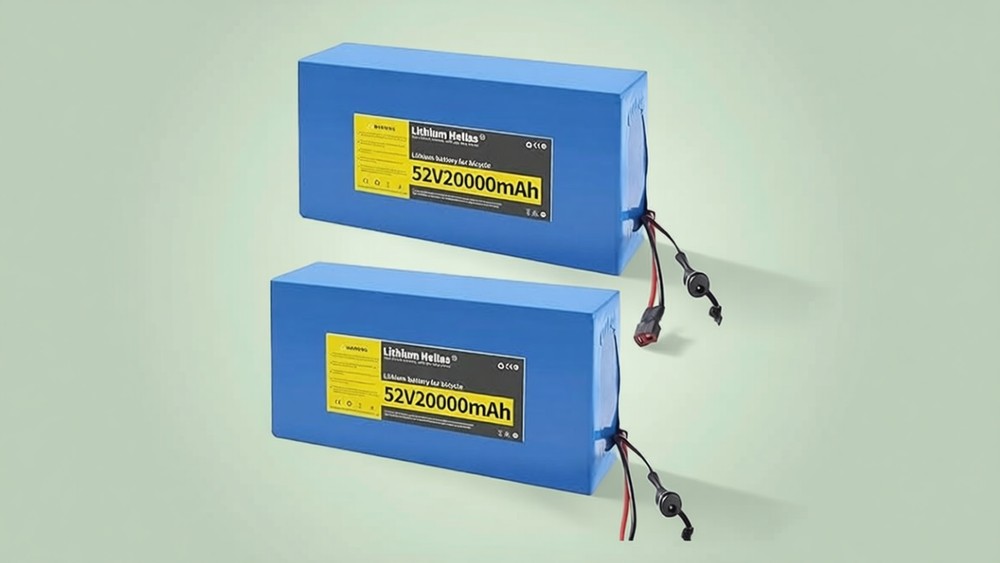
What the pair was, per unit
Each pack in the listing was a 52V 20Ah unit, so 52 x 20 = 1040 watt-hours apiece. The BMS was rated 30A continuous, which at 52V nominal means 30 x 52 = 1560W per pack. Together the pair holds forty amp-hours at 52 volts, twice the energy of either single, at the same voltage the controller already expects.
The connector was a T-plug, one of the most common discharge connectors on mid-power ebike systems. That matters for a pair more than for a single, because a dual-battery setup needs matching connectors on both packs plus whatever adapter or blender joins them. T-plug to XT60 adapters are cheap and easy to find if your bike runs XT60.
US stock was part of the title. The old text promised a section on that advantage and never wrote it, so all the record really holds is the phrase itself: ships from a US warehouse, which usually means shorter replacement shipping than an overseas parcel.
One more thing the record never held: the pair's own price. No campaign note, no old spec box, no captured page ever printed what the two-pack listing charged. That gap shapes the value question below.

Series and parallel, corrected
The old version of this page made a physics error worth fixing, because it's exactly the mistake that kills controllers. It described two packs "connected in series" while describing what parallel does: capacity rising to forty amp-hours while voltage "still remains at 52V". Those are different wiring schemes, and they do different things.
Series adds voltage. Two 52V packs in series make 104V and keep 20Ah. Parallel adds capacity: the same two packs in parallel make 52V and forty amp-hours. A dual-battery ebike setup is almost always parallel, because the controller and motor are built for one voltage platform. EM3ev's dual-battery guide puts it plainly: match the voltage platform first, and mixing voltages, say a 36V pack with a 48V pack, can destroy the controller.
The guide names the two ways riders actually join packs: a parallel blender that discharges both packs at once, or a switch that toggles between them. Either way, the BMS in each pack has to support the combined current demand, and both packs should sit at the same state of charge before you join them. Two packs at very different voltages, connected live, will push a rush of current between themselves the moment the contact closes.
What the second pack actually buys
Range math on a pair is unglamorous arithmetic. Real-world consumption for a hub-drive bike runs roughly 24 to 31 watt-hours per mile on throttle and roughly 15 to 19 on light pedal assist, per the em3ev 48V guide range table. One 1040Wh pack covers about 33 to 43 throttle miles or about 55 to 69 pedal-assist miles under that anchor. The pair doubles the tank: about 67 to 86 throttle miles or 110 to 138 light-assist miles across both packs, charged separately or drawn together.
That anchor is a category figure, not a promise. Hills, rider weight, tire pressure and weather all move it. But the doubling is the point: the second pack buys either range on the same ride or a swap mid-route, and it buys a spare the day one pack ages out.
Here's the honest version of the backup argument. A second pack doesn't make a failing pack healthy, it just means the failure costs you a shopping trip instead of a stranded ride. For anyone commuting on an ebike, that difference is most of the value.

Buying the pair today
The two-pack listing is gone, so the practical route is the singles. We track the Lithium Hellas 52V 20Ah single at 149.99, which works out to about 14 cents per watt-hour, among the cheapest energy in our full battery table. Two of them run 299.98 for the pair. Whether the old two-pack listing undercut that with a bundle discount is unknowable now, and the old page's claim that a bundle was cheaper per unit was never backed by a captured price. Take it as unverified.
If you buy two singles to run together, the checklist is short. Same brand and same model, so the voltage platforms and BMS behavior match. Both charged to the same level before the first joined ride. A parallel adapter or blender rated for the combined current, not a pair of bare connectors twisted together. And if you'd rather not run a blender at all, a plain swap rotation gets most of the range benefit with none of the wiring, which is what the single-pack version of this battery is for.
For the wiring details, the em3ev dual-battery guide covers blender-versus-switch choices and the storage advice worth following: packs parked for weeks do best at about half charge, not full.
Frequently Asked Questions
Can I connect two 52V packs in series for more speed?
You can wire them that way, but you shouldn't on a stock ebike. Series makes 104V, and every controller, motor and display on a 52V bike is built around the 52V platform. Over-volting past what the components are rated for usually ends the controller. More capacity on a stock bike comes from parallel, which keeps the voltage and doubles the amp-hours.
Do both packs need to be the same brand?
Matching brand and model is the safe answer, because identical cells, BMS behavior and charge curves make the pairing predictable. The brand name matters less than the platform: both packs need the same nominal voltage and comparable BMS current ratings. An old pack and a new pack of the same model can still work in a switch setup, where each pack runs on its own until you flip.
What connector does a dual-battery setup need?
Both packs need the same discharge connector as each other, and the adapter or blender needs to handle the combined current. These packs used T-plugs, and T-plug to XT60 adapters are common if your bike's side is XT60. Match the connector on the pack, not the bike, when you order the second unit, and check what the blender or adapter is rated for before the first ride.
Does the dead two-pack listing matter anymore?
Only as a spec sheet. The pair's page is gone, so the price it charged and any bundle discount it offered are unrecoverable. What survives is the configuration: two 52V 20Ah packs with 30A boards and T-plugs, which is a configuration you can still reproduce from the singles we track and pair yourself.