Rear hub kits for road bikes are the quiet workhorses of the conversion market, and this listing wants to sell you the loudest one in the aisle. The Lidhujnk 48V 1500W rear hub conversion kit puts a gearless direct-drive motor in a 700C rear wheel and calls the result a fat tire kit in the same breath as a road bike kit.
The record's as thin as records get while still being readable. Three ratings, two written texts, and the only one that says anything is a wheel-size complaint that the listing's own spec rows can settle.
So this review does three things. It reads the wheel naming against the ISO 5775 standard, because that's where the one real complaint lives. It reads the parts list, which is the fullest thing about this listing. And it sizes the electrical system the listing won't size for you.
The short verdict: the box list is excellent, the price sits close to the middle of the kits we track, and the wheel is a 622mm road rim no matter what the title calls it. Buy it for that rim and for nothing the fat-tire words promise.
Three ratings, two words that matter
The listing reads 4.2 out of 5 from 3 global ratings, with a histogram as printed of 59 percent five-star and 41 percent three-star and nothing else. That reconciles to two five-star ratings and one three-star.
The written record is two texts, both purchase-badged, neither endorsed by a single helpful vote. The January one reads, in full, "Great". That's the entire positive evidence base: one word, written on day one, with no install detail, no range, and no riding impression attached.
The July text is where the substance lives. The owner reports the kit is fine but not even close to the 24-inch wheel they expected, measures it at about 29 inches, resells the kit, tries a replacement from another retailer that is also wrong, and concludes that a pre-built 24-inch wheel in this class does not exist.
That complaint deserves a serious answer rather than a dismissal, because the listing invites it. The title says fat tire. The spec row says 28 inches.
The parts list says 700c. One owner ordered expecting a 24-inch wheel, and nothing on the page told them what was coming instead. The next section settles which words were true.
One wheel with four names
The bicycle industry sizes rims by bead seat diameter precisely because the inch names are a mess. The ISO 5775 standard exists so that a buyer can check a number instead of a marketing word (Wikipedia).
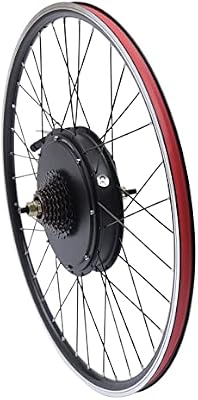
Under that standard, 700C, 28 inch, and 29 inch all describe one rim: 622mm at the bead seat. The names differ only in the tire height each market usually fits.
So the parts list's 700c motor wheel, the spec row's 28 inches, and the owner's 29-inch tape measurement are the same wheel wearing three labels.
The owner's measurement was correct. The wheel was correct. The words around it were noise.
The two false words are the title's "Fat Tire". Nothing in the parts list, the spec rows, or the photos describes a fat-tire wheel, and a 622mm road rim with a road tire is what the box contains.
A buyer who wants a fat-tire build shouldn't order this listing, and a buyer who wants 24 inches shouldn't either, because 24-inch rims run a 507mm bead seat in the BMX class, a size this kit has never been offered in.
The owner's last observation is their own market read, and our table softens it rather than confirming it. We track a handful of 24-inch hub kits, against dozens in the 20-inch folder class and dozens more in the 26-inch class, so pre-built 24-inch wheels exist but are outnumbered roughly five to one on the shelf. The owner tried two and missed on both.
The practical takeaway is to measure the wheel you are replacing and compare it to 622mm, not to any inch name. If your bike takes a 700C, 28, or 29-inch rear wheel, this kit's rim matches it. If you own a 24-inch bike, the listing's own title has already misled you once, and the return window will not care whose fault it was.
What the box actually includes
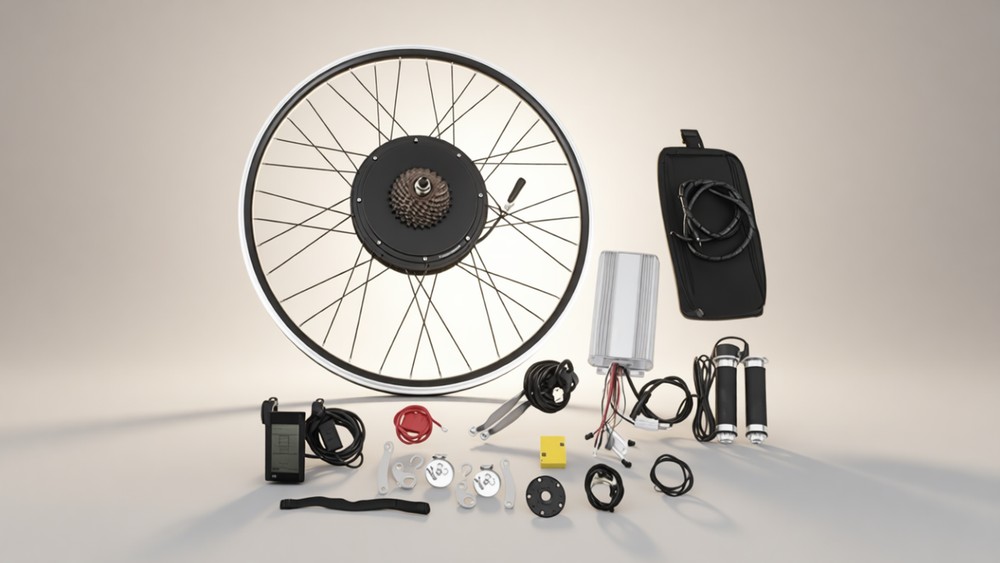
The parts list is the best thing about this listing, and it's worth reading in full because most listings in this band refuse to write one. The box names a pair of power-off brake handles, two torque arms, the 700c 48V 1500W rear motor wheel, a controller bag, the brushless controller, a pedal-assist boost sensor, an LCD display, a swing handle, cables, and an English manual.
Two torque arms in the box is the standout line. A torque arm clamps the axle to the dropout so the motor's reaction torque cannot work itself loose, and on a rear hub pulling 1500W it is treated as required hardware rather than an accessory.
Most kit listings in this tier never mention them, and the owner record of our DDYOOK 28-inch kit review treats fitting one as a lesson learned the hard way. This listing includes a pair by name, which is the single strongest trust signal on the page.
The rest of the spec table cannot say the same. Rim Width reads 9.53 inches, which no bicycle rim is.
Wheel Backspacing and Rim Size 13 inches are car-wheel rows pasted onto a bicycle kit. The Manufacturer Part Number field holds the phrase "Brushless Gearless Motor" instead of a part number. The Maximum Weight Recommendation of 331 pounds is a round 150 kilograms run through a converter and rounded up, an artifact rather than a tested figure.
And the warranty row is a bare slash. Whatever protection exists lives in the marketplace's return window, not in a printed term, so the durability bet you are making is on the gearless design itself. Direct drive is the durable layout, with no internal gear cluster to strip, at the cost of a heavier wheel and drag when you pedal unpowered (Wikipedia).
1500 Watts, 31 Amps, and a Speed Claim With No rpm
The electrical sizing is left entirely to the buyer, so here it is. A 1500W motor at 48V draws about 31 amps at full rating, and the controller has to be rated above that. Your battery's BMS needs to sit above the controller, not merely above the motor, because a hard launch pulls the controller's ceiling, not the motor's rating.
So the practical pack is 48V with a BMS rated for 35 to 40A continuous. You can browse 48V ebike batteries on Amazon and filter by continuous discharge, which is the figure that matters here.
The speed claim reads 58-60km/h with no rpm figure anywhere on the page. The arithmetic bounds it anyway.
A 622mm wheel with a road tire rolls about 2.0m per turn, so 58 to 60km/h needs roughly 480 to 500rpm, which sits inside the no-load band of the 500rpm-class motors sold all over this tier. The claim is plausible and unverifiable from the listing, and real riding speed lands well below any no-load ceiling. No rider has published a measurement.
The "5 Speed Gears" bullet belongs to the same family of loose words. A gearless hub has no gears to shift, so the five levels are controller assist settings, which is fine as a feature and wrong as a name.
The bullet's "Dual Drive" paragraph, which describes switching drive "by turning the handlebars" and claims electric drives will replace human ones, is translationese that should be read as marketing static rather than instructions.
Buy it for the 622mm road build, nothing else
The decision this listing forces is narrower than its title. If your bike takes a 700C, 28, or 29-inch rear wheel, you want a powerful fair-weather hub, and you value a complete box list with torque arms included, it's a coherent offer at a middle-of-the-road price per watt in our table. It's no bargain, and the record does nothing to lower the risk you are carrying.
You are also accepting three things. A record whose only substance is the wheel complaint this article just decoded. A warranty row that says nothing.
And a spec table so full of pasted car-wheel rows that its genuine rows, the parts list chief among them, have to be read with extra care.
If the 1500W rating is more than your use case needs, the same brand's 20-inch 1000W front hub kit covers the small-wheel corner of the market with the same complete-parts-list habit. And for the same pasted-speed-figure story on a different wheel, the Goshet 48V 1500W review covers a 26-inch fat-tire kit carrying the identical 500rpm and 29.82mph pair.
What would change this verdict is simple. One owner account with an install report and a month of riding would give this kit the durability signal its record lacks. Until one appears, the parts list is the evidence, and the parts list is good.
FAQ: the 622mm wheel, the fat-tire words and the pack you pair
Will the Lidhujnk kit fit a 24-inch bike?
No. The rim is a 622mm bead-seat wheel, the size the industry also calls 700C, 28 inch, or 29 inch.
A 24-inch BMX rim measures 507mm at the bead seat, and no fork or frame built for one accepts the other. The July owner hit exactly this: they expected 24 inches, measured about 29, and the listing's own rows confirm the 622mm wheel. Measure your rim's diameter before ordering.
Is it really a fat tire kit?
No. The title says fat tire, but the parts list names a 700c motor wheel and no spec row, photo, or bullet describes a 4-inch tire. Treat the fat-tire words as recycled copy and the 622mm road rim as the real wheel.
What battery should I pair with it?
A 48V pack whose BMS is rated for 35 to 40A continuous. The motor draws about 31 amps at its 1500W rating, the controller must be rated above that, and the pack's BMS must sit above the controller for hard launches. The battery doesn't ship with the kit.
How fast does it really go?
The listing claims 58-60km/h with no rpm figure. The arithmetic on a 622mm wheel puts that at roughly 480 to 500rpm, which is inside the normal no-load band for a 48V hub, so the claim is plausible. Real riding speed sits below any no-load figure, and no rider has published a measurement on this kit.