The Lidhujnk 20" x 48V 1000W conversion kit from amazon (link) offers a good option for those wanting serious electric-assist while using a small-frame, folding bike.
If you'd like additional background information regarding other options and how they compare to each other, please check out our ebike conversion kit comparison table or our article "electric bicycles" on Wikipedia.
Specifications and Build Quality
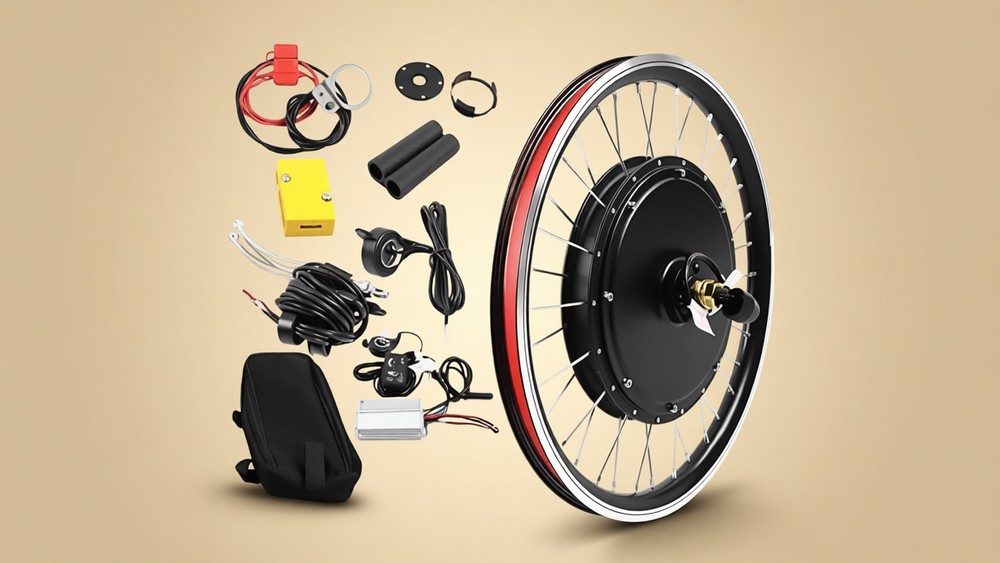
The Lidhujnk contains a 48V 1000W brushless DC hub motor with a toothed-belt drive. The motor mounts directly onto a 20" wheel. No tires are provided. The controller is a 30a rated controller - far above the rating of many low-cost Front-hub kits that provide only 15a to 20A ratings. The kit also comes with an SW-810 LED display, thumb throttle, five-position PAS sensor and power cut-off brakes.
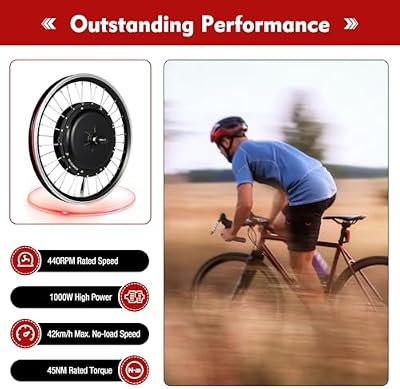
That 30a controller dictates the maximum amount of current (peak amps) delivered to the motor. Lower torque from the motor is preferred for Front-hubs as excessive torque increases the chance of spin-out and subsequent loss of directional control. this kit provides far greater torque delivery than a typical entry-level Front hub kit. However, the design is intended to increase performance. the kit available on amazon is one of the more aggressive Front-hub kits offered today. The product listing states that the top speed is approximately 50 km/h or 31 mph with a suitable 48-volt battery. Actual results may vary depending upon rider's weight and terrain.
The package includes: motor wheel, controller, PAS sensor, electronic brake levers, thumb throttle, LED display, waterproof wire, and a case to hold the controller. All connections are made via color-coded lead wires that require manual identification. The motor body is constructed from aluminum with a toothed belt pulley. The controller resides in a small aluminum heat-sink enclosure. The display is a simple LED bar graph, not an LCD screen. Although the selection of parts is adequate for the cost of the kit, the non-waterproof nature of the kit restricts operation to dry conditions only.
Spin-out Risks Associated with Front Hubs
When you apply torque to a Front-hub motor, all that torque is applied to the very center of the wheel. When you have a long fork and significant weight under the Front-end of your bike, there isn't usually enough force being generated to cause issues with spin-out. However, when you combine a small wheel with instant torque generation from a high-torque Front-hub motor (such as the Lidhujnk), you create a perfect storm for spin-out - especially if you're running a narrow tire on your 20-inch wheel.
In reality, when you experience a spin-out situation while using a Front-hub system, the Front wheel separates from the rest of the bike and continues spinning faster than the bike itself. As soon as this occurs, you lose steering ability and your bike begins wandering uncontrollably. In some cases, you might be able to recover from such a spin-out in dry weather. However, as soon as you venture into wet weather conditions, loose surfaces, sandy trails, etc., the chances of recovering quickly from a spin-out dramatically decrease.
Another issue related to applying torque to a Front-hub system concerns fork strength. As we've previously discussed, most smaller wheel forks (especially those found on folding bicycles) utilize quick-release style axles instead of through-axles. Through-axles provide added structural support by having two heavy-duty nuts clamp the fork legs together and resisting torsion during hard acceleration. Quick releases, by contrast, rely solely on a relatively light and slender skewer to keep everything aligned properly - it simply doesn't offer anywhere near the same resistance to twisting forces as a through-axe would.
The Lidhujnk lists the fork spacing as roughly 100 mm. However, it doesn't specify whether it utilizes quick-release or through-axes. If your fork uses a quick-release style axle, then i strongly recommend adding torque arms. Torque arms are metal brackets that attach from the axle back to the drop-outs and help prevent the motor from twisting the fork legs excessively during hard acceleration.
While rear hub kits represent the majority of conversion kits sold today due to their advantage over Front hubs in terms of supporting greater amounts of torque at heavier weights (as well as offering a wider contact patch with more traction prior to losing traction) putting 1000 watts through the Front of your bike represents a much more complex task than attempting to convert a rear wheel. If you wish to know more about how rear hub conversions compare to Front hub conversions across various metrics, check out our ebike conversion kit comparison table.
Installing Yourthis Kit & Color Coded Wiring Caution
Installation entails removing your original Front wheel. Attaching the motor wheel into 100mm fork spacing. Connecting your controller to your motor. Display. Throttle. Brake levers. PAS sensor. And finally connecting a compatible 48-volt battery. Additionally, the listing specifically cautions against incorrectly wiring your controller as mismatched wiring could result in destroying your controller. These controllers do not protect themselves against reverse polarity on either your motor phase wires or your battery inputs. Get it wrong just once and your controller is dead.
Fork spacing is roughly 100mm - similar to most 20-inch frames/folding bikes. Disc brakes/v-breaks supported. No tires included. You'll need to purchase a tire that matches your rim width and can accommodate the motor housing.
Brake lever power cut off disconnects motor power upon application of brake. PAS sensor mounts near fork dropout detects rotation via magnet ring provides five assist levels. The SW-810 display shows speed/battery level/assist level via LEDs. The throttle provides independent pedal-free input to motor.
Waterproofing is nonexistent. While some connectors may be waterproofed, the controller is not waterproofed. Listing explicitly advises against riding in rainy conditions. If you regularly ride in rainy conditions, this kit is not suited for you.
For Whom Should You Consider Purchasing the Kit?
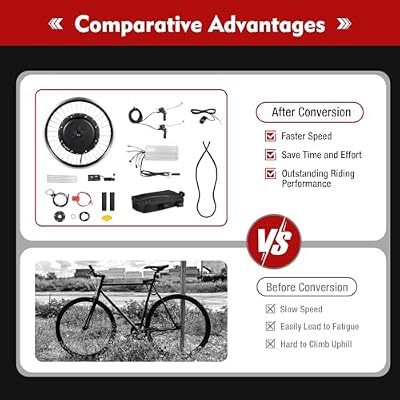
Primarily designed for riders with small frame/folding frames who desire serious electric-assistance but cannot accommodate a rear-hub kit due to frame size constraints. Has ample torque output for city rides on dry pavement. Features an integrated PAS sensor & display making it a fully-functional assisting kit (not strictly throttle-based).
Works best for dry-climate riders/tinkerers who appreciate matching connectors/wiring carefully prior to turning power on. Best suited for riders utilizing compact builds where rear hub kits would fail due to geometric limitations in frame design.
Not recommended for wet commuters/riders - this kit is not water-resistant. Riding through puddles will damage multiple components. Also not recommended for loose terrain - the color-coded wiring must be handled carefully. If this seems like too much hassle for you, consider checking our gomotorbikes blog where we cover multiple kits that have easier-to-install hardware.
Carefully manage your installation. Run torque arms. Ride dry pavements...and you will have a reliable Front hub conversion for smaller wheels.
Frequently Asked Questions
Can This Kit Fit My 20-inch Fork?
The kit states that it can accommodate fork spacings of approximately 100mm. Check your fork spacing before purchasing, wider or narrower and it won't fit. Supports both V-brake and disc brake setups.
What Type of Battery Should I Use W/ This Kit?
You need a 48-volt battery. None provided in kit. The battery connector must match the controller input wires and produce sufficient current output for a 30-a controller. A 48V / 13Ah battery will limit range. Using a 48V / 20Ah+ battery will provide longer usage time.
Is a Front Hub Better Than a Rear Hub on Smaller Wheels?
No. Generally speaking, rear hubs are superior on smaller wheels due to increased weight-bearing capacity and larger contact patches providing greater traction prior to spin-out. Smaller wheels generally have less overall grip - so if possible choose rear hub kits first.
Is the Lidhujnk Water Resistant?
No. While some connectors are sealed, the controller is not water resistant. Listing clearly states do not ride in rainy conditions. If you commute regularly in wet conditions this kit is not suited to your riding style.
How Fast Does It Really Go?
Listing claims approximately 50 km/h or 31 mph. That is theory based upon lightweight rider flat ground and high-current-sustaining battery. Actual results will vary based upon rider's weight tire type and terrain - expect slightly lower speeds than listed value.
See where it lands in our ebike conversion kit comparison table, or read more in the GoMotorbikes blog. Basics: electric bicycle fundamentals.