A 1500W rear hub kit is the kind of purchase you make once and then live with, because it forces the rest of the build to fit around it. The battery decides whether the motor ever delivers what the title promises, and the controller decides whether the battery survives the pairing. That is the part listings like this one leave out.
Liffshsy's 26-inch fat tyre kit promised a lot on paper: a gearless 1500W rear hub, an LCD display, a 55 km/h top speed. It never printed the one number that would let you check any of it, the controller's amp rating. Then it sold through two ratings that could not disagree more, and now the listing is gone.
What is left is the record, and the record is worth reading. One buyer's controller failed and took two batteries with it. Below: what the kit actually contained, what the failure tells you about pairing a 1500W hub with a pack, and what to check before you buy any kit in this class today.
The verdict first, because the listing can no longer speak for itself. As a hardware bundle the Liffshsy 26 inch 1500W fat tyre kit read well: a gearless 1500W rear hub for 26-inch fat wheels, an LCD meter that showed fault codes alongside speed, mileage and voltage, and a box list that covered the wheel, controller, display, brake handle and wiring.
But the record ends badly. One of its two ratings is a written account of a controller that failed and destroyed two packs, and the listing never printed the amp rating that would have let a buyer pair a battery safely. Treat it as a design whose idea was right and whose paperwork was not.
What the kit actually contained
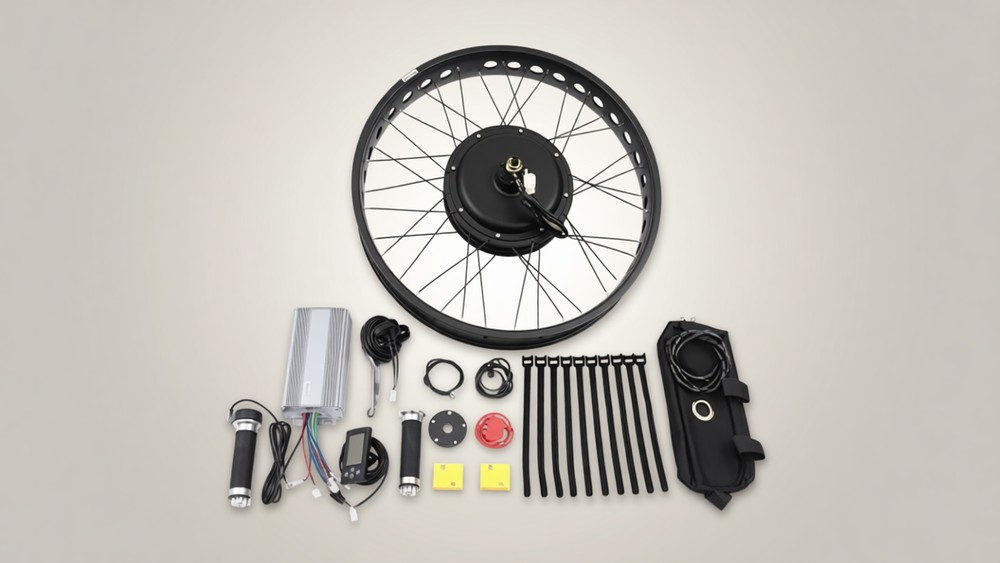
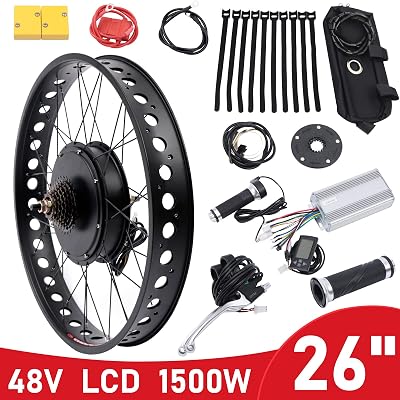
The recorded specification is short because the listing made it short. A 1500W brushless gearless hub motor laced into a 26-inch fat tyre wheel, built for a 48V battery the kit does not include. The details table lists aluminum, iron, copper and magnet steel as the motor's materials and gives the wheel size as 26 inches.
The box list has six entries: the rear motor wheel, the controller, the LCD meter, a brake handle, two wiring boxes and a part the listing names only as a turner.
Gearless is the meaningful word there. A direct-drive hub has no internal gears to strip, so it survives abuse that chews up geared hubs, and it runs quietly because nothing meshes inside. The trade is weight and drag: a gearless hub is heavier, and it resists the wheel when you pedal without power.
On a fat bike built for sand and snow, most riders accept both, because the motor's weight lands directly over the tyre that is already doing the traction work.
The LCD meter is the part worth naming. It displays fault codes, speed, mileage and voltage, with a five-speed booster and a fixed-speed cruise mode.
Voltage display matters more on a big hub than a small one, because a 1500W motor pulls a weak pack down fast enough that the gauge is your only early warning. A kit without a voltage readout leaves you guessing until the BMS cuts in.
One rating said yes, one wrote the review
The rating record is two ratings, split 51 percent five-star and 49 percent one-star. That is one buyer on each side, and only one of them wrote anything.
The written review is a purchase-badged account from September 2026, and it describes a controller failure with a cost attached.
The owner reports that the faulty controller supplied with the kit blew two new batteries, about 400 in losses, and that pictures were sent to the seller. After three weeks of generic replies, the offer that came back was 20 back, with no replacement controller shipped. The same owner has noted the motor cannot run without one.
Two things sit inside that account. The first is the failure itself, a single controller that died hard enough to take two packs with it.
The second is the support path, three weeks of form letters for a part the kit cannot work without. Neither proves the design is bad, because one failure is one failure, but together they explain a 3.0 average on two ratings: the buyer who had no trouble rated the kit five stars and said nothing, and the buyer who did said everything.
The number the listing never printed
A 1500W motor at 48V draws about 31 amps at full output. That single line of arithmetic is why the missing controller rating matters more on this kit than on a 500W commuter hub, and the listing never printed it.
Here is how the pairing works. The battery's BMS sets the continuous current the pack will release, and the 25A and 30A boards dominate our battery table.
Pair this kit with a 25A pack and the motor's full draw exceeds the board's ceiling, so the BMS cuts output on hard climbs. That reads like a weak motor, but the motor is fine, the pack is protecting itself. Pair it with a 30A pack and the draw still sits a hair over the board's rating, which leaves nothing for the spikes a steep climb asks for.
The right pack for this motor is a high-discharge unit with headroom above 31 amps, and the only way to know you have one is the controller's amp rating, which this listing did not print.
The battery comparison table lists each pack's BMS rating in its spec box, which is the number to hold against any controller you are considering. A controller failure like the one on this record is rarer than a mismatched pairing, but a mismatch punishes you every ride instead of once.
Where a 1500W kit can legally ride
The title's claims put this kit outside the street-legal envelope in most of the United States, and the federal definition is the reason.
Under the Consumer Product Safety Act, a low-speed electric bicycle has fully operable pedals, a motor-only top speed under 20 mph and a motor under 750W. This kit claims 1500W, twice the cap, and a 55 km/h top speed, which works out to about 34 mph. Class 3 rules in the states that use them top out at 28 mph, six miles an hour under the claim.
That does not make the kit useless. It makes it an off-road build: private land, snow fields, sand, beach riding where local rules allow. Western Australia police seized and crushed more than 30 overpowered e-bikes in January 2026, which is a fair reminder that enforcement is real where you stand on it.
Check your own jurisdiction before you buy hardware in this power class, because the kit will not warn you.
Checking a replacement kit today
The listing is gone, so the practical question is what to demand from the next kit in this class. Four checks, in order of how much they cost you if you skip them.
Controller amps first. Ask for the controller's continuous amp rating before anything else, and hold it against your battery's BMS. The controller rating is the number that protects the pack, and any seller who will not print it is asking you to buy blind on the exact fault that ended this kit's one written review.
Connector second. Battery and controller must meet on the same plug, and adapters breed resistance.
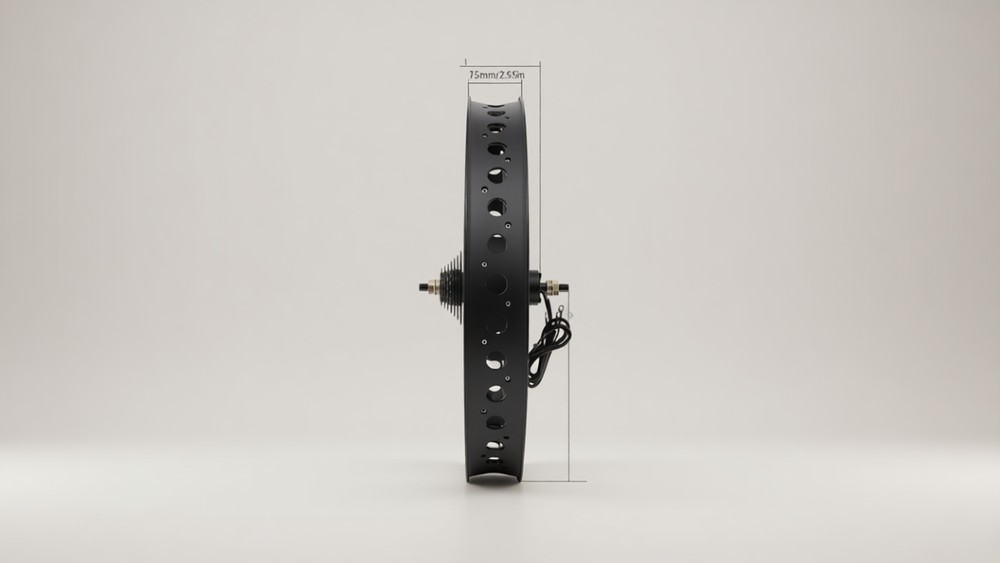
Wheel size third: a 26-inch fat wheel needs frame clearance for a four-inch tyre, and the motor's axle must match your dropout spacing. Battery last, from the conversion kit table side of the pairing rather than the motor's. The motor names what it wants, the pack decides what it gets.
Frequently asked questions
Did the kit include a battery?
No. The box list held the rear motor wheel, turner, controller, LCD meter, brake handle and two wiring boxes. No battery and no charger, which was normal for kits at this price and remains the buyer's problem to solve.
What battery should a 1500W hub be paired with?
One whose BMS clears the controller's continuous draw. At 48V this motor wants about 31 amps at full output, more than the 25A and 30A boards that dominate our table, so look for a high-discharge pack rated above 31 amps. The specs box on our battery table prints the BMS rating for every pack we track.
How fast does it go?
The listing claimed up to 55 km/h, about 34 mph, on motor power. Real speed depends on rider weight, tyre pressure and terrain. The claim also sits above the 28 mph class 3 street limit, so plan for off-road use.
Will it fit any 26-inch fat bike?
It fits 26-inch wheels with clearance for a fat tyre and a rear dropout spacing the axle matches. Frame clearance is the check people skip: measure the rear triangle before ordering any fat hub wheel.
Was the controller failure a common fault?
One written account exists and it describes one failure. Two ratings in total means the sample cannot say how common anything was. The honest read is that the failure happened, it was expensive for the buyer, and the seller's response was slow and small.