Anyone who has shopped for a 48V 20Ah silver fish replacement has probably noticed the same pack shape appearing under several brand names, with spec cards that look almost identical and claims that are hard to tell apart. LGNUO is one of those names, and its 20Ah listing is the one this article takes apart.
The LGNUO 48V 20Ah silver fish battery sells at 219.99, which works out to about 23 cents per watt-hour. That is a mid-pack price for the silver fish 20Ah class, but it sits above the other LGNUO-branded 20Ah shells we track, and the comparison table holds all of them with live prices.
There is also a wrinkle that shapes everything else here. LGNUO already sells a 48V 20Ah pack we have covered in full, from a different listing with a different connector, different measurements and a different motor band. This article walks the new listing on its own terms, checks its numbers against each other, and flags the one claim that fails its own arithmetic.
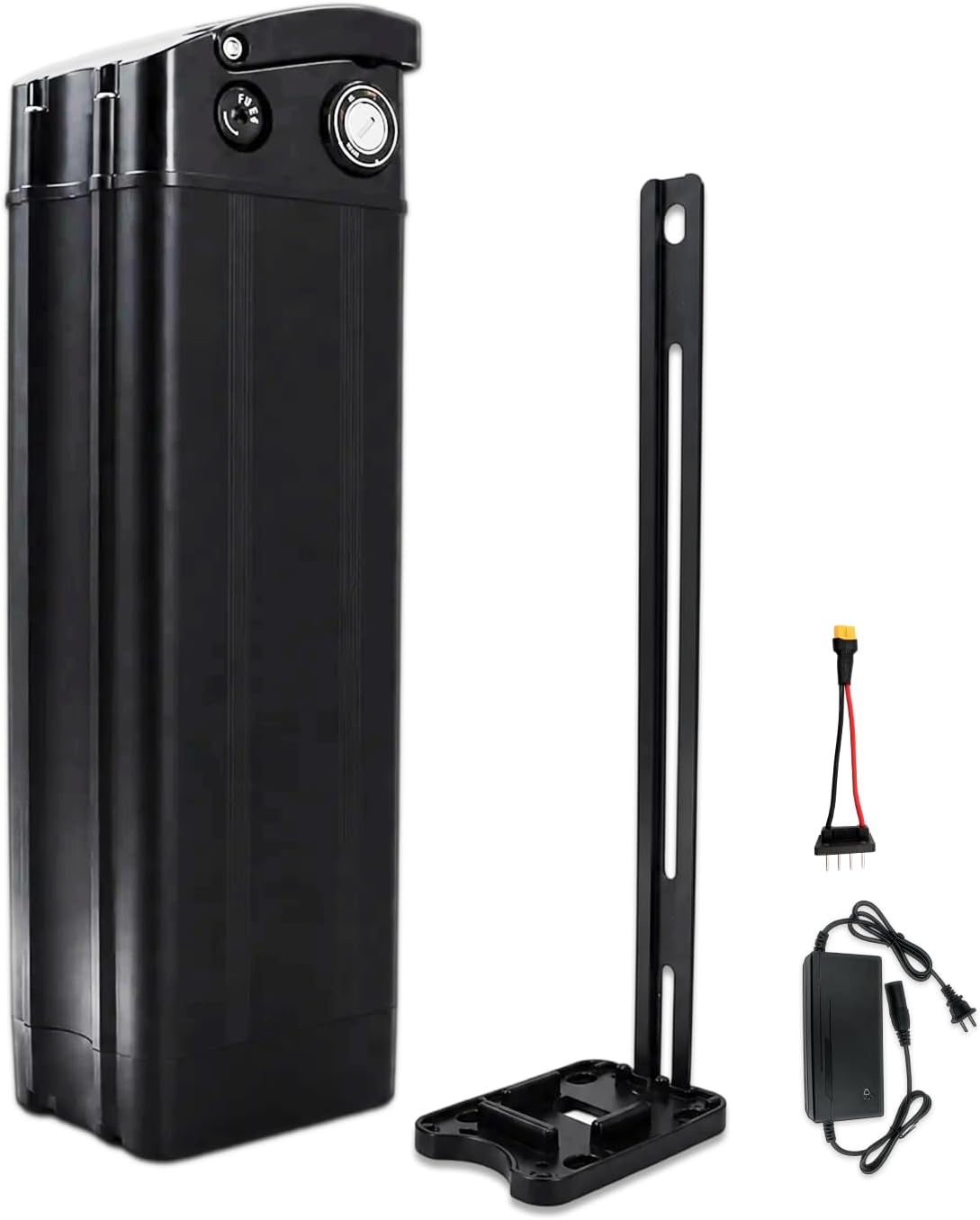
Two LGNUO packs with one name, and an empty record
Start with the record, because there isn't one. This listing carries no rating and no review of any kind. We checked the recent and helpful sorts of the reviews section while signed in, and both came back empty, so any star field rendered near the buy box is client-side decoration rather than evidence.
That makes this the ninth zero-record battery listing we have covered, and it puts the whole purchase on the listing's own claims. Those claims come from a parameter card that prints a 960 watt-hour energy figure, a 30A BMS, a 1000-plus cycle life, a 54.6V 2A charger and a 0-1500W motor band.
Now the twin question, because it matters for which page you should buy from. The covered LGNUO 48V 20Ah pack comes from the same manufacturer, Huizhou Hengcheng, but it is a different product.
The covered rung ships a T-plug with an XT60 adapter, measures 266 by 120 by 70 millimetres, weighs 8.38 pounds and claims 200 to 1000W motors. This one ships a 4-pin discharge connector, measures 392 by 76 by 115 millimetres, weighs 9.11 pounds and claims 0 to 1500W.
Different footprints, different plugs, different copy. They are two packs sharing a brand, not one pack sharing two pages, so we have covered each on its own terms.
The price gap says the same thing. The covered rung sells at 169.00, about 18 cents per watt-hour, which makes this listing about five cents per watt-hour dearer for a pack of the same voltage and capacity. If the covered rung's connector fits your bike, that is where the value sits.
A charge-time claim that fails its own arithmetic
The card prints a charge time of 6 to 7 hours, and this is the line that doesn't survive checking.
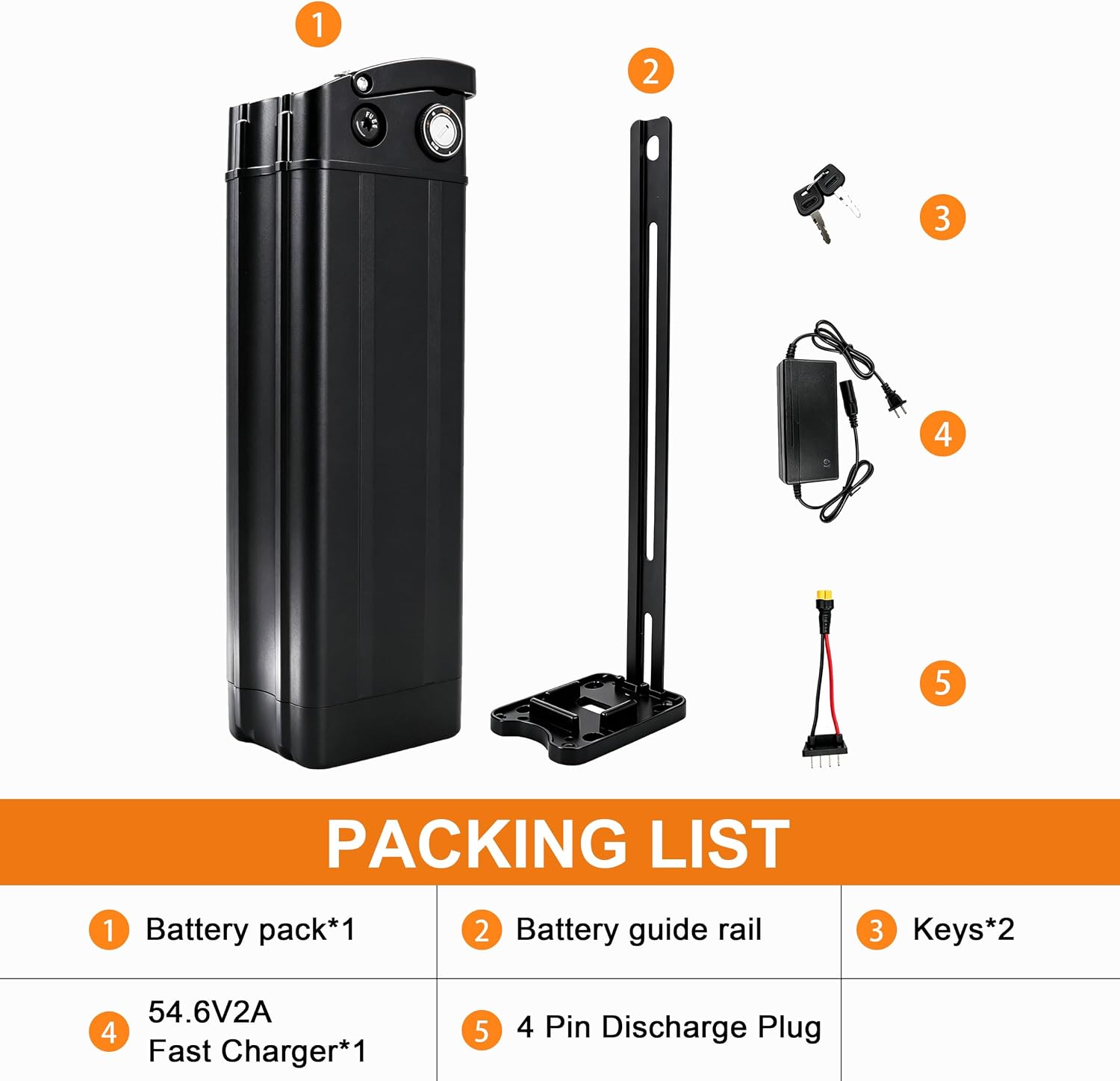
The shipped charger is 54.6V at 2 amps, which the card and the packing list agree on. A 20 amp-hour pack at 2 amps needs about 10 hours to fill before the taper at the top of the charge, and every lithium pack tapers. The printed claim sits three to four hours below the listing's own floor, and nothing on the page explains the difference.
The charge-socket card offers a hint of an excuse. It warns that the socket's current cannot exceed 5 amps, which means a faster 5-amp charger would be possible in principle. But the box ships 2 amps, so the honest expectation for a buyer is the 10-hour figure, and a full charge is probably an overnight job.
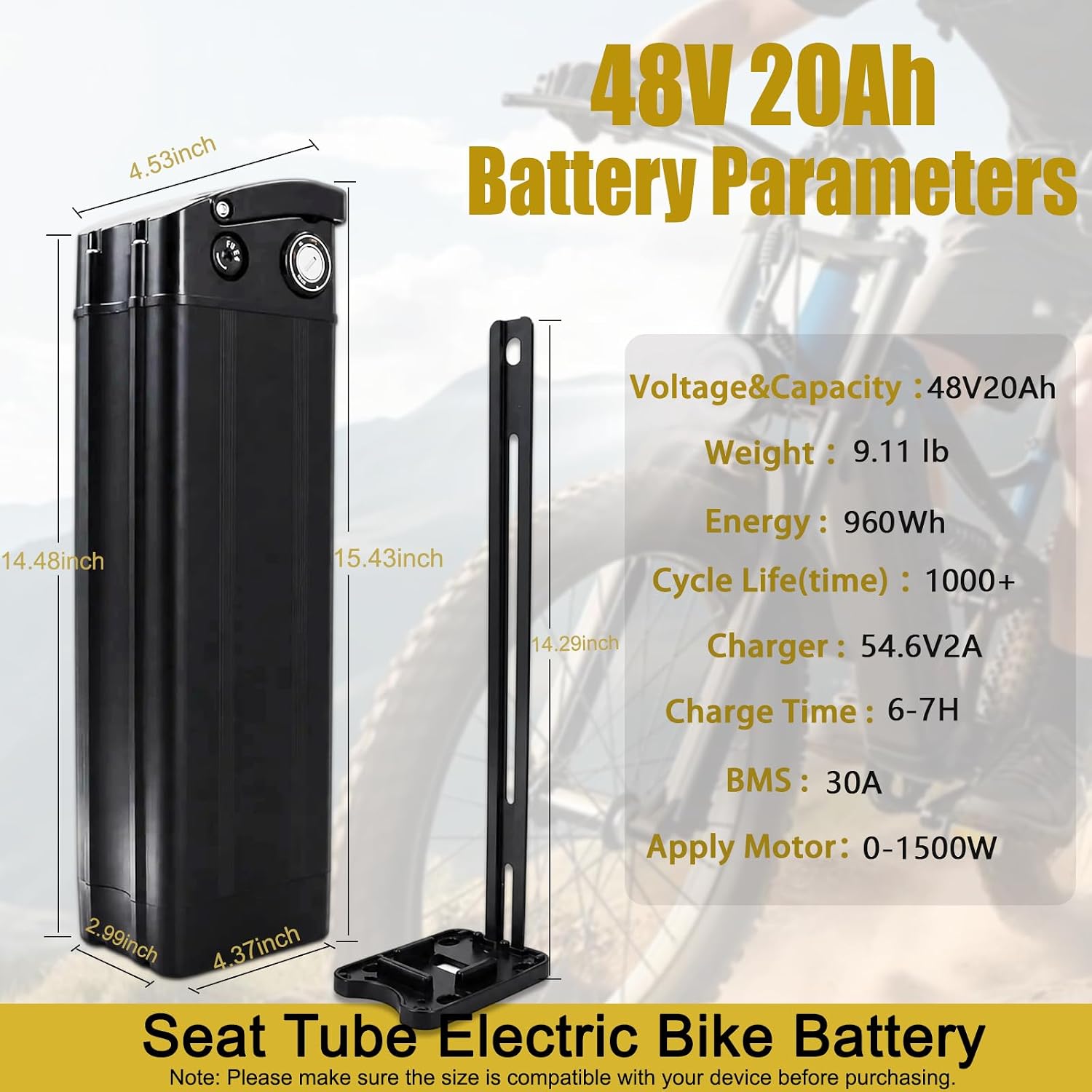
The same card carries the LED gauge decode, and it is unusually specific for this price class. Four blue lights mean 100 percent, three blue mean 75, two blue mean 50, and a single red light means 20. The card also notes that the pack ships partially charged from the factory, which is normal for lithium shipping rules and nothing to worry about.
If 10 hours to full is a dealbreaker, the covered LGNUO rung and the LZIXYM 20Ah shell sell at lower prices for the same capacity, and our full LZIXYM review covers that pack's own quirks.
What the 30A board actually allows
The title sells motors from 0W to 1500W, and the zero-watt floor is the usual marketing flourish. The 1500-watt ceiling is the part worth checking, because the listing's own numbers don't reach it.
A 30A BMS at 48 volts tops out at 1440 watts continuous. The title's top sits 60 watts above the board's own ceiling, so plan around 1440, not 1500. A 750W motor drawing hard sits near 15.6 amps, comfortably inside the board, and a 1000W motor sits at about 21 amps with room to spare.
The honest direction here is that the board has more headroom than most buyers need, not less.
The housing claim needs a footnote too. Bullet three calls the shell IP65-rated, and the IP code standard says that means dust protected and resistant to water jets, not dust-tight and not submersible. The first digit 5 is one grade below the 6 that means dust-tight.
The practical point is the charge socket, which the card shows as an exposed port on the pack's face. Spray from a wet road is within the rating. A pressure washer or a deep puddle is not, and no rating covers a socket left uncovered.
The 4-pin port, the weight, and how to buy blind
The 4-pin discharge connector is this listing's practical risk point, and the listing itself says so. The connector card shows red for positive and black for negative, then warns buyers to make sure their cable's polarity matches the battery's before ordering. That is the listing telling you, in its own words, that the plug is not universal.
So the buying method writes itself. First, photograph your old pack's connector and count its pins before you pay, because a 4-pin plug on a 5-pin bike is a return. Second, measure the cavity.
The printed footprint is 392 by 76 by 115 millimetres, and the bullet asks you to confirm compatibility first, which is the one instruction on the page worth following exactly.
Third, weigh the pack on arrival. The printed 9.11 pounds works out to about 4.13 kilograms, and 960 watt-hours at that weight is about 0.23 kilowatt-hours per kilogram at pack level. Mass-produced 18650 cells store roughly 0.16 to 0.30 kilowatt-hours per kilogram before any case, BMS or wiring, so a finished pack this light with this much claimed energy needs near-top-of-band cells with very little room left for the hardware.
Some packs we have covered print this reading and deliver it. Others don't. A kitchen scale is the cheapest test there is, and a pack landing well under 4 kilograms cannot contain what the card claims.
Then meter the first week. Full charge, a few short rides, and a watch on the four-light gauge against the range you actually get. At 960 watt-hours, a typical 20 to 25 watt-hours per mile puts the honest range expectation near 40 to 48 miles, and a pack that delivers half of that on the meter is telling you something the empty record cannot.
For context on the rest of the class, the LOCKBUS 20Ah USB shell sells at about 22 cents per watt-hour and our LOCKBUS USB review covers its own card in full. The comparison table sorts every 48V pack we track by price per watt-hour, which is the fastest way to see what this listing's 23 cents buys elsewhere.
Frequently asked questions
Is this the same battery as the other LGNUO 48V 20Ah listing?
No. Same brand and same factory, but the connector, the measurements, the weight and the motor band all differ, and the two listings carry different variant ladders. The covered rung ships a T-plug and claims 200 to 1000W motors at 169.00, and this one ships a 4-pin plug and claims 0 to 1500W at 219.99. Buy the one whose plug and footprint match your bike.
How long does a full charge actually take?
About 10 hours on the shipped 2-amp charger, before the taper. The card's 6 to 7 hour claim does not match the listing's own charger, so treat the 10-hour figure as the honest expectation and plan charging overnight.
Will the 4-pin connector fit my bike?
The listing won't answer that for you, and neither can we, because no owner has reported a successful fit yet. Photograph your old pack's plug, count the pins, and match the polarity the card shows before ordering. If your bike's discharge cable is not a 4-pin type, this pack needs an adapter the listing does not include.
Is an IP65 housing waterproof enough for rain?
For spray, yes. The IP65 rating covers dust in useful quantities and water jets, but it is not a submersion rating, and it is not dust-tight. Keep the charge socket covered when riding in wet weather and never aim a pressure washer at the pack.