A 20Ah pack in the Silver Fish format is unusual enough that it earns a look. Most packs in that bottle-shaped case stop at 13 or 15 amp-hours, and riders who need more range usually have to jump to a bulkier case or a different mounting system.
The catch is that this capacity comes from a listing with almost no history. When we checked in late October 2026, the LZIXYM 48V 20Ah carried six ratings and five written reviews, and only 14 were left in stock.
This article walks through what the record actually contains, where the price sits against the packs we track, and the two gaps a buyer has to fill in before ordering: the charger that doesn't ship, and the install work one owner describes that the listing says you won't need.
The LZIXYM 48V 20Ah silver fish battery is priced at 209.00, which works out to about 22 cents per watt-hour for the 960Wh the title describes. That is among the cheapest fifth of the 301 packs we track, and it's the strongest single fact about this listing. The record behind it is thin.
Six ratings is a small sample, every written review is five stars, and two of the five texts read like advertising copy rather than owner reports. If your bike already takes a Silver Fish pack and you verify the port and the fit first, the price makes the risk worth pricing in. Our battery comparison table shows where this pack sits against everything else.
What the LZIXYM 48V 20Ah is, and who it fits
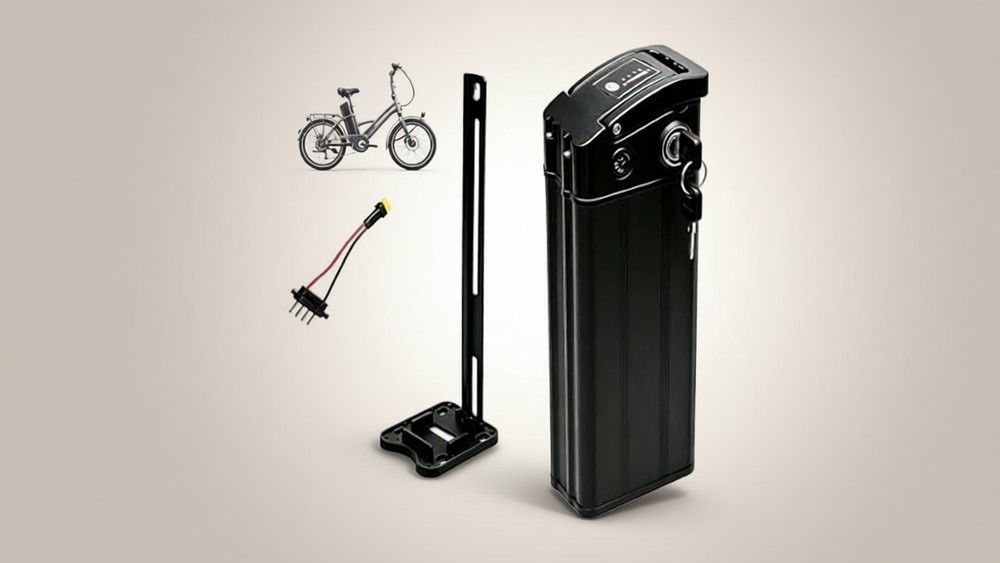
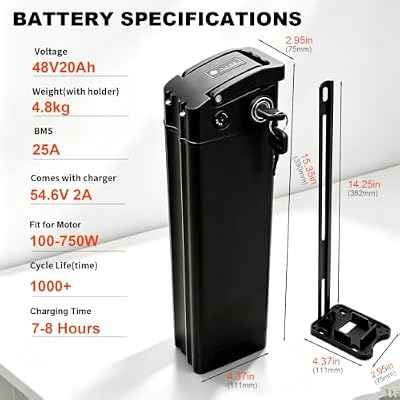
The pack is a Silver Fish case at 390 by 75 by 111 millimeters, which is the format that slides into a bracket behind the seat tube on a large share of budget ebikes and trikes. The title claims motors from 100W to 750W, and the first bullet repeats that with a controller-voltage check: the pack is for 48V controllers only.
The BMS passes 25 amps, according to the second bullet. That's 1,200 watts at 48 volts, so a 750W motor sits under the limit with room to spare.
The BMS rating appears only in a bullet. There's no spec-table row for it, which means the seller could revise the number without any table row changing, so confirm it in writing if your controller draws close to the limit.
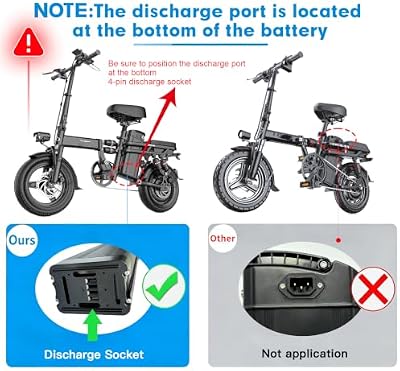
The compatibility gate is not the voltage or the connector. It's the discharge port.
The listing devotes an entire bullet to telling you the 4-pin port sits on the bottom of the battery, not the top, and asks you to verify port location before ordering. That's an honest warning, and it's also an admission that Silver Fish packs vary in exactly the way that produces returns. Check your old pack's port position and pin count before this one goes in the cart.
The rest of the kit is a battery holder, a manual and two keys. The pack has an LED charge indicator, a key lock and a carrying handle.
The price per watt-hour carries the case
Divide 209.00 by 960Wh and you get about 22 cents per watt-hour. Our comparison data tracks 301 batteries by that measure, and this pack lands in the cheapest fifth of all of them. The exact position renders in the specs box on our table, since the numbers move on every data refresh.
Capacity per dollar is the one claim on this page no review can take away, because it comes from the arithmetic rather than the record.
Two caveats keep the number honest. First, the listing doesn't name its cells, so you don't know what's inside the case. The spec row for battery cell composition literally reads Other Than Listed.
Second, price per watt-hour says nothing about how long the pack keeps that capacity, and with six ratings nobody has owned one long enough to say.
A six-rating record with an ad-shaped pair in it
The rating math is odd from the start. The page prints a 76 percent five-star and 24 percent four-star split, which doesn't reconcile to six ratings, and the histogram shows no three, two or one-star band at all. We quote those numbers as printed.
What we can count directly is the text record: five written reviews, all five stars, three carrying a purchase badge and two that don't.
The two without badges are the problem. Both landed the same day in late August, and both read like marketing. One thanks the seller for fast shipping and clear communication without saying anything about the battery. The other restates the listing's own port-location warning almost word for word and praises the listing's images for being clear. Neither mentions a specific bike, a range figure or a problem solved.
The three badged texts carry everything worth knowing. Two are trike conversions, which makes sense given the port-warning bullet. One owner reports about 50 percent more range than the 13Ah pack on their Narrak S180 trike, and the arithmetic backs them: 20 amp-hours against 13 is roughly 54 percent more capacity. Another fits it to an Ancheer trike and reports a few more amps than the original battery. The third text is a one-liner that adds nothing either way.
So the honest read is this: the three purchase-badged owners are happy, nobody has reported a fault, and the praise pool has been padded with two texts that would look the same whether the pack worked or not.
The install the record describes is not the install the bullet promises
The deepest owner account in the record is also the one that contradicts the listing. The fourth bullet says the battery is easy to install and can be set up quickly without the need for rewiring. The Narrak owner's account describes soldering, wire connecting, reversing the positive and negative leads on their old battery's base plate, and doing work on the new pack's base plate to make it fit.
None of that is a complaint. The owner finished the job, kept the old Narrak battery as a spare, and reports the arrangement as giving them 150 percent more range than they started with. It's the most useful text on the page.
But it establishes that plug-and-play is not guaranteed, even between packs in the same format class.
The lesson generalizes beyond this seller. Silver Fish cases share a shape, not a standard. Bracket heights, wire lead positions and port locations all vary, and the listing's own port bullet concedes as much. If your replacement needs to drop in without touching a wire, buy a pack marketed for your exact bike. If you can solder or know someone who can, the format flexibility is worth real range, and this owner's trike build is the proof.
What the listing leaves out, and the four checks before you order
The packing list names a battery, a holder, a manual and two keys. There's no charger in it, and no charger appears anywhere in the bullets either. Some sellers in this band ship one anyway, but the page makes no promise, so treat the charger as a separate purchase until the box proves otherwise.
That pushes the charger math onto the buyer. A 48V pack is 13 cells in series, and lithium-ion cells charge to 4.2 volts each, so the correct charger is labeled 54.6V output.
A 36V charger stops at 42 volts and leaves the pack undercharged, which reads as short range rather than as a fault. A 52V charger pushes toward 58.8 volts, which no buyer wants near a 13-cell pack. Get the output voltage in writing before ordering.
Range depends on capacity, terrain, rider input and assist level, so no single mileage figure fits every build. As labeled arithmetic rather than a promise: at a typical assist-heavy 15 watt-hours per mile, 960Wh works out to about 60 miles, and gentle pedaling stretches that while full-throttle riding cuts it roughly in half.
The weight rows disagree with each other. The bullet says 10.6 pounds for the pack, and the spec table's battery-weight row says 7 pounds. The likely explanation is that the rows measure different things, but the page never says which. The model number is FP4820R0-097, and the manufacturer of record is Dongguan Yizhan Electronics Technology, a name that also appears behind the LGNUO packs we track. A one-year warranty row is the only durability promise on the page, and with a record this young, no owner has tested it.
This pack makes sense for one buyer: someone whose bike or trike already runs a Silver Fish battery, who wants meaningfully more range, and who can handle a fitting job that might involve a soldering iron. The price per watt-hour is close to the best we track, the 25A board covers a 750W motor, and the three purchase-badged owners all report success.
Before ordering, run the four checks the record can't do for you. Match the 4-pin bottom port against your old pack. Match the 390 by 75 by 111 millimeter case against your bracket. Confirm the 54.6V charger, since the box doesn't ship one. And get the BMS amperage confirmed in writing if your controller draws anywhere near 25 amps.
Everyone else should pay slightly more per watt-hour for a pack with a longer record and a named cell supplier. The comparison table sorts the alternatives, and the zero-record Yasco 48V 13Ah shows what the thin end of this market looks like when the price isn't there to justify the risk.
Frequently Asked Questions
Does the LZIXYM 48V 20Ah include a charger?
Not according to the packing list, which names the battery, a holder, a manual and two keys. No bullet mentions one either. Some sellers add a charger without listing it, but you should plan on buying a 54.6V-output charger unless the seller confirms otherwise in writing.
Will it fit my bike?
It fits anything that takes a Silver Fish case near 390 by 75 by 111 millimeters with a bottom-mounted 4-pin discharge port and a 48V controller. The listing itself tells you to verify the port location before ordering, because top-ported and bottom-ported packs both exist in this format.
Is 25 amps enough BMS for my motor?
For a 750W motor on 48 volts, yes. A 750W motor draws about 15 to 16 amps continuous at full load, which sits well under a 25A board. High-current builds above 1,000 watts need a bigger board, and the listing caps its claim at 750W anyway.
Can I trust a battery with only six ratings?
The three purchase-badged reviews are consistent and the range report matches the capacity arithmetic, which is about as good as a small record gets. But six ratings can't speak to how the pack ages, and two of the five texts read like promotion. Buy it for the price with your eyes open, not because the record proves reliability.