A tired 36V pack is the moment most people meet this market. Your old battery cuts off under load, the charger light goes green in twenty minutes, and you start comparing rectangular 36V replacements at prices that all look too similar to trust.
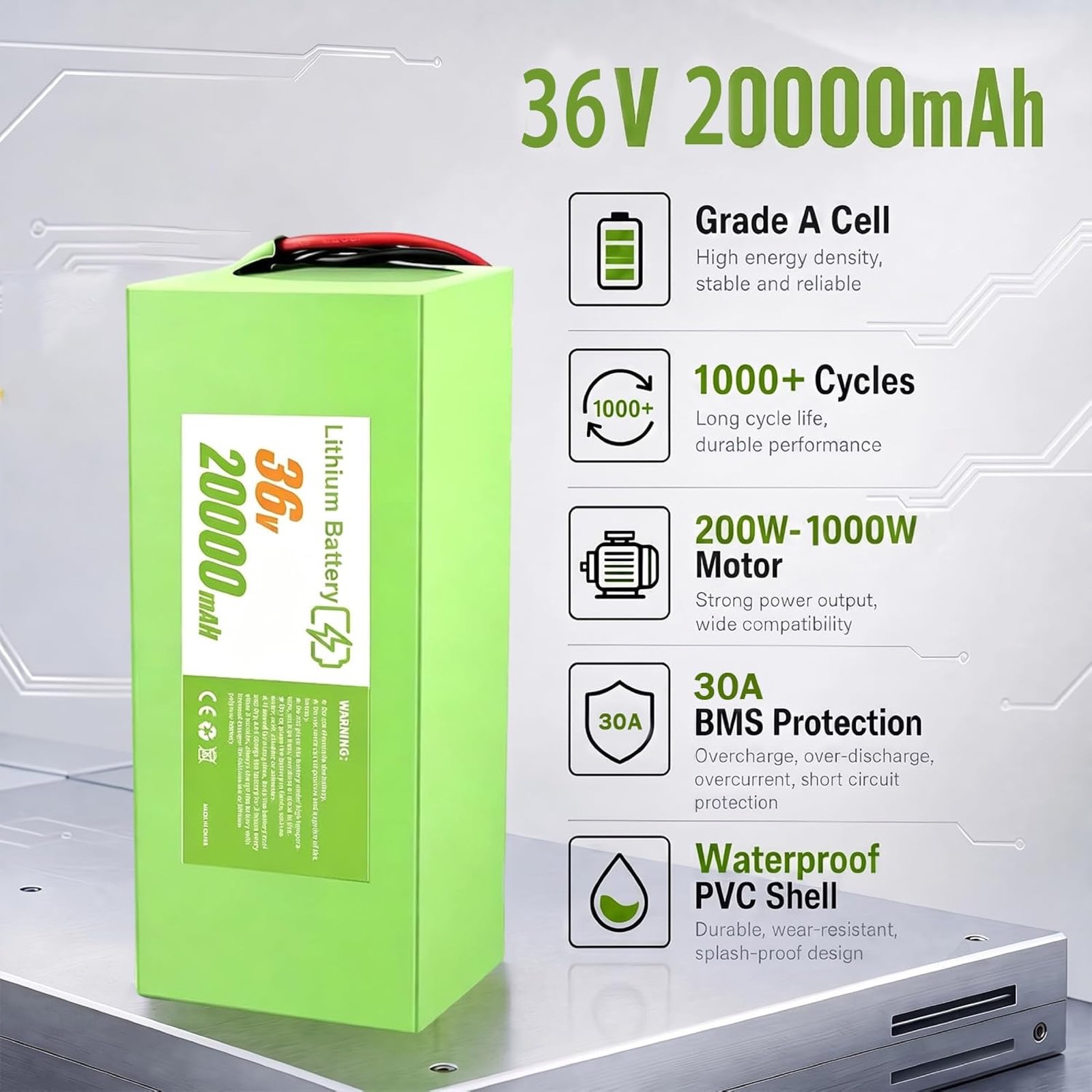
The LGNUO 36V 20Ah pack sits in that pile with a green case, a 42V charger in the box, and a price that reads like a typo in your favor.
It is also a listing that argues with itself in the first paragraph of its own bullets. The title promises a 30A BMS.
The bullet heading repeats 30A. The sentence right after it says 40A. That is not a spec you can look up, it is a choice the seller has to make, and this page has not made it.
This review walks through what the price buys, what the contradictions mean for you, and how to check the two claims that decide whether this pack is a bargain or a disappointment.
What the price buys you
At 149.00 for a claimed 720 watt-hours, this works out to about 21 cents per watt-hour. That is the cheapest fifth of the 324 packs in our ebike battery comparison table, and the exact position renders in the specs box on that table if you want the live number.
For a 36V pack, that price is genuinely good. The older LGNUO 36V 20Ah listing we reviewed was priced at 179.00 when we rebuilt it, and it carried the same factory's template disease, selling one pack under two voltages. This listing lands 30 under it with a page that at least agrees it is a 36-volt product. If the capacity is real, the value case closes itself.
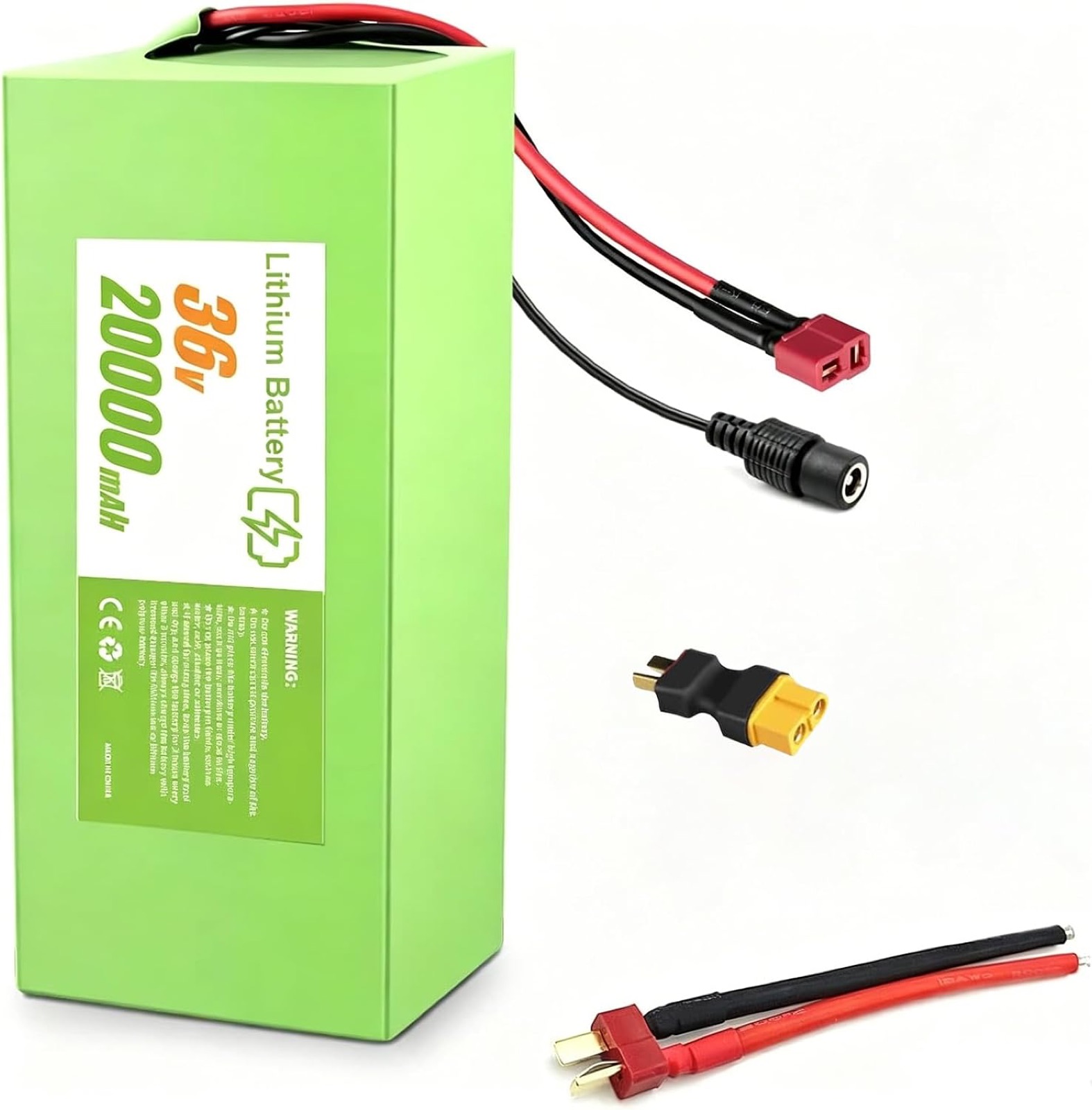
The box is more complete than most in this bracket. You get the pack, an XT60 extension cord, a 42V 2A charger, and a manual, plus a one-year warranty row. Sellers at this price often ship the pack alone, so the included charger and cord are worth real money and save you a compatibility hunt.
The stock counter read only 12 left when we checked, and the listing carries a 5.0 star figure from a single rating. Neither fact tells you much on its own. Together they say this is a young listing, and young listings are where the weigh-and-meter advice in this review matters most.
The record is one wordless rating
Everything on this page is the seller talking. The rating count stands at one, that rating carries no text, and the written review pool was not readable at publish time, so there are no owner accounts to weigh and no way to know whether any exist. I want to be plain about that, because it changes how you should read every claim below.
With no owner record, three things are unknowable from the page. Nobody has confirmed the pack delivers 20 amp-hours on a meter. Nobody has posted a range figure you could compare against your own riding.
And nobody has reported how the pack behaves in month six, which is where budget cells usually show what they are.
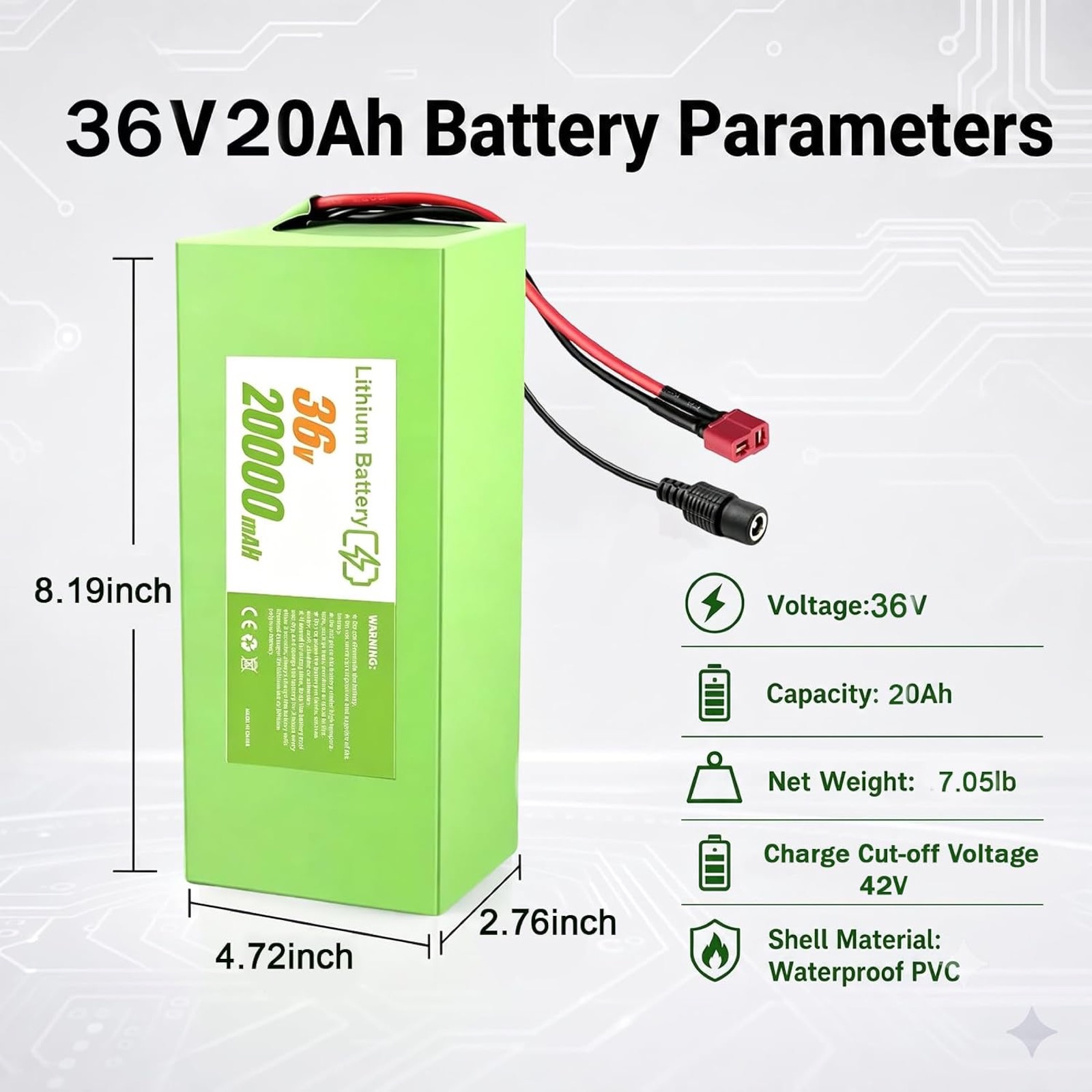
What you get instead is the listing's internal consistency, and that is checkable. The dimensions agree everywhere, 8.19 by 4.72 by 2.76 inches in the bullet and on the parameter card. The 42V charge cutoff is printed twice and matches the charger in the box.
The motor range, 200 to 1000 watts, appears in both the bullet and the card.
So the record gives you a consistent page with no independent signal. The price is the compensation for that, and the return window is where you actually learn the truth.
Three weights and two BMS numbers
The weight story is the one worth your attention. The bullet and the parameter card both say 7.05 pounds, which is 3.2 kilograms.
The spec table row says 5 kilograms, which is 11 pounds. Somebody printed a number nobody checked, and the two readings imply different batteries.
Standard lithium-ion cells hold between 0.16 and 0.30 kilowatt-hours per kilogram, so 720 watt-hours needs about 2.4 to 4.5 kilograms of bare cells before the case, the BMS board and the wiring weigh anything at all.
At 3.2 kilograms total, this pack has room for mid-band cells and packaging, but it sits close to the top of the plausible range and leaves very little slack. At 5 kilograms, the math closes easily with ordinary cells and room to spare.
The same arithmetic flagged the Sinigerel pack earlier this month, and that listing had a written record behind it. This one does not, so the weigh-on-arrival advice carries the full load.
Weigh the pack when it lands. If it comes in near 3.2 kilograms, the cells are dense and the claim is at least coherent. If it comes in near 5 kilograms, the row was right and the bullet was marketing.
Either way, meter a full charge if you own a meter, and do both inside the return window.
The BMS contradiction is less dangerous than it looks, but you should still understand it. A 30A board on a 36V bus raises a ceiling of 1,080 watts.
A 40A board raises it to 1,440 watts. The motor claim tops out at 1000 watts, which draws about 28 amps at full load, so either number covers the advertised use with room to spare. The contradiction is a listing-quality signal, not a safety gap, and the practical difference only shows up if you push the pack past what the page promises.
The model number says 48V
Here is the strangest line on the page. The spec table prints a model number of 48V20Ah, on a pack whose title, bullets, voltage row, charger and parameter card all say 36 volts. Nothing on the page resolves it.
The manufacturer row explains the pattern without excusing it. Huizhou Hengcheng Electronic Technology builds this pack, and it is the same factory behind the LGNUO 48V 20Ah pack with the 40A board we reviewed this week and its Zlvwem twin. A factory that sells both voltages copies listing templates across them, and the model number is the copy-paste scar.
That matters to you in one specific way. If you order this pack expecting 48 volts because a spec string said so, you will get a 36-volt battery that cannot reach a 48V system's low-voltage cutoff and will cut power early.
The page is right everywhere that counts, the charger is 42V and the voltage row says 36, but check your system's voltage before you order, because the listing itself gave you one reason to doubt it.
One more template trace is worth naming. The gallery card showing the PVC insulating layer and shock mounts is the same image file that appears in a 52V 30Ah RANSYRI listing we scraped the same day.
Two brands, one card. It does not prove the packs share cells, but it tells you how much of these pages is boilerplate.
Charging, and what waterproof actually means here
The charging story is honest and slow. The included charger runs 42 volts at 2 amps, and 42 is exactly 10 cells at 4.2 volts, a correct 10S figure for a 36V pack.
Two amps into 20 amp-hours is a 10-hour floor from empty, so plan on charging overnight. There is no fast-charge option and no charge-time claim printed, which at least means nothing to disbelieve.
The connector is XT60, and the extension cord in the box is a quiet benefit, because it lets you mount the pack where the connector reaches rather than where the wire allows. Measure or photograph your bike's discharge port before ordering anyway, since XT60 is common on DIY builds and conversions and less common on brand-name bikes.
The waterproof story needs a careful read. The bullet says the hard shell prevents direct contact with water. The card says waterproof PVC shell.
The card also says splash-proof design. Those are three different promises, and none of them carries an IP code, which is the only version of the claim you can actually check. Read the strongest word as marketing and the weakest word as the design intent, and keep the pack out of puddles regardless.
The 1,000-cycle claim gets the same skepticism. Budget sellers print cycle figures at the top of the range lithium-ion chemistry can deliver under gentle lab conditions, and real pack life runs shorter with full-depth discharges and fast charging. Read it as a ceiling, not a promise, especially on a pack with one rating behind it.
Frequently Asked Questions
How far will the LGNUO 36V 20Ah actually go?
Range is arithmetic once you pick a consumption figure, and assist level, terrain and rider weight drive consumption far more than the pack does.
At about 20 watt-hours per mile, typical for throttle-heavy riding, 720 watt-hours is near 36 miles. Gentle pedal assist can stretch that toward 45 miles at 16 watt-hours per mile, and full throttle on a heavy bike at 30 lands near 24. Those figures assume the full 20 amp-hours, which nobody has metered yet, so treat them as the ceiling.
Will it fit my bike?
It fits systems that want a 36V pack with an XT60 discharge connector and a case measuring 8.19 by 4.72 by 2.76 inches. The listing names electric scooters, bikes and outdoor equipment rather than specific bike brands, so fitment is on you. Check the connector and the bay size before ordering.
Is the BMS 30A or 40A?
The page says both, and there is no way to resolve it from the listing. Either number covers the advertised 1000-watt ceiling, so the practical risk is low, but if your controller draws close to the pack's limits, ask the seller which board ships before you buy.
What warranty comes with it?
The listing carries a one-year warranty and a 24-7 support claim. Test the pack hard inside Amazon's return window regardless, because in this price bracket the return window is the stronger protection, and a pack with no owner record has no reputation to fall back on.
Who should skip this pack?
Skip it if you need an owner record, a documented safety file, or a fast charger. The comparison table has packs with deeper records at higher prices, and our latest ebike reviews cover the rest of the budget field. Buy this one if the price is the point, your system is definitely 36 volts, and you are set up to weigh and meter a pack on arrival.