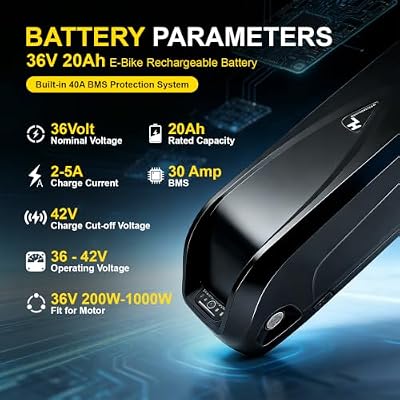
A 720-watt-hour pack for 179.00 sits close to the middle of everything we track on price per watt-hour, and that's honest value for a battery with no name on it. I like the arithmetic here. What I don't like is a page that can't decide what voltage its own pack runs, and a buyer record that amounts to one rating with no words attached.
That combination asks more care than a cheap pack usually gets. When a listing contradicts itself on the one spec that decides whether the pack works with your bike at all, you check the details before you order, not after the return window has closed.
This review sorts the page's own numbers against each other, because with zero owner reviews the listing is all the evidence there is. I'll also give you the checks that settle the questions the page leaves open, and most of them take nothing more than a kitchen scale and a look at a charger label. That's a cheap insurance policy, and I'll take it every time.
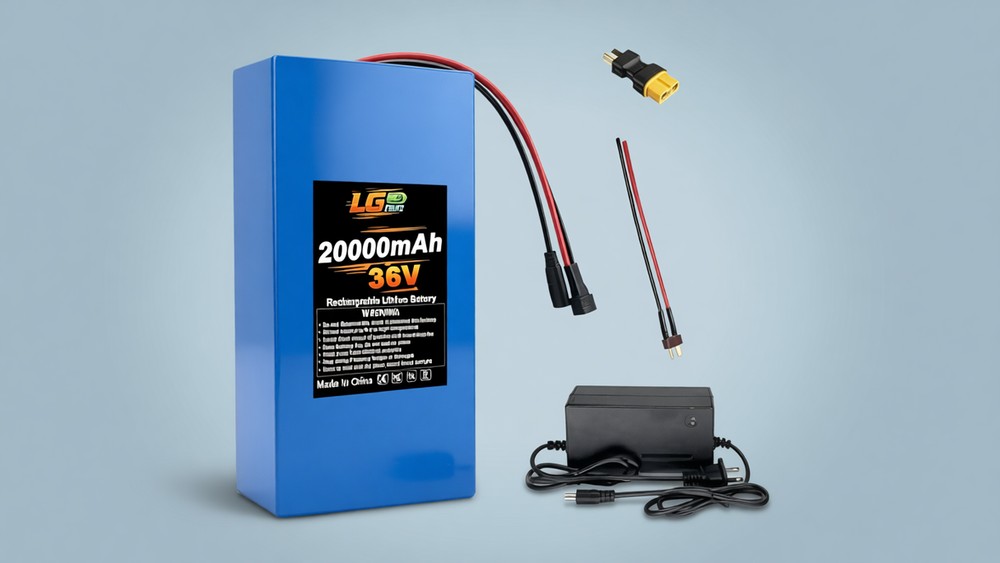
One pack, two voltages, and the charger that settles it
The title and the spec table agree with each other, and they hold their line from start to finish. Both say 36 volts and 20 amp-hours, which multiplies out to 720Wh, and the spec table repeats the 36 volts in a line of its own. So far, so normal.
Then the bullets start calling it a 48V battery. Bullet 1 promises compact and lightweight 48V lithium batteries, bullet 2 pins the 48V name to the 30A BMS inside, and bullet 4 stretches it across a motor range of 200W to 2200W. Bullet 5 swings back and calls the product the 36V 20Ah battery pack, and that same bullet holds the detail that ends the argument, because the included charger is specified at 42V output.
A lithium-ion cell full-charges at 4.2 volts, so ten of them in series read 42V at full, which is exactly what a 36V pack is. A 48V pack carries thirteen cells in series and needs 54.6V to fill. The charger figure matches the title and the spec table, so the 48V copy in the bullets is a listing error, and the pack on the LGNUO listing should be planned around as a 36V pack. That's the test I'd run first, before the money leaves your account.
One more string is worth a look. The model number runs EB-S1/FP4813R0, and the digits in the middle, 48 and 13, fit neither a 36V 20Ah pack nor the 48V 20Ah the bullets describe. My read is a part number inherited from a different model rather than a hidden spec, but it fits the pattern of a listing assembled from leftovers.
What the spec sheet promises, and what it can't deliver
The 30A BMS is the strongest claim on the page, and it carries real arithmetic with it. Thirty amps at 36 volts is about 1080W of continuous discharge on a fresh pack, which covers most 36V commuter motors with room to spare.
It doesn't cover the top of the motor range in bullet 4. Pulling 2200W from a 36V pack takes about 61 amps, more than twice what the stated BMS allows, so the pack would cut out long before any 2200W motor showed its nameplate. Match your motor to the BMS and treat the 2200W figure as noise, because the bottom of the range at 200W gives the pack no trouble at all.
The cycle claim has the same problem in a different shape. Bullet 2 promises 1000 deep cycles of long life expectancy, and Battery University's BU-808 puts consumer lithium-ion at 300 to 500 cycles before capacity drops to about 80 percent. Throttle-heavy riding burns cycles faster than the gentle use those long-life claims assume. The warranty that would test any of this runs one year, and 300 daily full cycles is about ten months of hard use, so the window barely covers the pessimistic end.
The case is called waterproof in bullet 3, and that's the whole claim. No IP rating appears anywhere on the page, so the word carries no test behind it. On a pack that lives outside the frame in the rain, I'd treat waterproof as describing a covered box, not a sealed one, and I wouldn't point a pressure washer at it either.

Three weights on one page
Bullet 1 gives the weight two ways at once. It says 9.2 pounds, and then it says 4.2 kilograms in the same line, and those two figures don't agree, because 4.2 kilograms converts to 9.3 pounds.
The spec table makes it three. Its battery weight line says 4 kg, which is 8.8 pounds, so one pack now carries 9.2, 9.3 and 8.8 pounds depending on where you look. None of the three matters much in practice, but a listing that can't repeat its own weight is a listing you should verify on arrival, and a kitchen scale settles it in ten seconds. That's the whole test, and it's free.
The dimensions are the one measurement that agrees with itself. The 14.5 by 3.54 by 4.5 inches in bullet 1 converts cleanly to the 36.8 by 9 by 11.4 centimeters printed next to it, so measure your mounting space with confidence on those numbers.
The weight matters for more than shipping. Take the pack's 720 watt-hours, which is 36 volts times 20 amp-hours, and divide by the stated 4.2kg. That puts the pack at about 171 Wh/kg versus a cell-level band of 160 to 300 Wh/kg that Wikipedia's lithium-ion figures give, and a complete pack with a case, BMS and wiring always lands below its cells. A 171 pack-level figure asks a lot of the cells inside, and if the true weight turns out to be the spec table's 4 kg, the number climbs further. It isn't impossible with modern high-energy cells, but it's the kind of claim that a scale on arrival can confirm or deflate.
One rating, no words, and what that leaves standing
The buyer record is as thin as it gets. One rating, five stars, no text, no photo, nothing. The histogram reads 100 percent five-star because one person out of one gave it five stars, and that's a very different thing from a proven pack.
Nothing in the record speaks to range in practice, cycle life on a real bike, how the BMS behaves on a long climb, whether the USB port actually charges a phone, or whether the safe lock deters anything. Every performance statement you can read about this pack is the seller's own. I don't hold that against the pack, because every product starts at zero, but I do hold it against any purchase made in a hurry. You've got nothing to lose by waiting a month to see whether more ratings show up.
The listing itself hints at the stakes. It shows only 20 left in stock, and the pack sits 686th in its Amazon subcategory, which is the profile of a slow-moving listing rather than a proven seller. Buying one puts you near the front of the line of people actually testing it, and as I see it that's part of what you're paying for.
Range arithmetic, since the listing gives none
The seller claims no mileage anywhere on the page, and I count that as a small honesty point in a category full of invented numbers. It leaves the work to you, so here's the work.
Divide the pack's 720 watt-hours by what your bike actually drinks. A full-throttle pace on a heavy bike runs near 20 watt-hours per mile, and 720 divided by 20 is about 36 miles. A light pedal-assist pace drops the draw to somewhere between 10 and 13 Wh/mi, and that same 720Wh stretches to roughly 55 to 72 miles. Wikipedia's electric bicycle article puts the real-world band for the whole category at 25 to 75 miles depending on assist level, terrain and how much you pedal, and this pack's numbers land inside it.
The honest use of those figures is on your own last ride, not on a bullet. If you know your bike drank 15 watt-hours per mile on your commute, this pack is a 48-mile pack for you. I'd rather you trust your own log than any bullet on any page, and our battery comparison table sorts the alternatives by the same arithmetic if 720Wh turns out to be the wrong size for your frame.
FAQ: the 42V charger that settles the voltage, the motor the BMS stops at 1080 watts and the cycle claim to distrust
Is it a 36V or a 48V battery?
Plan on 36V. The title, the spec table and the 42V charger all agree on it, and a 42V full charge is what a ten-cell 36V pack reads. If a pack ever arrives with a charger labeled 54.6V, that's a 48V pack, and it doesn't belong on a 36V bike.
Can it run a 1500W or 2000W motor?
The 30A BMS tops out near 1080W continuous at 36 volts, so no. A motor beyond that will trip the BMS long before it reaches its own rating. This pack pairs sensibly with motors up to about 1000W, and I wouldn't go past that on the listing's word.
Is it waterproof?
The word appears in a bullet and no IP rating backs it anywhere on the page. I'd treat the case as rain-resistant at best, keep the charge port out of streams, and think twice about the pack on a ride where water is the point.
Will it really last 1000 cycles?
Consumer lithium-ion cells manage 300 to 500 cycles to 80 percent capacity per Battery University, and the warranty window is one year. Plan on the low end, and treat 1000 as marketing arithmetic.
What is the value like?
At 179.00 for 720Wh, the pack costs about 25 cents per watt-hour, which lands close to the middle of the 301 packs we track. The live figure renders in the specs box beside this review, and the comparison table holds the whole field. The price is real. The evidence behind the pack isn't, not yet, so check the weight and the charger label before the return window closes, and buy it here only after both checks pass.