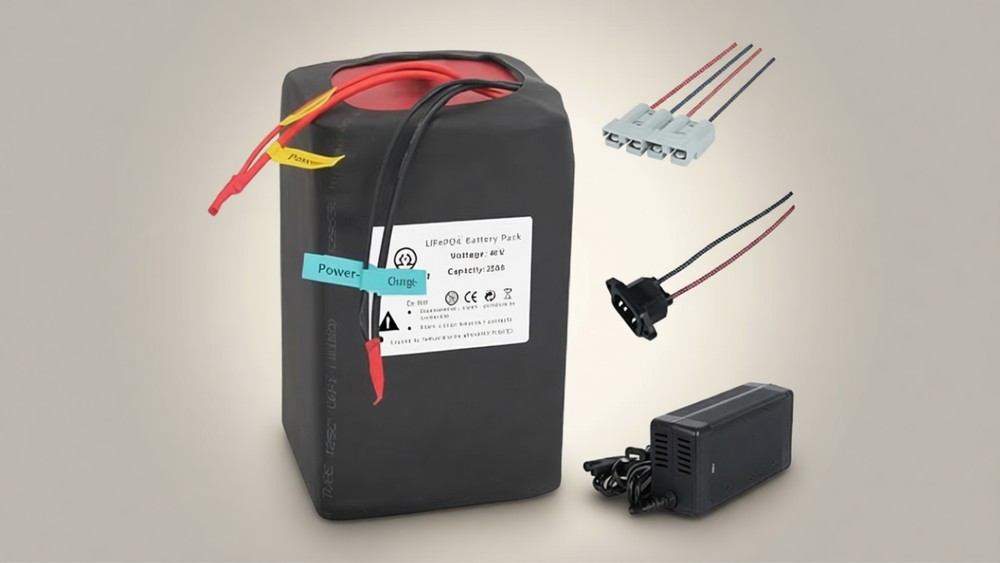
This LFPNERYE 48V 25Ah battery is a major gamble for riders that require a large capacity LiFePO4 cell without paying the premium price tag. You receive lots of energy, but the unproven track record of the brand creates uncertainty and a risk for serious commuters. Compare the raw specifications to the uncertain quality prior to investing your money.
Specifications and Chemistry of the Cells
The battery utilizes Lithium Iron Phosphate (LiFePO4) chemistry. This chemistry is fundamentally different from the lithium-ion chemistry that exists in the majority of all other cheaper ebikes. The main benefit of LiFePO4 chemistry is its stability. Lithium iron phosphate cells are much less likely to burn up if they're stressed.
Cycle life is claimed to be between 3,000 to 5,000 cycles. If this claim is true, the battery would last for many years beyond a normal lithium-ion pack. Unfortunately, since this brand is new to the platform, no one has independently validated those numbers. As mentioned previously, LiFePO4 is typically more heat-stable. Therefore, there's less of a danger of thermal runaway occurring due to excessive usage.
For those that worry about battery fires, LiFePO4 is safer. While you'll sacrifice some energy density for safety and longevity of internal parts, the increased safety margin of LiFePO4 is appealing.
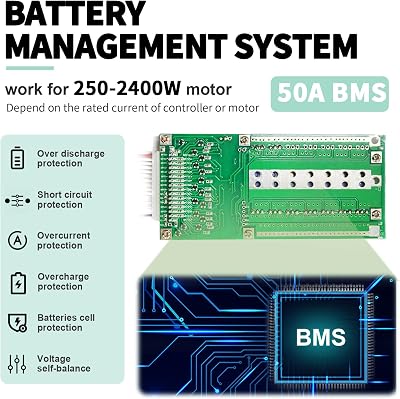
The battery management system (BMS) has a 50 amp rating for managing current flow. This helps regulate how much current can leave the pack at once. Typically speaking, most mid-drive motors and smaller hub motors stay under the 50-amp limit. However, if you attempt to run a high-powered motor that exceeds 50 amps consistently, the BMS will probably disable itself to protect the individual cells.
Therefore, your maximum power output on extremely steep hills or during rapid acceleration will be limited by the BMS. Make sure you verify the peak amperage of your motor before purchasing and installing this unit.
In addition to regulating current flow, the internal circuitry of the BMS acts as the brain of the pack. It regulates every cell to maintain a safe voltage range while you are using it.
Weight, Installation, and Fitment Options
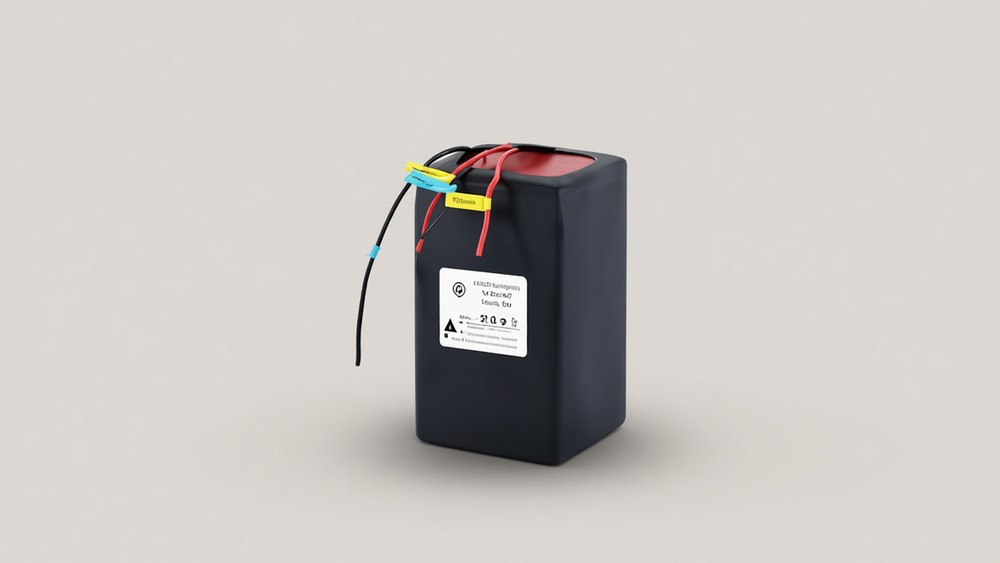
Due to their density compared to lithium-ion cells, LiFePO4 cells tend to be substantially heavier than lithium-ion cells. As such, a 25Ah pack made from LiFePO4 cells will be relatively heavy. Excessive weight causes reduced cornering ability for your bike. If you decide to install this on a rear rack, your bike may become unstable or wobbly. Installing this on the downtube tends to provide better balance and keep your center of gravity as low as possible. Although you will gain added longevity and safety through the increased weight, there is a price paid for these features.
Physically, the dimensions of this unit are slightly larger than units utilizing lithium-ion cells to account for the increased density of LiFePO4 cells.
The exterior casing is constructed from what appears to be regular ABS plastic. The three-terminal discharge connectors are industry-standard and should connect directly into most ebike controllers. Verify that your existing ebike controller uses the same type of connector as this pack before purchase. If it uses another type of connector, you will have to create custom wiring or splices in order to make them compatible.
Although the description indicates that a charger is included with the unit, we recommend verifying compatibility of the charger with your ebike controller and/or BMS before ordering. Furthermore, although the manufacturer claims that this charger matches the voltage requirements for LiFePO4 cells, do not assume that a Li-ion charger can safely match these voltage requirements. LiFePO4 cells require their own specific voltage ceilings.
Due to its size and weight, you may want to add additional padding around this unit to reduce vibrations caused by road irregularities. Vibrations will cause wear on internal electrical connections as well as potentially damage your ebike controller.
Energy Storage Calculation
To determine your usable range with 1200Wh of storage space available per charge, simply divide the storage space (in Wh) by your average wattage usage. At a very light 20W draw while coasting, the pack would technically run for 60 hours. In reality, most riders pull anywhere from 250W to 500W depending on terrain and assist level. Based upon these two extremes of usage, your range will vary from approximately 2 to 4 hours of active riding time per charge.
As mentioned previously, this unit provides a lot of energy storage space allowing you to travel considerably farther than a unit with either 500Wh or 700Wh capacity.
However, for long distance tour riding (i.e., >100 miles per day), the high capacity offered by this unit (1200Wh) is beneficial. You are essentially buying protection against running out of juice mid-day on a long ride, since you will have plenty of energy stored in your pack.
While you will certainly lose some speed and possibly some comfort with the added weight of this unit compared to lighter alternatives, this is often worth it for the assurance that you can ride long distances without having to stop frequently to recharge.
What Other Riders Have Said About this Product on Amazon
There is very little review history for this pack yet, and the early reviews are too sparse to say anything about long-term reliability. Read whatever reviews exist carefully and know your return window before you order. If the pack arrives damaged or will not hold a charge, start the return immediately.
Who Would Benefit from Buying this Unit
If you value both durability and safety above the weight penalty associated with them, then you should seriously consider this unit for your daily commute. Additionally, if you plan on doing extended tours and require large amounts of energy storage in a compact format (albeit a bit heavy) then this unit should also be considered.
Don't buy this unit if you need extreme speed or if you are trying to save weight for mountain biking. The weight penalty associated with LiFePO4 cells will severely impact performance in both areas.
If you like using established brands that have a reliable reputation for producing quality products that perform well over time rather than taking a risk on a new company entering the market for the first time, please continue looking elsewhere. Buying it means weighing the strong spec sheet against a brand with no track record.
You can check the current listing on Amazon before you commit.
Frequently Asked Questions
Does LFPNERYE come with a charger?
Yes. According to the seller, a charger compatible with LiFePO4 voltages is included with this pack. Please do not swap your old charger with one originally designed for a Li-ion pack because charging profiles differ and LiFePO4 cannot exceed certain voltage ceilings.
Can I run this on my 52V controller?
No. This is a 48V nominal pack. A 52V controller expects a higher voltage range, so the BMS may cut out or the controller may fault. Match the controller voltage to the pack before you order.
How far will I be able to ride?
Based on calculations alone (and assuming average usage), approximately 1200Wh storage equates to 40 to 70 miles of range (assuming moderate terrain, rider weight etc.). However, aggressive riders with high torque settings (or hills) can easily consume their entire battery reserve in an hour or less.
Will my motor be restricted by the 50 Amp BMS?
Yes. Your motor may not produce more than 50 amps continuously as per BMS regulation. Most hub motors/mid-drivers produce less than 50 amps continuous max load regardless of terrain (flat ground or otherwise). If your controller produces greater than 50 amps continually at full-load conditions (for example: during rapid acceleration uphill) then your motor will be throttled back by the BMS to protect each individual cell.
Are LiFePO4 really safer?
As stated previously, LiFePO4 chemistry exhibits improved thermal stability characteristics relative to Li-ion cells commonly used in most entry-level packs thus reducing potential fire hazards when subjected to stress.
Full spec rows live in the battery comparison table, and more guides are in the blog.