Shopping this shelf feels like comparing five products, and that's the trap. Five listings sell a 36V 10Ah pack at 119.00 apiece under three brand names, and four of the five print the same manufacturer on their detail pages: Guangdong TianChi New Energy Technology. Same size, same weight, same 30A board, same charger. Our comparison table lists them as separate rows because they are separate listings, but you're really choosing between five storefronts standing in front of one product.
The LFPNERYE 36V 10Ah battery is the listing worth reading, because it's the only one of the five with a record: 62 ratings and 33 written accounts stretching back two years. The other four carry 14, 9, 2 and 1 ratings respectively, samples too small to mean anything. This article reads that two-year record in full, including the failure reports, and checks the numbers the title gets wrong.
Five storefronts, one factory
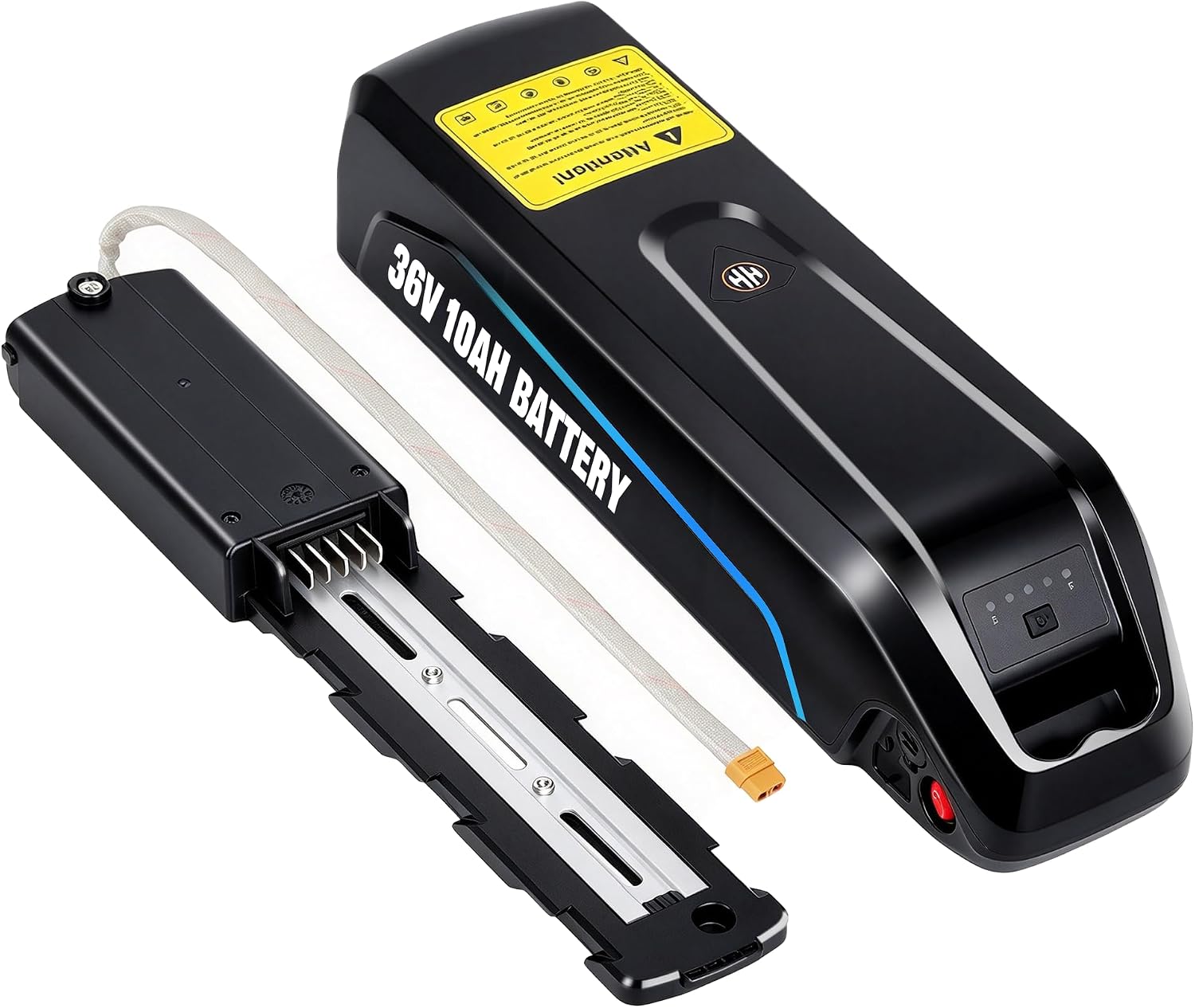
The evidence for the shared pack is on the pages themselves. The LGECOLFP listings and the second LFPNERYE listing all name Guangdong TianChi New Energy as manufacturer, and the fifth prints the brand name in that row instead. All five print the same size, 367.5 by 95 by 89 millimeters. The same 6.4-pound weight, the same 30A board, the same 42V 3A charger. The same XT60 discharge pair, the same 5-pin base with mounting plate, the same USB port and key lock. The same 12-month warranty behind each, with return windows of three months on most and 30 days on one.
All five sell at the same 119.00 price, which lands below the middle of the packs in our comparison table on price per watt-hour.
The variant ladders cross-reference each other too, with 5-pin, USB and XT60 variants at 36V, 48V and 52V shared across the storefronts. The 48V rungs of this same brand family are already on our site: the LFPNERYE 48V 15Ah review and the 48V 20Ah LiFePO4 review cover bigger siblings of this pack. The pattern is common on Amazon: the brand on the buy box is a marketing layer, and the factory behind it sells the same hardware to whoever will list it.
What that means for a buyer is that the differences that matter are the ones the buy box cannot show. Service, stock, and the record. A 4.8-from-9 rating on a sibling listing is nine people's experience of this same pack. The 4.3 average on this listing, drawn from 62 ratings over two years, is the closest thing this pack has to an honest score.
Two years of record
The positives concentrate where you'd want them. The most helpful five-star account, from May 2024, describes an easy install, pedal-assist use at up to 30 MPH, and a thirty-mile ride with no loss of power. A 750W Rambo owner from August 2024 turned to this pack after the original battery died and the brand's replacement quote ran far past what this pack costs. They call it far more cost effective. A May 2024 buyer praises the mounting-plate connection as secure where a previous brand's pack had to be returned, and likes that the power switch is separate from the key lock.
The recent history holds up too. A September 2026 owner reports the pack as a perfect replacement that restored range on a bike whose original battery had slowed down. Support stories appear with specifics: one owner describes the company offering a half refund to keep a pack with a dead LED bar, and taking it, and a four-star account mentions a letter from the company in the box plus a noisy charger and missing screws. Whatever else is true here, the service line is real and dated.
One long account needs careful handling. An August 2025 buyer describes wiring this family's pack into a 48V bike, measuring 52 volts at the terminals, and chasing a voltage mismatch across two bikes. That text describes a 48V-class 15Ah rung of this ladder family, not the 36V 10Ah this listing sells, and yet the review sits on this page. That is how ladder families blur their own records, and it's a reason to check which rung you are actually ordering.
Two failure clusters
Four written one-star accounts exist, all verified, and they split cleanly in two.
The electrical pair is recent. An August 2026 owner reports a pack that stopped taking a charge, with capacity readings that disagreed between the bike's display and the battery's own gauge. A May 2026 owner describes shutdowns during rides on a pack that showed sufficient charge, and says the experience ended their trust in it. Two electrical failures inside 2026, out of 33 written accounts, is a real signal but not a pattern of collapse, and the two-year span of working packs around them matters.
The fitment pair is older and more instructive. A May 2024 owner reports that the listed dimensions don't include the cradle or base, found the pack would not fit either mount on their bike, and calls it non-returnable. A March 2024 owner bought two and found them incompatible with their bike. The listing's own parameter card supports the first complaint: it prints a weight of 6.59 pounds with holder against the bullet's 6.4 pounds bare, which tells you the printed size is the bare pack and the mounting hardware adds more.
The listing never prints a with-holder size, so measure your space with the base in mind, or ask the seller first. I treat any unmeasured fitment on this tier as a coin flip, and here the odds are printed in the seller's own favor.
What the title gets wrong
The title reads "Built-in 30A BMS, 720W Power Output", and those two figures argue with each other. Thirty amps at 36 volts sustains 1,080 watts. Seven hundred twenty watts is the arithmetic of a 20-amp board instead. The title looks like sibling-rung copy pasted across, and the bullet quietly disagrees with it too, claiming motors of 0-750W.
The bullet and the BMS agree with each other, which is the pairing that matters. A 750W motor sits inside the 1,080-watt ceiling with margin, and the protection card shows the board's full function list: overcharge, overvoltage, overcurrent, over-discharge, equilibrium and short-circuit protection. Treat 750W as the motor top and ignore the title's 720W.
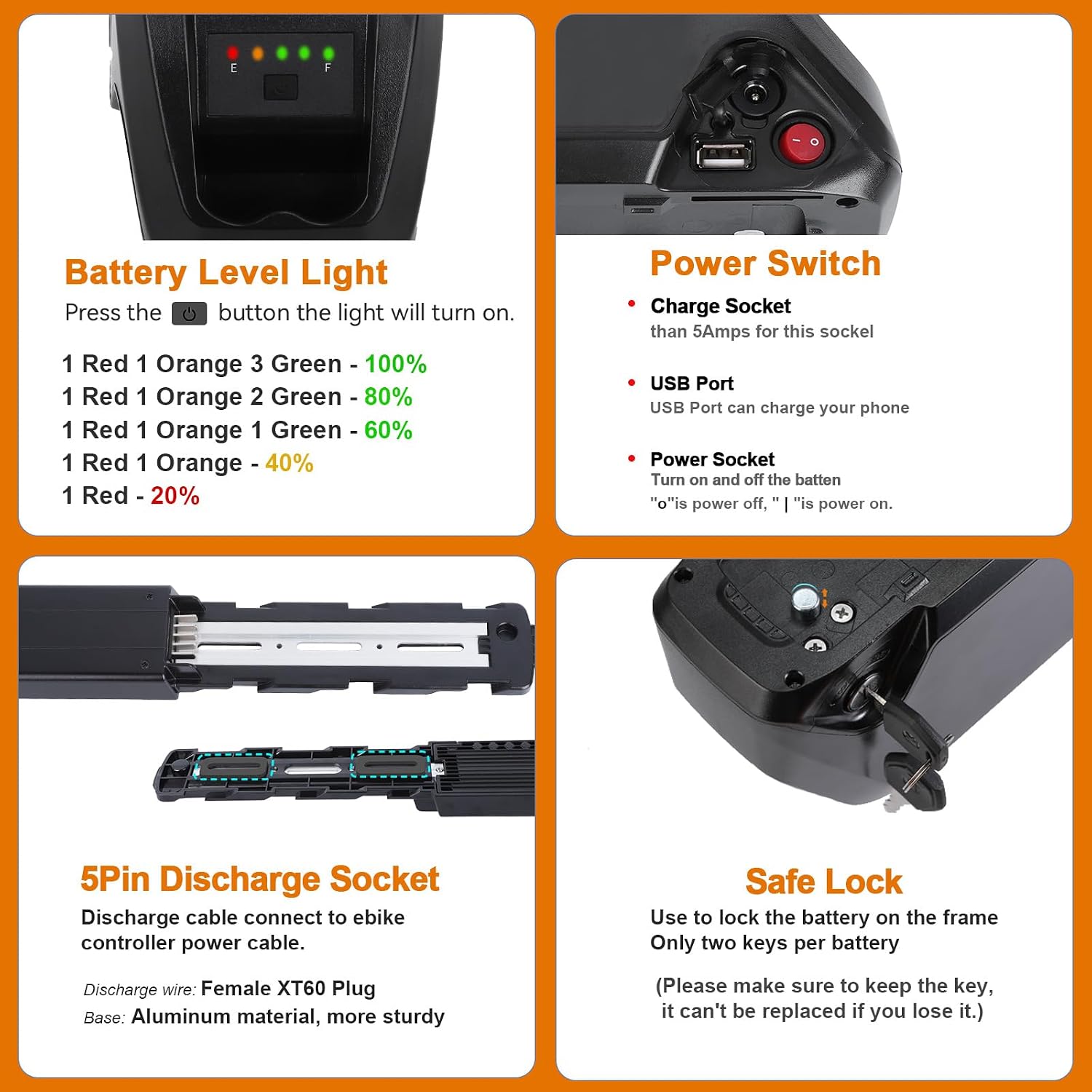
The charging side is honest by omission. The 3A charger divides into 10 amp-hours for a floor of about 3.3 hours per full refill, and the listing prints no charge-time claim to contradict it. The gauge card does print a socket cap of 5 amps for charging, so faster chargers are off-label, and the 3A unit sits under it with room.
The detail table is thin, with no model-number row, no voltage row and no weight row. The warranty is the exception, and it reads the same in both places it appears: 12 months, with a 3-month return window in the bullets.
Sizing it to your frame
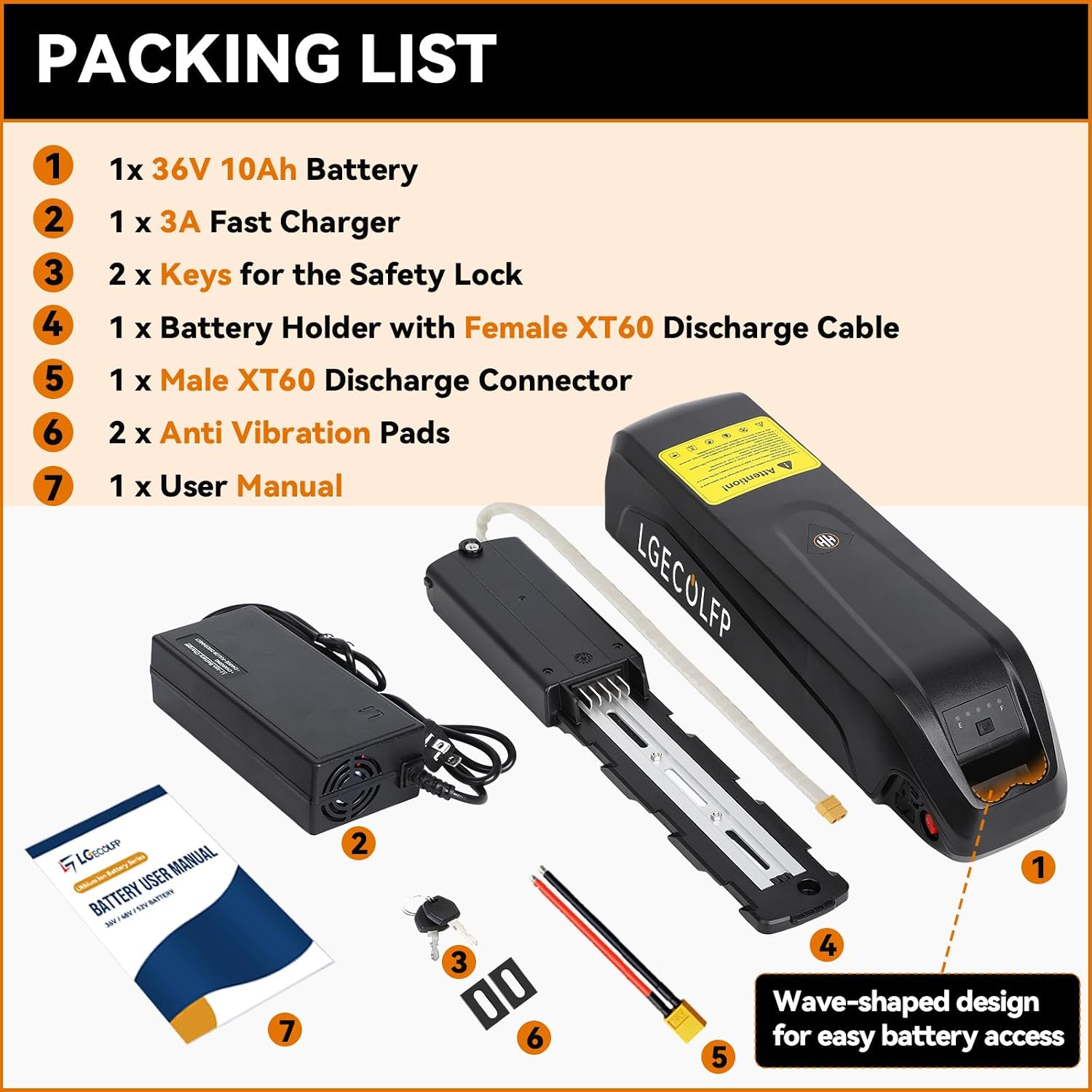
The bare pack measures 367.5 by 95 by 89 millimeters, about 14.5 by 3.7 by 3.5 inches. The mounting plate and holder are included in the box, alongside the 3A charger, two keys, a male XT60 connector and two anti-vibration pads, but they're not part of that printed size, and the May 2024 failure above is what happens when a buyer assumes otherwise.
The discharge side is a 5-pin base with a female XT60 cable on the plate and a male XT60 connector for the controller, so check your bike's connector before ordering. The safe lock uses two keys, and the gauge card carries a warning worth reading twice. The keys cannot be replaced if you lose them. The aluminium base holds the pack on the frame, the LED bar shows charge in 20-percent steps, and the USB port will top up a phone off the pack's own charge.
At 360 watt-hours, expect roughly 14 to 18 miles per charge at a 20 to 25 watt-hours-per-mile pedal-assist draw, less at full throttle. If that range envelope fits your riding, this is the listing of the five to buy from, because it's the only one whose history tells you how the pack ages.
Frequently asked questions
Are the other 36V 10Ah listings at 119.00 the same pack?
Four of the five print the same manufacturer, Guangdong TianChi New Energy, and all five share the same size, weight, BMS, charger and connector, with the same 12-month warranty behind each. They're separate storefronts of one product. This listing carries the only record deep enough to learn from, which is why it's the one this review covers.
How long does a full charge take?
About three and a half hours at the included 3A charger, since 10 amp-hours over 3 amps is a 3.3-hour floor. The gauge card caps the charge socket at 5 amps, so anything faster is off the printed spec. The listing itself prints no charge-time claim.
Will it fit my bike?
Measure for the bare pack plus its base, because the printed dimensions exclude the cradle and holder, and two of the four one-star accounts are buyers who learned that the hard way. The discharge is XT60 through a 5-pin base plate, so your controller needs an XT60 connection or an adapter.
Is the 12-month warranty real?
It appears twice and reads the same both times: 12 months with a 3-month return and refund window. The record shows service actually happening, including a half-refund resolution one owner describes and a company letter another mentions. A 12-month term is short next to the cell-life claims in the bullets, so weigh the two-year record of the pack itself when you decide.