JESIMAIK's H5 two-pack lands at 149.99 against 179.98 for two singles, a 16.7 percent discount, and the brand's other current two-pack does the opposite: the R18 Lite pair charges about 30 percent over two singles. Same brand, opposite ladder direction, so the pack decision comes before the feature list.
The H5's defining spec is the one the listing half-admits: a bullet prints that intercom and music cannot run at the same time, and a three-star owner explains why. Inside sits one radio, he writes, so it either connects to your auxiliary gear or works as an intercom, never both. Mesh wording in the spec table promises six riders, the bullet counts a real-time 2-rider link, and the difference is a pairing pool, not a group talk channel.
What the H5 does own is hardware the clip-on class doesn't ship. A magnetic base holds the headset and releases in about a second for fuel stops, and owners confirm the magnet stays put at speed. Battery claims run 23h of intercom from an 800mAh cell with a one-hour Type-C charge, and one owner measured closer to 30 minutes.
The record is thin and worth reading carefully: 4.6 from 10 ratings, one purchase-badged text among the ten captured, and no failure reports anywhere in the pool.
The JESIMAIK H5 two-pack carries a 4.6 histogram with no ratings at all in the bottom two bands, 72 percent five-star, and a spec table that reads clean by the standards of this price band. Its price per rider lands in the pricier third of the 210 intercoms we track, middle of the two-rider class. One structural caveat first, because it shapes every ride with these units.
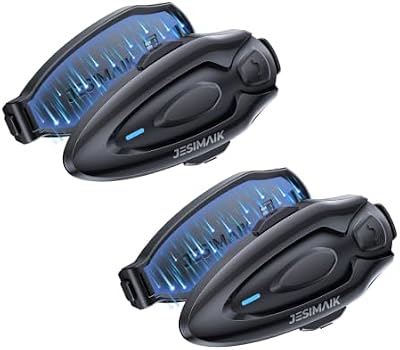
One radio, two jobs
The single most useful account in the record is also the lowest star rating. A three-star owner lays the design out: there is no listen-and-talk function, no sharing functions, one radio inside, so the headset either connects to your auxiliary equipment or works as an intercom. The listing says the same thing in its own voice, in a bullet that opens with Please Note and then states that H5 intercom and music cannot run together.
That's a real constraint, not a quirk. A rider who wants turn-by-turn GPS audio and rider-to-rider talk on the same ride has to pick per trip, or run the aux device one day and the intercom the next. The single-chip design the AUX bullet brags about is the same one-radio fact restated as a feature.
The spec table wraps the limitation in stronger language. An Additional Features row prints 6-Rider Mesh Intercom on a unit whose connectivity is Bluetooth 5.2 and whose own bullet says real-time 2-rider intercom with switching between riders. Mesh is a different radio design, one where every node routes audio continuously, and a Bluetooth two-way link isn't that no matter what the row says, per Wikipedia's Bluetooth article. Six is the pairing pool. Two is the talk channel. One owner who connected six headsets together was describing the pool.
Buyers who need music and talk at once should look at two-radio units. The JESIMAIK R18 Lite two-pack decodes the same way on paper, one radio doing the switching, and the covered two-rider JESIMAIK is the brand's simplest rung at a lower price.
The pair discount, and the opposite rung next door
The two-pack math is the good news. Two singles run 89.99 each, 179.98 together, and the pair sells at 149.99, so ordering the pack saves 29.99, about 16.7 percent. That's mid-band for this season, where two-packs mostly priced two and a half to eighteen percent under two singles.
The contrast inside the same brand is the sharper fact. The R18 Lite two-pack at 119.99 ran about 30 percent over two singles, one of the stiffest pair premiums measured this year. Two JESIMAIK pairs, opposite pricing logic, sold side by side in the same month. A buyer choosing between them is choosing a discount or a premium before comparing a single feature.
Per helmet the H5 pair costs 75.00, which ranks in the pricier third of the 210 intercoms we track and in the middle of the 121 two-rider listings. The R18 Lite pair costs 60.00 per helmet. The 15.00 gap buys the magnet mount and the AUX port, plus a much thinner record to read.
A magnet instead of a clip
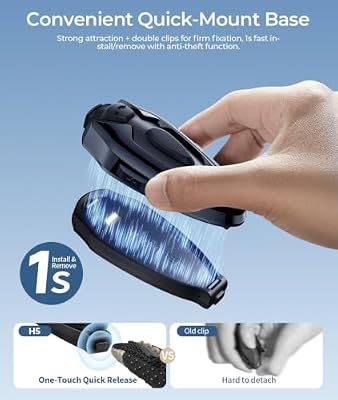
The hardware story starts with the mount. Instead of a clip, a magnetic base stays on the helmet and the main unit snaps onto it, with the listing claiming a one-second release for fuel stops so the headset can ride in your pocket instead of on the helmet. A gallery card spells it One-Touch Quick Release.
Owners back the mechanism. One describes the intercom's brains clipped to the side by a really strong magnet, with only the speakers inside the helmet. Another owner's account centers the quick release as the favorite feature, removing the main unit without fighting the helmet install. A third bought the system for her husband's Harley group rides and praises the snap-on base along with enlarged raised buttons that work with gloves on.
The install is standard helmet surgery: speakers into the ear pockets, wires run behind the trim, adhesive pads for the base. The purchase-badged owner found the fit perfect for his helmet and the wiring easy depending on how accessible the helmet is behind the pads.
Clips are the known failure point in this class, the part that works loose with vibration and drops the intercom on the road. A magnetic base removes the latch, and the owner record, thin as it is, contains no mount failures at all.
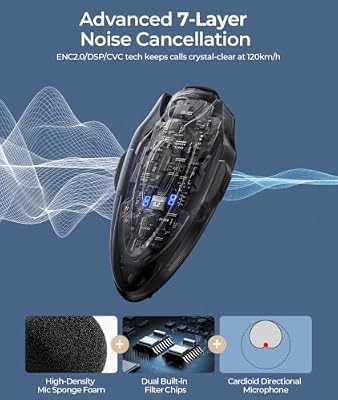
Battery, speakers, and the 120 km/h claim
The battery claims are the boldest on the page: 800mAh delivering 23h of intercom time, 25h of music, and 450h of standby, recharged over Type-C in one hour. The one owner measurement runs ahead of the claim, with a full charge in about 30 minutes, so the printed figure errs in the honest direction.
The speakers are the compromise. The listing sells ultra-thin 8mm drivers that fit shallow helmet ear pockets without pressing on your ears, and the gallery card calls them Zero-Fatigue High-Fidelity. Budget intercoms in this class commonly ship 40mm drivers, so 8mm is a comfort-first trade. The one owner with the purchase badge splits the difference in practice: music sounds good, this isn't an actual stereo system, and intercom voice could be a little better.
The noise card carries the loudest claim on the listing: seven-layer noise cancellation, ENC 2.0, DSP, CVC, calls kept crystal-clear at 120km/h. The spec table repeats the noise-cancellation wording, and one owner reports it does a good job keeping wind and engine noise out of conversations. A second practical limit shows up in the same four-star account that praised everything else: voice control works, but Siri activation takes yelling into the microphone before the headset picks up his voice.
A thin record, read carefully
Everything above rests on ten ratings and ten captured texts, and the structure of that sample matters. One text in the pool carries the verified-purchase badge, a four-star from October 2026. The other nine are unverified, clustered in August and September of the same year, which is a pattern that can follow a review push rather than a slow accumulation of buyers.
The rating itself, 4.6 from 10, carries no weight in the bottom two bands, so nobody in the sample reports a failure. No dead units, no support complaints, no returns, no mount losses. That's a clean sheet, and with a sample this small it's also weak evidence. The spec table's waterproof rating is IP67, the opposite print from the not-water-resistant line on the Sena 5R pages in the same price band, and no owner has reported a wet ride yet either way.
The best-seller rank sits at number 218 in Powersports Bluetooth Headsets, a broader and shallower category than the helmet-communication chart the established brands fight over. Buy the H5 for the magnet mount and the honest pair discount, and treat the unproven durability as the price of a new listing. You can check the two-pack's current price on Amazon against the single rung.
Common Questions
Can the H5 play music and talk on the intercom at the same time?
No, and the listing says so in its own bullet. One radio inside means the headset either connects to your aux device or runs the intercom. Riders who need both at once need a two-radio headset.
Does it really work with six riders?
Six is the pairing pool, two is the talk channel. The bullet says real-time 2-rider intercom, the mesh wording in the spec row describes Bluetooth pairing, and no owner account in the record describes six-way conversation.
Is the magnetic mount secure?
Owners report a strong magnet that holds the main unit at riding speeds, and the listing claims it stays locked on the highway while lifting off in about a second when you want it gone. No mount failures appear in the captured pool, which is ten texts.
How long does the battery last?
The listing claims 23h of intercom time, 25h of music, and 450h of standby from an 800mAh battery, with a one-hour Type-C charge. One owner measured a full charge in about 30 minutes. No long-term battery reports exist in the pool yet.
Is the H5 waterproof?
The spec table prints IP67 waterproof, which would put it ahead of the not-water-resistant Sena 5R pages in the same price band. No owner has reported riding in rain with one yet, so the rating has no road record in the captured pool.