A 1,664 watt-hour triangle pack for 399.99 is a serious claim on paper, and this page makes several more. An 80-amp BMS, motors up to 5,000 watts, IP65 weather sealing and more than a thousand charge cycles, all from a brand whose storefront answers none of the questions a buyer would ask first.
This is the fourth listing we have rebuilt that turns out to have no rating record at all. The HAIPACKBA 52V 32Ah triangle battery shows zero ratings and zero written reviews, confirmed signed in, so nobody reading this article can lean on another buyer's experience. You are buying a spec sheet, and the spec sheet argues with itself in four separate places.
That is not an automatic disqualification. The Yasco 48V 13Ah rebuild showed how to buy on zero evidence by checking the page's internal consistency, and this page fails the same test we applied there. What follows is every claim the page makes, the arithmetic you can run yourself, and the places where the numbers do not hold together.
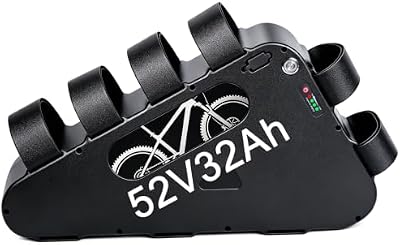
Our first look at this pack, written in August, said two owners had left reviews and both were five stars. Today the page shows nothing. Either Amazon reset the rating count, which happens on relisted or merged products, or the old article described reviews that were never really there, which the old writing process made possible.
I can't settle which from the outside, and the honest position is to say so. What matters for a buyer today is that the record is empty and the price is unchanged, so the two five-star signals the old article leaned on can't be checked by anyone.
The best sellers rank still says the part sells. It sits at #2,879 in Powersports Batteries, a mid-band number for a high-capacity triangle pack, with the broader Automotive rank at #1,119,073. Sales without reviews leaves two possibilities, that earlier wordless ratings were removed along with the written ones, or that nobody who bought has rated it, and the page doesn't say which.
What the listing argues with
The first fight is over the charger. The title sells the pack with a 5A charger, spelled Char-ger in the title's own typo.
The spec table's Included Components row says the box holds a battery, full stop. Both statements are on the same page and they cannot both be true, and the charger question is the one with a dollar value attached.
The second fight is the frame-compatibility bullet, printed twice, word for word, in the bullet list. A duplicated bullet is a small thing on its own. It tells you the page was assembled from a template by someone who did not read it, which is exactly the frame of mind that produces the charger contradiction.
The third fight is the warranty rows. The manufacturer warranty description reads three months, which is among the shortest protections we've tracked on any listing this size, and the recent norm in this tier is a full year.
Elsewhere in the table sits a two-year EU spare-part availability row, which is a legal disclosure rather than an offer, but the two numbers side by side make the protection picture look better than it is.
The fourth is smaller and stranger. The voltage row reads 52 volts_of_direct_current, a garbled template string where a clean specification should be. It still tells you the pack is 52 volts, and it tells you nobody proofread the table.
The charger line that can't charge this pack
The parameter bullet names the charging connector as 84V at 5A. Run the cell math and that number cannot describe this pack's charger.
A 52V pack is fourteen cells in series, and each lithium-ion cell tops out at 4.2 volts, so a full charge lands at 58.8 volts.
Fourteen times 4.2 is 58.8, and our old article stated that figure correctly even though it fumbled the review record. Eighty-four volts is the same math on twenty cells in series, a 20S configuration, which would make this an 84V pack rather than a 52V one. The printed charger voltage and the printed pack voltage describe two different products.
The practical read is that 84 is a typo or a copied row, and the real charger, if it ships, puts out 58.8 volts.
But the row is the only charger specification on the page, and a buyer who wires in an 84V supply against a 14S pack would not be charging it, they'd be damaging it. Ask the seller what the charger's output label says before the pack ships, and check the label again when the box arrives.
If the 5A figure survives the same scrutiny, a 32Ah pack at 5 amps needs about 6.4 hours to fill, and that is the floor before the taper near full. Plan overnight charges.
The 80A BMS against the 5000W bracket
The BMS is the strongest spec on the page. Eighty amps continuous is genuinely high for this market, where 30 to 50 amps is the common band, and on 52 volts it caps sustained draw near 4,160 watts.
The title's motor range runs to 5,000 watts, and the top of that range sits above the BMS by the same arithmetic we've flagged on two other rebuilds this month.
A 5,000W motor at full load draws about 96 amps on 52 volts, well over the 80-amp limit. A 2,000W motor draws about 38 amps and sits inside it. The honest top of this pack's practical range is the low 4,000s in sustained watts, with the BMS's own headroom deciding how hard the pack sags on climbs.
For the riders this pack is actually aimed at, that ceiling is mostly fine. Big hub motors and high-power mid-drives in the 2,000 to 3,500W class fit under 80 amps with margin, and the XT90 discharge connector, included on both male and female sides, is rated for exactly this current class.
The bracket in the title is a search-box number. The BMS is the hardware.
Triangle fit, weight and weather
The pack measures 15.67 by 9.15 by 14.37 inches and weighs 15 pounds, and both numbers belong in your frame check before ordering. A triangle pack fills the main triangle of a diamond frame, so the question is whether your frame's triangle takes those dimensions with strap clearance. Small frames, step-through frames and most folding frames don't, and no amount of adapter hardware fixes a triangle that's too small.
The IP65 claim decodes as dust protected plus water jets. That is the level-5 dust grade, where ingress isn't entirely prevented but can't interfere with operation, plus the level-5 water grade, a 6.3mm nozzle spray from any direction for a few minutes. It is weather sealing for rain you ride through, not a dust-tight or immersible enclosure, and the standard's own tables draw those lines precisely so buyers can tell the difference.
The cell chemistry row reads lithium ion and nothing more specific, so the cells behind the 1,000-cycle claim are unnamed.
Typical lithium-ion cycle durability runs 400 to 1,200 cycles with the count conventionally taken at 80 percent of rated capacity, so the claim sits inside the normal band rather than beyond it. It's a credible number on paper, from a seller nobody has held a pack long enough to test in writing.

What 1,664Wh costs and what it buys
Capacity times voltage gives 1,664 watt-hours, the label math checks out, and at 399.99 the pack works out to about 24 cents per watt-hour. That sits close to the middle of the 301 packs we track, which is a fair price for the capacity and nothing more. The comparison table renders the live position in the specs box and shows the 52V alternatives side by side.
Range is where the capacity pays. A full-size ebike battery usually delivers 25 to 75 miles per charge depending on the power level, and 1,664Wh sits at the top of that spread in practice.
At a gentle 15 watt-hours per mile of pedal assist it's about 110 miles. Under heavy throttle at 30 it's about 55. Either figure is a full day of hard riding, and the pack's weight rides low and centered in the triangle rather than swinging off a rack.
Who should look at it hasn't changed since the empty record arrived. A rider with a big triangle and a 2,000 to 3,500W build gets 1,664Wh for a mid-table price per watt-hour, and being the first documented owner is the price of admission.
Anyone who wants a track record behind their purchase should wait, because a three-month warranty and a page with this many internal contradictions put the whole burden of proof on the buyer.
The LGNUO 52V 20Ah rebuild covers the other zero-record 52V pack we've reviewed, and the smseler 48V 7.5Ah rebuild shows the drift problem in its sharpest form, a review record that vanished after our first look was written. The current listing is the source for every figure in this article.
Frequently Asked Questions
Does the HAIPACKBA 52V 32Ah ship with a charger?
The page disagrees with itself. The title says the pack comes with a 5A charger and the Included Components row says the box holds a battery only. Ask the seller directly before ordering, and check the charger's output label when it arrives, because the only charger voltage the page prints, 84 volts, doesn't match this pack's 14S chemistry.
What voltage should a 52V battery charger put out?
A 52V pack is fourteen cells in series, and fourteen times the 4.2-volt cell ceiling is 58.8 volts. A charger labeled 84 volts is built for a 20S pack and would damage a 52V one. Match the charger label to the pack before plugging in.
How far will 1,664Wh take me?
About 110 miles at a gentle 15 watt-hours per mile of pedal assist, or about 55 miles under heavy throttle at 30. Hills, cold weather and rider weight pull the real number down, and no buyer has reported a measured figure on this pack, so the plan is arithmetic rather than experience.
Will it fit my bike's frame?
Measure the main triangle first. The pack is 15.67 by 9.15 by 14.37 inches and 15 pounds, and a triangle pack needs a frame triangle that takes those dimensions with room for straps. Small, step-through and most folding frames don't have the space, and the listing's own bullet says to check frame tube sizes before ordering.
Can I trust a listing with zero reviews?
Treat it as a blank, not a positive or a negative. Everything on this page can be checked against arithmetic, and some of it fails that check, which is why the contradictions matter more here than they would on a page with a deep record. If you buy, test everything inside the three-month warranty window, because that's the entire protection the seller offers.