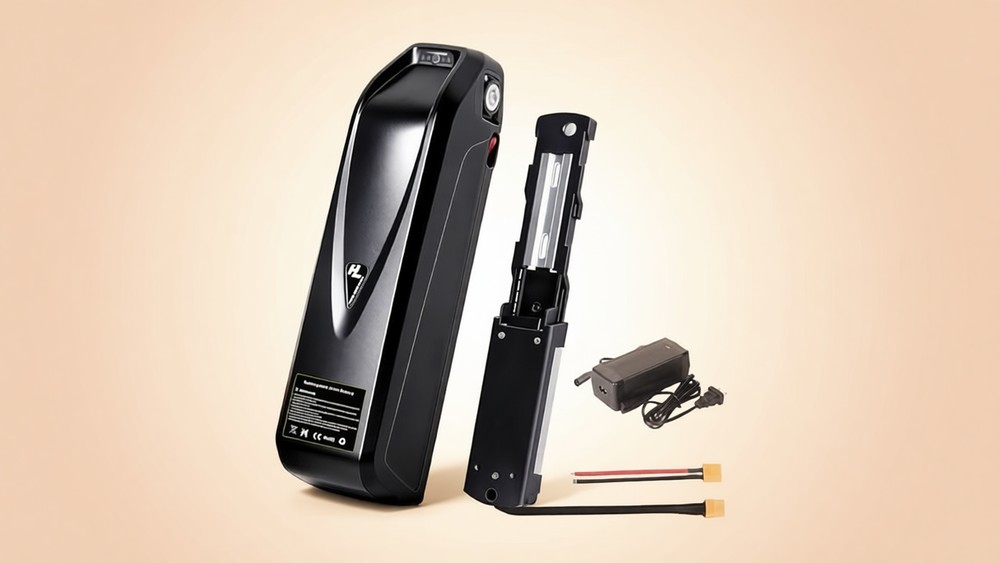
Big rack packs live or die on two numbers, the energy they claim and the amps they can actually push, and the HAIPACKBA 48V 25Ah battery claims a lot of both: 1200 watt-hours, a 50A board, motors from 200 to 2000W, a USB port and a keyed lock on a 5-pin base. The price sits almost exactly in the middle of our table, which makes the claims the only thing left to check.
Checking them turned up something odd. Bullet one caps your controller at 50A, and bullet five caps it at 20A. Same listing, two amp ceilings a factor of two and a half apart, and the motor range shrinks with them. That disagreement is the spine of this review, because the answer decides whether this pack runs a 2000W bike or a 960W one.
The listing argues with itself about amps
Here are the two claims as printed. Bullet one sells a 50A BMS and calls the pack a fit for 200 to 2000W motors, with a controller rated current of no more than 50A. Bullet five, the fitment checklist, tells you a matching device runs a controller rated at no more than 20A and a motor between 200 and 1800W.
Fifty amps across 48 volts is a 2400W ceiling, and 2000W draws about 42 amps, so bullet one's story holds together. Twenty amps is a 960W ceiling, which would cap the same 2000W claim at less than half its number.
One reading is that bullet five is a copied template from a smaller pack in the same family, which would fit the pattern we keep finding in this tier, where bullets travel between listings faster than anyone edits them. The other reading is that the board rating is optimistic and 20A is the safe continuous figure.
Nothing on the page settles it, and with the record this listing carries, no owner has settled it either. The practical move is to ask the seller which figure is the continuous rating before you buy, and to match your controller's rated current to the smaller number while you wait for the answer.
The rest of the electrical story agrees with itself. The 54.6V 3A charger matches a 13-series 48V pack, and the 1200Wh title math, 25 amp-hours times 48 volts, is correct. The board's protection list includes an over-temperature cut-off, which the sibling listings we checked this month omit, and the XT60 discharge connector is named on both ends.
A record with no words in it
This page carries one rating, five stars, and not one written review. That is a different problem from a thin record, because there is nothing to weigh at all, no bike model, no install story, no range report, not even a complaint to learn from.
Our September article leaned on that single perfect rating, and today the page still shows one rating with no words attached, so the article you are reading starts from zero evidence rather than from a record that shrank.
Zero evidence does not mean zero information, it means the spec sheet and the arithmetic carry the whole decision, so that is what this review checks. The brand gives us one earlier result to work with.
We rebuilt the HAIPACKBA 52V 32Ah triangle pack earlier this month, and the same habits showed up there: a charger typo baked into the title, an empty record from the day it shipped, and bullets that read like a family template. Those habits do not prove anything about this pack, but they tell you the storefront writes listings the way factories write part numbers, so check rather than trust.
The fitment list names Bafang and Voilamart kits, and with no reviews on the page, nobody has confirmed or disputed that list. Measure your bay against the printed dimensions before ordering, because the listing cannot even settle its own length, 14.5 inches in one bullet and 14.2 in another.
The weight only works at the top of the band
The bullet says 12.5 pounds and the details row says 13, close enough to treat as one figure, about 5.7 kilograms. Here is where the energy claim gets tight. Twelve hundred watt-hours needs roughly 4 to 7.5 kilograms of bare cells at the standard 0.16 to 0.30 kilowatt-hours per kilogram energy band, the range Wikipedia's lithium-ion article covers for this chemistry.
A 5.7 kilogram pack total leaves nothing for the case, the board and the wiring unless the cells inside sit at the very top of that band, around 4 kilograms of cells and 1.7 for everything else.
That is possible with premium cells, and the listing claims Grade A cells, but it is the plausible edge rather than the comfortable middle, and it is the same reading the folding LZIXYM pack got a few weeks ago.
The contrast with the LOCKBUS shell is instructive, because that pack claims less energy, 960 watt-hours, in a similar case at a similar weight, and its budget fits with room to spare. Weigh this one on a bathroom scale when it arrives.
Near 12.5 pounds and the claim survives, and if it lands lighter than the claim, the capacity inside is in doubt, which you want to learn inside the return window, especially with a three-month manufacturer warranty standing behind it.
The case, the port and the shared footprint
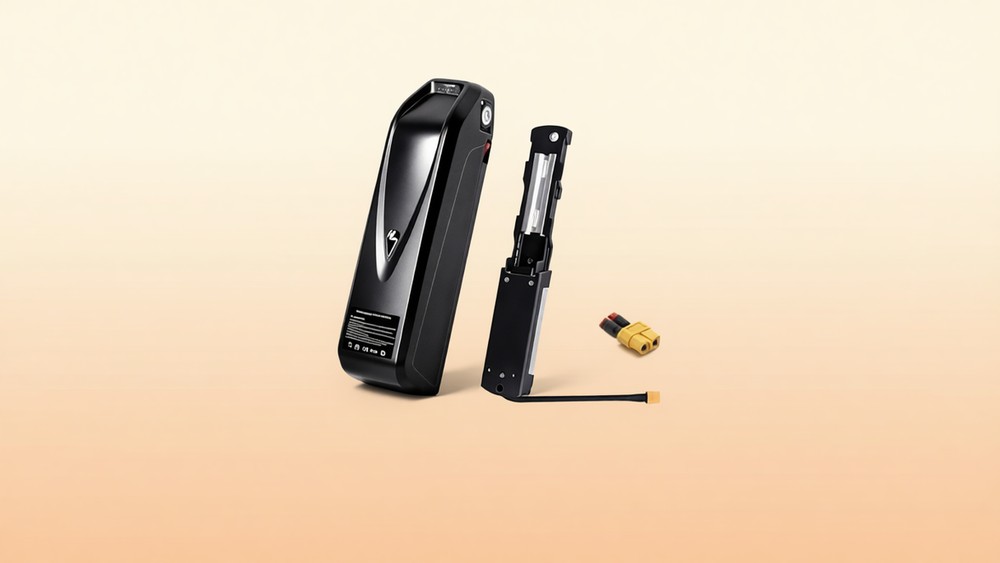
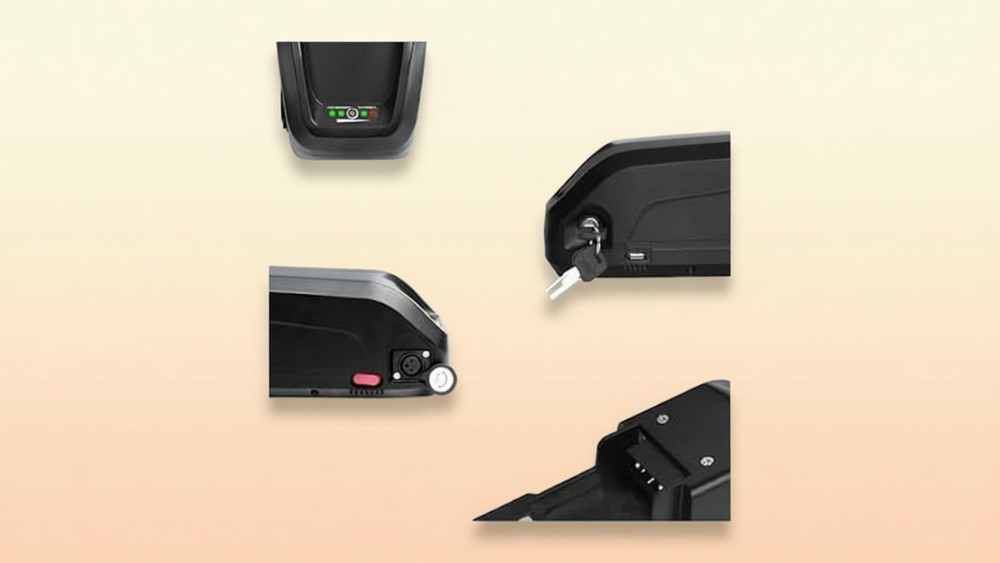
The case deserves its own look because of who it resembles. It runs 14.5 by 3.54 by 5 inches, with a USB output, a key lock, an LED gauge and a 5-pin battery base, and that is the same footprint, the same port set and the same feature list as the LOCKBUS 48V 20Ah we rebuilt the same week, matching on length and width and missing the depth by about a tenth of an inch.
The manufacturer rows differ, HAIPACKBA against Dongguan Yizhan, so I am not claiming one factory, but two listings this close in hardware and bullet architecture are buying from the same case catalogue at minimum, and their prices should be compared as siblings rather than rivals.
The waterproof casing claim is unstated as an IP code, so the cautious reading is splash resistance rather than anything rated. The USB port is again a convenience output for a phone, with no output rating printed anywhere, and the 5-pin base matters more than either, because the base is what mates the pack to your rack or carrier, so confirm your mount expects five pins before the rest of the list convinces you.
What the energy costs
At 276.99 for 1200 watt-hours, this pack works out to about 23 cents per watt-hour, which places it 99th of the 301 packs on our comparison table, cheaper than roughly two thirds. The live rank renders in the specs box on this page and moves with the price, and our row carries this exact figure, so the table and the live listing agree for once.
Mid-pack pricing on a spec sheet that partly contradicts itself is a fair summary of the deal.
The LOCKBUS 48V 20Ah sells about a fifth less energy in the same footprint for about 25 percent less money, with a 40A board that clears its own motor claim cleanly and a one-year warranty against this one's three months. If the bay fits both, the LOCKBUS is the stronger buy on paper, and if you need the full 1200 watt-hours, this is the only one of the two that claims it.
The shipping note reads two to three days rather than next-day, which fits a storefront without local stock.
Common questions about the HAIPACKBA 48V 25Ah
Is it a 50A pack or a 20A pack?
The listing says both, and it cannot. Bullet one's 50A board matches the 2000W claim, bullet five's 20A ceiling would hold the pack under 1000W. Until the seller answers, plan around 20A, because a controller that expects more than the board delivers will shut the system down or cook the board, and a controller under the smaller figure runs either way.
Can a pack with zero reviews be any good?
The record cannot help you, so check what can be checked. The title math holds at 1200 watt-hours, the charger voltage matches a 13-series pack, and the over-temperature protection is a genuine addition. What remains unproven is the capacity inside, given the weight budget only closes at the top of the cell-density band, and the amp rating, given the contradiction.
Buy inside the return window, weigh the pack, and run a range test in the first two weeks.
How does it compare to the 52V HAIPACKBA triangle?
The 52V pack is a different animal, a triangle for frame-mounted builds with an 80A board and XT90 connectors at 399.99, and it shares this one's empty record and the charger typo in its title. This 48V pack is the rack-and-base option with the USB port.
Choose by where your bike carries a pack and how many amps your controller draws, not by brand loyalty, because the brand's main product so far is consistency of spec-sheet confidence.