A battery listing usually tells you what it is in the first five words. This one can't decide. The title names three voltages and two capacities in a single line, six possible packs sharing one page, and it misspells the word adapter while doing it.
That mess matters more than it looks, because one number on the page does name the real pack. The charger voltage is the fingerprint of a battery's cell layout, and the figure printed in this title points at one specific layout. Everything else in the title is a search-index wish list.
The case itself is the most familiar shape in the budget ebike world, the price per watt-hour lands well inside the cheap half of what we track, and the whole review record fits in three words. What follows is the listing taken apart claim by claim, the arithmetic behind the two numbers that matter, and the checks worth making before the return window closes.
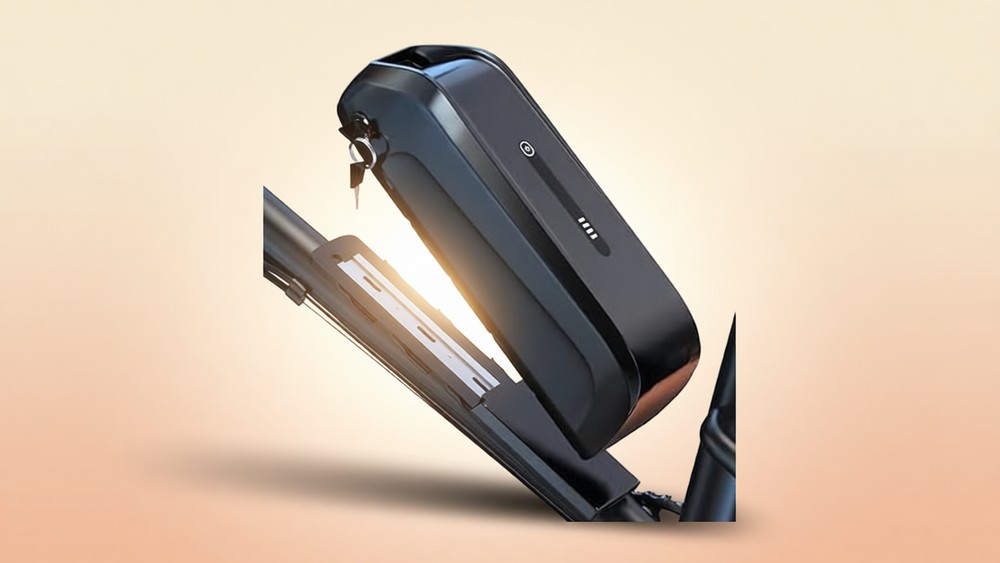
The H HAILONG 52V 20Ah sits in the cheaper third of the 301 packs we track on price per watt-hour, and that's the strongest fact on the page. You get 1040 watt-hours in a standard Hailong shark case, a 40A BMS that covers the claimed 1500W motor ceiling with real margin, and a spring-lock mount that drops onto the standard Hailong bracket.
You also get a title that lists six different packs, a page with exactly one feature bullet, a spec table that files the battery under lawn mower equipment, and a review record consisting of one three-word text. The word waterproof appears in the pack's own name with no IP code behind it anywhere on the page.
Six packs on one page
The title reads 'H HAILONG 36V 48V 52V 15Ah 20Ah Battery for 58.8V 4A Fast Adpter & 40A BMS'. Strip away the search bait and one figure does real work: 58.8V.
A 52V pack is built from 14 cell groups in series, and it charges to 58.8V. A 48V pack has 13 groups and charges to 54.6V, while a 36V pack has 10 groups and charges to 42V.
The em3ev 52V buyer guide lays out the series counts plainly, because the charge voltage tells you which layout you're actually holding. One physical pack cannot charge to three different voltages, so the title is describing a family of variants, not one pack. The variant this ASIN sells is the one its own charger names: 52V.
That has a practical edge worth stating. Listings in this class can imply a pack that adapts itself to whatever system you connect it to. Voltage doesn't work that way.
A 52V pack on a 36V bike sits far above what a 36V controller expects, and the mismatch isn't a firmware setting you can adjust away.
The page's care level
The details around the title predict the quality control you can't see. 'Adapter' is misspelled in the title itself. The whole listing carries a single feature bullet, so the specs you'd want for comparison simply aren't there.
The spec table lists 'Lawn Mower' as the recommended use and the antenna location, while the best sellers rank sits inside Wheelchair & Mobility Scooter Replacement Batteries. The title courts 100W-1500W motorcycle motors. Three pages of the listing tell three different stories about what this battery is for.
None of that is disqualifying on its own. Together it tells you the page was assembled quickly, so the figures you care about deserve a second source. The good news is that the figures that matter most here are the ones the title does state, and they hold up under arithmetic.
What 40A covers, and what the charger costs you in time
The 40A BMS figure is the claim the specs actually back. 40 amps at a fresh 52V works out near 2080W of continuous discharge, and even at the nominal voltage it stays around 2000W. A 1500W motor sits under that ceiling with room to spare, so the motor claim in the title is honest arithmetic rather than marketing inflation.
The compatibility side needs more care than the title gives it. Most 48V controllers handle a 52V pack because their capacitors are typically rated to 63V, which clears the 58.8V peak, and the same guide notes the catch: the low voltage cutoff.
A controller set for a 48V pack shuts down around 39 to 41V, while a 52V pack shouldn't drop below about 43V. On a fixed-cutoff controller, the pack can be drained deeper than it should be. Riders on a true 48V build should confirm their controller's cutoff or watch pack voltage on the display.
Charging time is the other number worth computing. The title names a 58.8V 4A fast adapter, and 1040Wh through a 4A charger lands near four and a half hours before the slower top-off phase, so call it five to six hours to full. That's a genuine convenience over the 2A chargers common in this class, which would need twice the time on a pack this size.

Three words carry a perfect score
The rating sits at 5.0 from a single global rating, and the entire written record is one review: 'Well package, very well built!!' It was posted in June 2026 and it's tied to an actual order, the only form of purchase confirmation available at this sample size. The record holds nothing else to weigh against it.
The buyer has said nothing about range, nothing about which bike the pack fits, nothing about the charger's behavior, and nothing about how the cells age. Those four gaps are exactly what a battery buyer most wants answered, and at one review the record cannot carry any of them.
Filling the gap yourself
Buying on a record this thin makes the first month the review you write for yourself. Charge the pack full and ride it down once with the display's watt-hour readout or a cheap meter on the charge lead, and you'll know whether the capacity is close to 20Ah. Do it inside the return window, and the 1-year warranty the spec table lists becomes the second checkpoint.
A pack that meters near its rated capacity young and holds voltage through the first months has passed more of a test than this listing has ever published.
Two adjectives with no numbers behind them
The name promises a 'High-Cycle Waterproof Design', and neither adjective comes with a figure attached. No cycle count appears anywhere on the page, and the listing names no cell chemistry. For context, Battery University's BU-808 puts consumer lithium-ion at 300 to 500 full cycles by spec, and packs without a stated chemistry deserve the conservative reading.
The waterproof claim is looser still. Ingress protection under IEC 60529 is the tested standard behind every real water-resistance rating, and an IP code is exactly what this page doesn't publish. A word without a number behind it means the pack has no documented test result, whatever the case design looks like.
Treat it as splash-tolerant until the seller states a code, and keep the connectors out of heavy rain.
Buy the format, not the feedback
Here's the decision this listing actually forces. The case is the strongest argument: a standard Hailong shark shell, 14.41 by 4.6 by 3.81 inches and 13.85 pounds, with a spring-lock slide mount that matches the bracket format the budget market already standardizes on. That shared standard is the long-term bet, because slides, mounts and replacement packs are everywhere in this format.
When this one eventually wears out, the next pack drops onto the same base, which is more than proprietary cases can promise.
Buy it when you already run a Hailong-style mount, need a 52V pack in the 1500W class, and you're comfortable being the evidence base yourself.
Skip it when you want owners to carry the risk first, because the comparison table has 52V packs higher up the value band with real review records behind them. Riders on 48V systems have the same case in a 48V 20Ah version, and browsing other Hailong-format packs is worth ten minutes before committing to a listing with no track record.

Frequently Asked Questions
Is this really a 36V, 48V and 52V battery? No. The title lists a product family, and the 58.8V charger named in the same title identifies this ASIN's variant as a 52V pack built from 14 series groups. A 48V pack charges to 54.6V and a 36V pack to 42V, and one pack can't charge to all three.
What motors can it run? The 40A BMS works out near 2080W of continuous discharge on a fresh 52V pack, so the claimed 100W-1500W motor range is arithmetically covered with margin. Confirm your controller's low voltage cutoff first, since a fixed 48V-class cutoff can over-discharge a 52V pack.
How long does a full charge take? On the 58.8V 4A adapter the title names, expect five to six hours including the top-off phase. A 2A charger would need roughly twice that on 1040Wh, so the fast adapter is worth confirming at checkout.
What range should I expect? At the 15 to 25 watt-hours per mile a moderate pedal-assist ride costs, 1040Wh works out to roughly 40 to 70 miles, and full-throttle riding lands nearer 30 to 40. That sits inside the 25 to 75 mile band typical for e-bike batteries per charge, and nobody has published a real figure for this pack yet.
Can I trust the waterproof claim? Treat it as untested. The page publishes no IP code, and IEC 60529 is the standard that turns water-resistance words into tested ratings. Ride it through splash and drizzle with the connectors sealed, and keep it out of standing water until the seller states a code.
Will it fit my bike? Measure your frame's triangle against 14.41 by 4.6 by 3.81 inches, and check that you have a Hailong-style slide mount or the downtube space to add one. The spring-lock base is the most common format in the budget market, which is why fitment is this listing's most answerable question. The 48V 20Ah version of the same shell is covered separately, charger math and all.