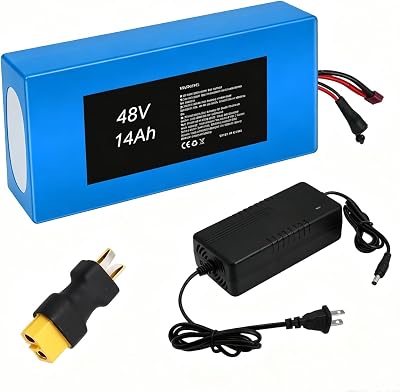
The cheapest battery we tracked was a bare brick. No shell shaped for a downtube, no paint, just 8 pounds of cells wrapped in PVC with a T-plug hanging off it, and a price that worked out to about 16 cents per watt-hour. Riders building on a budget put up with the looks because the math was hard to argue with.
It's gone now. Amazon reads Currently unavailable, no restock date, and the price widget drifted up to 119.99 on the way out. Four people left ratings and not one of them wrote a word, so the record this pack leaves behind is a spec box and nothing else.
That record is still worth reading, because the spec box was honest in one way that matters: it printed a 30A BMS, and that number is what made the 200-1000W claim check out. Here's what the recorded specs say, where the range would have landed, and the four checks that pick a replacement you can actually buy.
The 48V 14Ah universal power pack recorded at 109.99, which for 672 watt-hours is about 16 cents per watt-hour and lands among the cheapest of the 324 packs we track.
What you gave up for that price was every kind of convenience: no frame bracket, no fuel gauge on the pack, no brand behind the cells, and no written owner record at all. If you want the current cheapest packs rather than this dead listing, the battery comparison table sorts them by the same measure.
The cheapest pack we tracked, now unbuyable
The death has a date now. We probed the listing on November 2, 2026, and Amazon reads Currently unavailable with no restock promise.
The odd part is what the page still shows: a price widget at 119.99, ten dollars above the 109.99 we recorded, sitting above a buy button that no longer works. The Creators API serves the same bullets it always did. The listing died mid-drift, and nobody will ever pay the higher number.
The owner record ends the same way. Four ratings, average 5.0, zero written reviews.
When we first covered this pack in September 2026 there were two ratings, and the count grew in silence after that. Four strangers clicked five stars and left, which tells you the pack worked when it arrived and nothing about how it aged. We make no owner claims for it in this article, because there are no words to source them from.
What stays real is the spec box. It was more coherent than most budget listings manage, and the next four sections walk through it as a replacement checklist, because everything this pack got right is what a successor should match.
What the wrap was, and was not
The case defined this pack. It measured 10.03 by 2.95 by 4.64 inches and weighed 8 pounds, with a PVC wrap the listing called IP65. That rating, per the IP code standard, means dust-tight and protected against low-pressure water jets from any direction.
Rain and spray, in practice. Never a puddle, never a hose, and the connectors are the part water finds first.
The wrap was weather protection with no structure in it. Bare-wrapped packs like this were the norm before the ebike boom, and riders still mount them in bags and homemade enclosures, because the bag or the padding is what actually takes the shocks.
On a bike, this brick needed straps, a frame bag, or a rack bag, and none of that came in the box. Eight pounds mounted high on a rack will change how a bike handles. The old article got that part right, and it still applies to any replacement built the same way.
The one spec that made the wattage claim honest
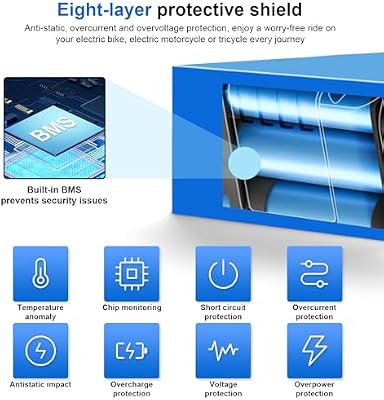
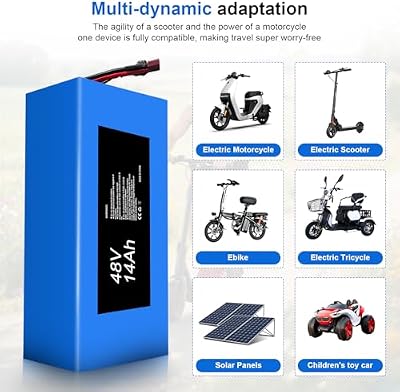
The title claimed support for 200W to 1000W systems, and most listings that print a band that wide are guessing. This one had a number behind it: a 30A BMS.
At 48V, 30 amps is about 1440W of continuous draw, so a 1000W motor pulling about 20.8A sits inside the limit with room, and the 200W floor at about 4.2A never comes close to it. The band and the board agree, which is rarer than it should be.
A printed BMS amp rating is the first compatibility check for any pack, because motor watts divided by pack volts gives what the controller will pull. The em3ev battery guides make that the opening question, and this listing answered it unprompted. That single printed number is why the recorded spec box is worth more than the four silent ratings.
The claims without numbers stay marked. A 1000-plus cycle figure, dual-layer protection, a certified self-discharge rate under 3 percent a month, and a 1-year warranty all rest on the seller's word, and no cell brand is named anywhere.
The charger was printed at 54.6V and 2A, which is the correct full-charge voltage for a 13S 48V pack, and 14Ah at 2A is about 7 hours from empty. The bullet calls it an adapter rather than a charger, one more small ambiguity in a record that is all spec sheet.
Range on 672 watt-hours
The em3ev 48V guide puts a 720Wh pack at about 22 to 28 miles on throttle alone and 35 to 45 on light pedal assist.
Scale that row to 672 watt-hours and the bands land at roughly 20 to 26 miles on throttle and 33 to 42 on light assist. Full throttle burns roughly 30 to 35 watt-hours per mile on a mid-power motor, and light assist burns far less, so a range promise that borrows the assist figure for throttle riding doubles itself on paper.
One number in the old article survives the check: it said a 500W motor at full throttle would run about an hour and a half, and 672 divided by 500 is 1.34 hours. That is the only range claim in the old text worth keeping, and it agrees with the scaled band.
The four checks that pick a successor
Since the listing is gone, treat the spec box as the template. First, the connector: this pack discharged through a T-plug with a T-plug to XT60 adapter in the box, and the replacement has to match your controller before anything else matters. Second, the printed BMS amps against your motor's draw at pack volts, the same arithmetic that made the 200-1000W band honest here.
Third, the charger: 54.6V for a 13S 48V pack, and the amps set the hours, at about 7 for 14Ah on a 2A unit. Fourth, the case: a wrapped brick needs a bag or straps, while a cased pack needs the bracket and port check our Silver Fish reviews describe.
The generic 48V 20Ah and generic 48V 10Ah packs we cover sit in the same no-name family, and anyone building a conversion kit should compare all three by price per watt-hour rather than by title wattage. The table does that sorting for you.
FAQ: the unavailable listing, the IP65 spray limit and the rating count that never spoke
Can you still buy it?
No. The listing read Currently unavailable when we probed it on November 2, 2026, with no restock date, and the seller never printed one. The tagged search link in this article leads to similar packs rather than back to it.
Was the IP65 claim real waterproofing?
It covered rain and low-pressure spray, per what IP65 actually means. It never covered submersion or a pressure washer, and a PVC wrap has no seams worth trusting in a puddle anyway.
What did the four ratings say?
Nothing. Zero written reviews were ever captured, and the count grew from two to four in silence. Every claim in the old article about what reviewers have said is unverifiable now, so this rebuild makes none.
Is a PVC-wrapped pack still the cheapest route?
The recorded 16 cents per watt-hour was the point of the pack, and cheap wrapped bricks still exist. Compare live listings by price per watt-hour on the comparison table instead of chasing a dead page, and run the four checks above before paying.