At 15 cents per Wh for 480Wh, this was the cheapest 48V pack we tracked, and the ASIN is now retired. The price sat far below the floor the DIY community calls trustworthy, and the garbled listing title told the same story. This decode covers what that extreme discount buys, and what it cannot, because the answer decides whether your garage is a workshop or a fire scene. Nobody should run it as a primary pack, and tinkerers get a disposable experiment at best.
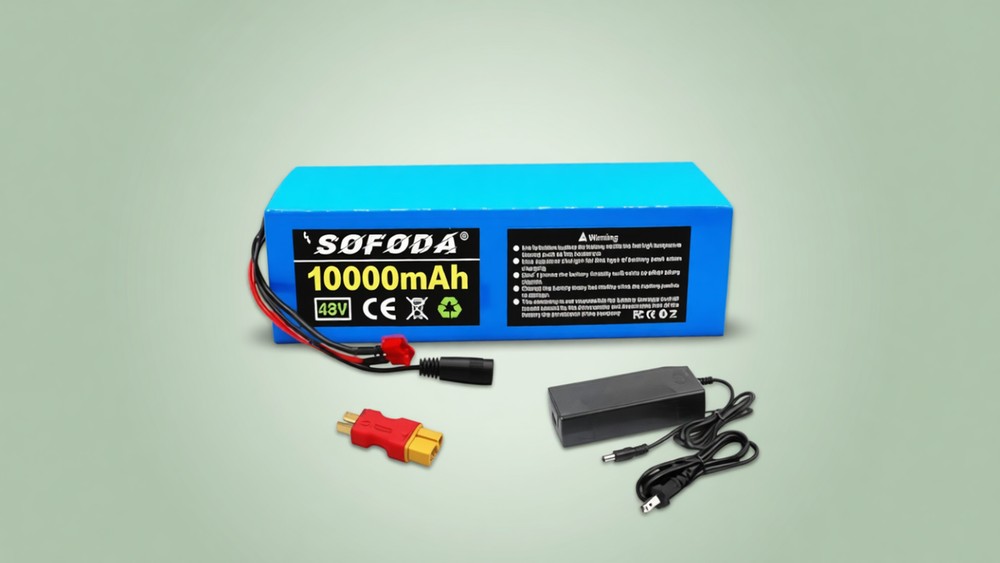
The floor-price math behind a 15-cent pack
Good 18650 cells alone cost more than half of what this whole pack recorded for, before you add the BMS, the welding, the case, and the labor. The DIY forum consensus puts the trustworthy floor for a 48V 10Ah pack at roughly double this price. Something gets cut to hit that number, and the cut lands on cell grading, BMS quality, or weld integrity. Usually all three.
The listing itself carried the second signal: a keyword-stuffed garbled title. Sellers who invest in their hardware also invest in their listing text. Ultra-budget packs are overrepresented in charging incidents, and the mitigation is certification or a known brand, neither of which a listing like this offers.
The fire-risk frame is the one that matters. A budget pack that fails on capacity disappoints you. A budget pack that fails thermally, while charging unattended near your living space, is a different event entirely. That asymmetry is why the price floor exists in the first place, and why this article treats the recorded price as the warning rather than the feature.
There is a per-cycle way to see the same math. A pack at this price that dies at 200 cycles costs about 37 cents per real cycle. One at twice the price that lives 800 cycles costs about 19 cents per cycle. The cheap pack is the expensive one over three years for anyone who rides weekly. The only buyer the cheap pack serves is one who rides so rarely that cycles never accumulate, and that rider is also the one who least needs a big battery.
What 480Wh actually buys you in miles
The pack held 480Wh, and about 408 of those are usable at the 85% rule cells follow in real riding. Light pedal assist at fifteen to twenty-five watt-hours per mile covers between sixteen and twenty-seven miles. Throttle-heavy riding at thirty to forty Wh per mile drops that to ten or fourteen miles. Even the honest numbers are short-run territory: backup range or a light commuter hop, not touring.
The hardware details died with the listing. Connector type, charger amperage, cell brand, dimensions, weight: none of it is in the recorded data, and no archive captured the page. The garbled title was the last thing the listing said, and it said nothing technical. Buying a pack whose specifications you cannot read is the definition of the risk this tier carries.
If the range math and the missing specs together read like a bad deal, that is the correct reading. The recorded price was the honest part of this listing, and the honest part is the problem.
What the current class looks like
The class around this size has a floor now. The VISET 10Ah lists near 110 with a stated 30A BMS and the bottle-boss mount, 20A-BMS generics sit near 100, and branded small packs run 140 to 160. The recorded 74 was below every alternative then, and every alternative now, which is the point: the tier that undercuts everyone is where the cuts happen.
The listing's death itself is part of the record. Packs at this tier get delisted when reviews turn negative, when marketplace policy catches up with uncertified lithium, or when the seller simply vanishes. A brand with a certificate and a storefront history survives those checks, and the ASIN graveyard is full of packs that didn't. Buying hardware whose seller invests in staying listed is itself a safety filter.
Checking any budget pack takes four looks: BMS amperage in writing, a named cell brand, a certification claim you can verify, and a seller with a history. A listing that hides its BMS rating is hiding the cutoffs too. Run those four checks across the live 48V 10Ah listings before you commit. Price differences inside the honest tier are smaller than spec differences, so rank by what is written down.
Who should buy at this tier, and who should spend differently
Buy at this tier only if you are a tinkerer who wants a disposable experiment pack, charges it attended in a space where a fire is survivable, and accepts the short range as the price of the experiment. That is a narrow and honest use case.
Spend differently if this would be your primary pack, if you charge near living space, or if you need proven hardware. The VISET LI 15Ah is the honest small-pack alternative with a stated BMS and a real brand, the Hawkvium 52V 25Ah is the certified middle ground, and the BtrPower 48V 50Ah LiFePO4 is where the cycle-life math points. Sort the whole field on the battery table and check the current 48V 10Ah listings.
Frequently Asked Questions
Why was this battery so cheap?
Cell grading, BMS quality, and weld integrity are what get cut to reach a 15-cents-per-Wh price. The DIY community's floor for trustworthy hardware sits at roughly double this pack's recorded price.
How far can I ride on a single charge?
Between 16 and 27 miles on pedal assist, or 10 to 14 miles throttle-heavy, from about 408 usable watt-hours.
Is it safe to charge indoors?
Treat an ultra-budget pack like a campfire: charge it attended, away from living space. This tier lacks the certifications that mitigate fire risk.
What died with the listing?
Connector type, charger amperage, cell brand, dimensions, and the review pool are all unverifiable now. There is no archive of the page.
What should I buy instead?
The current class starts near 110 for a pack with a stated 30A BMS and a real brand behind it, and you can see what is listed today. Anything you buy should state its BMS amperage in writing.
Can I use a pack like this as a range extender?
Only with a charger you trust and a mounting plan that keeps it away from you. The problem is that a second cheap pack doubles the cheap-BMS risk, not the range. A single honest pack in the 14-15Ah size costs about the same as two of these and carries one BMS to worry about instead of two, which is the better engineering at the same price.