The cheapest cost per watt-hour on our whole battery table belongs to a pack with no brand name at all. It's a 48V 20Ah unit in a plain PVC case, sold under a manufacturer code by a company in Hong Kong, and it undercuts every named pack on the page by a wide margin.
You save real money, and you give up the thing those names exist to provide, which is someone to hold accountable when a cell goes wrong.
The buyer record makes that trade unusually visible. Eight people have rated this pack and they've split into two camps with almost nobody in between. Half gave it five stars, more than a third gave it one star, and nobody has rated it two or three.
That split is worth more than any spec on the page. Happy owners say it's real and it lasts. Unhappy ones describe packs that arrived low and never reached full charge, and a seller who stopped answering.
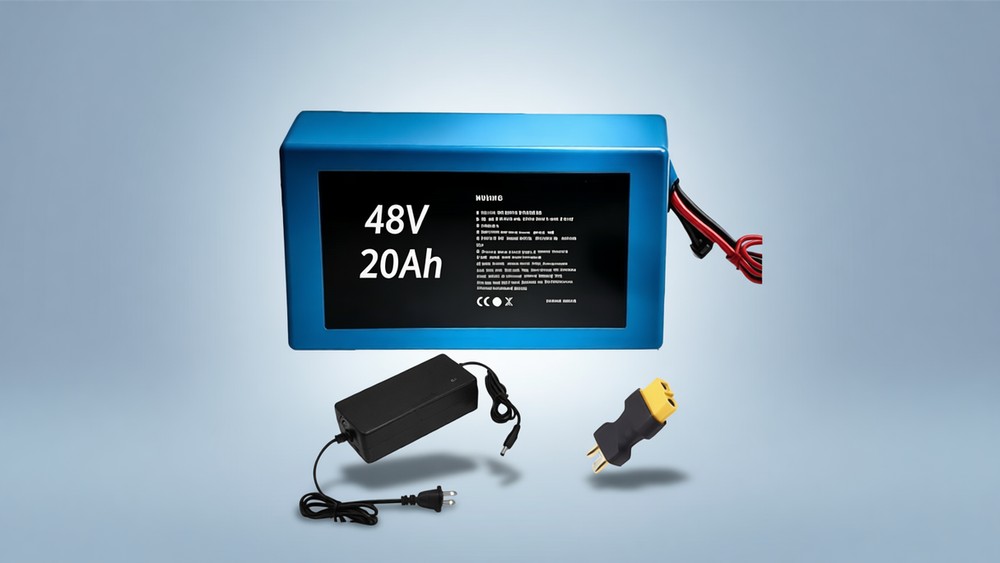
The verdict first. What sits on this page today is a 48V 20Ah universal power pack from a listing that names Brand: Generic and manufacturer Hong Kong HNBC Limited, at a checked price of 99.99 against the 132.99 our data held.
At that price for 960Wh it costs about 10 cents per watt-hour, which puts it among the very cheapest packs we track, and the full comparison table shows where it sits against everything else.
The rating is 3.4 stars from 8, and the written record is four texts, every one backed by a confirmed order and every one written in July 2026.
Two describe exactly the battery the title promises. Two describe packs that don't work. I don't know of a clearer lottery ticket in the battery category right now.
A 3.4-star record with nothing in the middle
Star histograms usually taper. This one doesn't. The breakdown reads 48 percent five-star, 16 percent four-star, and then zeros across three and two stars until 36 percent land on one star.
Whatever makes one pack good appears to make the next one useless, and nobody has had an okay experience.
The written side is small but consistent in its split. Four texts exist, and the three that carry a helpful vote share that vote one apiece, which means the most-endorsed things on the page are a one-star and a five-star in a dead heat. There is no consensus here to lean on, only a coin flip that other buyers have already flipped both ways.
What the record doesn't hold matters as much. No owner has reported a range figure, a metered capacity, a fit on a named bike, or enough months of ownership to say anything about how the pack ages. Both five-star texts are one line long and name no detail beyond working well.
You're buying on faith either way, and the only question worth asking is how to check the faith cheaply.
What the two unhappy owners actually hit
One owner has reported a pack that wouldn't take a charge at all, a return, and a company that vanished from the conversation. That text is blunt: defective battery, no customer support, buyer beware.
A dead-on-arrival pack is a known failure mode in this price class, but the vanished-seller part is the detail that should shape how you buy, because it tells you the warranty path may run through Amazon rather than through Hong Kong HNBC Limited.
The other one-star is more useful, because the owner measured. They bought two packs. One arrived reading 40.0 volts, and neither of the two ever charged up to 54.6 volts.
Both of those numbers mean something specific. A 48V pack is 13 cells in series, and full charge is 4.2 volts a cell, which is why every 48V charger terminates at 54.6 volts. A pack that never reaches that figure has a cell problem or a BMS problem, and no amount of additional charging fixes it.
The arrival reading is the more interesting one. Lithium packs are supposed to ship at about 30 percent charge, which rests near 3.7 volts a cell, or roughly 48 volts across a 13-cell pack.
A pack that arrives at 40.0 volts is sitting around 3.1 volts a cell, far under the shipping norm. That's not a pack that sat in a warehouse too long. That's a pack with something wrong inside it before the buyer ever plugged it in.
No cell name, no cycle curve, a 1000-cycle promise
The bullet promises 1000-plus charge cycles, rigorously tested. Here's what the page never tells you: whose cells are inside. No cell brand appears anywhere, no model number for the cells, no test curve, nothing.
Consumer Li-ion is typically specified at 300 to 500 full cycles before capacity fades toward 80 percent, per Battery University, and a claim of double that without a cell name is a marketing number until somebody meters it.
The warranty gives you one year, which is honest cover for a dead-on-arrival pack and no cover at all for a pack that fades early. And no certification mark, UL or otherwise, appears anywhere on the page. Plenty of no-name packs sell without certification, and most ride fine for years.
But the certification is the part of a branded pack you're not getting, along with the brand.
One wording note worth catching before you mount this thing. One bullet calls the PVC layer waterproof. The spec bullet says IP65, which covers dust and low-pressure jets from any direction. It is not an immersion rating, so rain is fine and puddles are fine, but a pack that sits in water is outside what the rating promises.
The arithmetic to run yourself
Start with the weight, because it's the number that smells. The listing claims 11 pounds. Nine hundred sixty watt-hours in about 5 kilograms is roughly 190 watt hours per kilogram, and a finished ebike pack built from name-brand cells lands in the 90-to-160 band.
A claimed density above the band doesn't prove anything on its own. It means the capacity claim and the weight claim can't both be exactly true, and the way to find out which one is bent is to put the pack on a scale and then meter it.
The BMS arithmetic is cleaner. Thirty amps at 48 volts is about 1440 watts continuous, so the title's 200-to-1000W systems claim fits comfortably inside the protection limit.
What the arithmetic can't tell you is whether the pack delivers, because not one owner text reports running any motor on it. The electrical ceiling is on paper only.
Charging runs slow by design. The included 54.6V 2A charger pushes 2 amps into 20 amp-hours, which is a tenth of a C rate, so a bulk charge from empty takes roughly 10 hours.
That figure is our arithmetic, not a listing claim, and the old version of this article printed a 5-to-6 hour figure attributed to the manufacturer that appears nowhere on the live page. Plan an overnight charge and stop believing everything a listing used to say.
Range depends on how you ride, with the denominator out in the open. At 20 watt-hours per mile, gentle pedal-assist on flat ground, 960Wh carries you roughly 48 miles. At 35 watt-hours per mile, heavy throttle and hills, it carries you roughly 27.
The old article's 20-to-40 mile band came from the same arithmetic with wider error bars, and the honest position is that no owner has published a real-world figure for this pack yet.
Buy it with a meter, not on faith
The decision this pack forces is unusual, because the price is right and the evidence is split down the middle. It costs less per watt-hour than almost anything we track, the two happy owners say the capacity is real, and the two unhappy owners have documented failure modes with dates behind them. Every written text on this listing sits behind a confirmed order, which is rare and worth something.
So the only sane way to buy this pack is with a test plan that finishes inside the return window. Weigh it on the kitchen scale first, because 11 pounds claimed is a checkable number.
Charge it and confirm it terminates at 54.6 volts, because the unhappy owners have told you exactly what a broken pack reads. Then meter a full discharge, and Battery University is blunt about why: no short test can measure a battery's true state, a full charge can mask a weak pack, and capacity is the indicator that matters.
A watt meter between the battery and the controller costs about as much as a lunch and turns the capacity question from a guess into a number.
Skip it if you can't run that test, if your build genuinely draws near the BMS limit, or if the pack needs to survive a wet winter outdoors on a rack.
The money you save isn't worth a pack you can't verify and a seller who has already stopped answering one buyer. It makes sense for a DIY builder, a mobility project, or a spare pack for a bike that sees light duty, bought by someone who enjoys the testing as much as the riding.

FAQ
Will this pack fit my bike?
Not on a standard mount, no. It's a rectangular PVC case with no bracket, no bottle-cage shape and no downtube form, so it lives on a rack, in a cargo box, or in an enclosure you build.
The case measures 10.03 by 2.95 by 6.1 inches, so measure your mounting space before ordering. It connects through a T-Plug, and the box includes a T-Plug to XT60 adapter.
Can it run a 1000W motor?
On paper, yes. The 30A BMS caps continuous output at about 1440W at 48 volts, which covers a 1000W motor with room to spare.
What nobody has reported yet is running any motor on this pack, so the ceiling is arithmetic rather than evidence. Keep an eye on pack temperature on long full-power climbs.
Why does the arrival voltage matter so much?
Because it's the one reading that separates a tired pack from a broken one. Lithium packs ship at about 30 percent charge, near 3.7 volts a cell, and this one's unhappy owner measured 3.1 volts a cell on arrival. A pack in that state out of the box has an internal problem, and it's the same owner who reports neither of two packs ever reaching full charge.
How do I meter the capacity myself?
Put a watt meter inline between the battery and the controller, charge the pack full, and ride until the BMS cuts off. The meter totals the watt-hours delivered. Compare that total to 960 and you have the real capacity, which is the number every future decision about this pack should rest on. We walk through the same test in our VATOSO 48V 13Ah review, where two owners metered packs that came in well under their rated capacity.