Running out of charge mid-ride has a simple cure: more watt-hours. The catch is what sits inside the pack. Two listings can claim the same 25 amp-hours and the same name-brand cells while carrying different warranties, different motor windows and different paperwork behind the safety badge.
This EXECYC 48V 25Ah pack lives in that gray zone. Its Amazon page shows a perfect five-star score, a title branded with initials that belong to a different company, and two different motor-wattage windows on the same page. The eight written reviews are all tied to actual orders, which is rarer than it should be, and none of them says a critical word.
This piece walks through what the page actually says: where the wattage claims come unstuck, why the title hedges on voltage, what the cycle and cert claims are worth, and what the riders who bought it actually report.
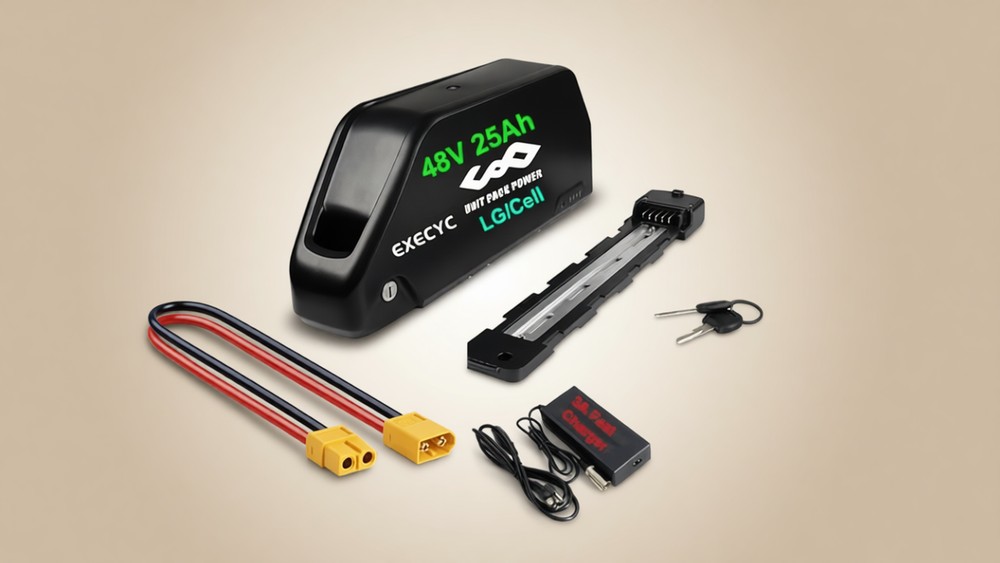
The EXECYC 48V 25Ah pack is a 1200Wh lithium battery with a 5-pin base, XT60 discharge leads, a lock and an LED gauge, sold by a brand whose name differs from the initials in its own title. On our price-per-watt-hour scale it sits close to the middle of the packs we track, so you are paying ordinary money for ordinary value here, not a bargain. The review score is perfect and the record is young, and the page's own spec rows disagree with each other in ways worth knowing before you order.
A Perfect Score on a Young Record
Thirteen buyers have rated this pack, all thirteen at five stars, and the eight written reviews carry purchase confirmation in every single case. That combination is genuinely unusual. Most young listings we rebuild carry a share of texts with no purchase confirmation, and this one has none of them.
The catch is what the pool cannot tell you yet. The oldest written review dates to early February 2026, so the whole record runs about eight months deep, and nobody has reported a full cycle-life measurement, a failure, a warranty claim or a winter of riding. One reviewer has flagged the gap directly, awarding five stars but adding that they will reevaluate if the charging cycles fall short of the claim. That is the right posture for a pack whose listing makes big long-life promises, and it is the honest reading of a perfect score this young: no bad news yet is not the same thing as good news for years.
Two Wattage Windows and No BMS Figure
The title says this battery suits motors from 50W to 2000W. The first bullet says it suits 1500W, 1200W, 1000W, 750W and 500W motors, then adds a parenthetical range of 100W to 1500W. Those two windows disagree at both ends, and the page never settles the argument.
What makes the clash hard to resolve is what the page leaves out. Most battery listings back a motor window with a BMS amp rating, because amps times nominal volts gives you the actual ceiling, and a 30A figure on 48V tells a very different story from a 50A one. This page names no BMS amperage anywhere, not in the bullets and not in the details table, so there is no arithmetic to check either window against.
One owner report lands on the title's side. One rider runs a 2000W motor and keeps this pack alongside two other 48V batteries, reporting no issues so far. That is a real data point at the top end, but it is one buyer, short-tenure, and the bullet's own 1500W ceiling would exclude their setup. Ask the seller for the BMS rating in writing before you pair this pack with a big motor.
One Pack, Two Voltages, One Model Number
The title hedges on the most basic spec a battery has. It names the pack as 48V and 52V at once, and the details table never resolves which it is, because no cell count and no charge voltage appear anywhere on the page. The bullets step around the question with fitment language, saying the pack suits 48V and 52V controllers, which is a statement about what it can connect to, not about what is inside it.
There is a clue in the model number. This listing carries model R049-6, and the Joyisi 52V 25Ah pack we rebuilt carries the same model number with the same one-year warranty. The same factory part appearing under two brand names is common in this market, and it hints the family may genuinely span both voltages. That is a hint, not an answer. A 13S pack charges to 54.6V and a 14S pack to 58.8V, and a charger built for one can leave the other undercharged or overdriven, so the voltage matters more than any other line on the page. Ask the seller which charger ships with it before you buy.
Cycle Counts, a Five-Year Claim and a One-Year Warranty
The listing stacks long-life claims high. The bullets promise more than 1000 deep charge cycles, at least 80% capacity remaining after 800 cycles, and a life expectancy of up to five years. Against that stands a one-year warranty, which is the only part of the stack with a signature on it.
The class norm matters here. Consumer lithium packs are typically specified for 300 to 500 full cycles before capacity falls to about 70 or 80%, per Battery University's cycle-life reference, and claims beyond that depend on cell grade, how deep you discharge and how you charge. A 1000-cycle promise is roughly double the norm, it comes from the seller's own testing, and the one buyer watching that claim has owned the pack for less than a year. The honest framing is that the five-year figure is a hope, the 1000-cycle figure is a claim, and the warranty is the only number anyone has to honor.
The safety badge deserves the same treatment. The title reads UL2271 certification by SGS, but it names no certificate number, and it spells the word as Certifated. UL's Product iQ database lets anyone search cert records for free, and a two-minute search settles whether a UL2271 record exists for this pack family. Until somebody runs that search and finds a record, treat the badge as a claim.

Where Riders Report It Fits, and How Far It Goes
The fit reports are the most useful thing in the pool. Buyers name the HappyRun G60 Pro, a QLife fat tire bike, an Aventon Adventure, a FreeSky Ranger and a Meetone trike, and one trike owner says the pack sat straight on the existing rails without needing the included bracket. The 5-pin base comes installed and the XT60 leads are in the box, and the page warns you to measure your battery space first, which is advice worth taking since returns are the cost of guessing wrong.
Two owners put mileage numbers on it. One upgraded from a 48V 15Ah pack that delivered 15 miles and reports 51 miles with a third of the charge still showing, putting their own estimate near 70 miles on a full pack. Another reports 45 to 50 miles running a single motor and about 30 running two motors half the time, first on an Aventon Adventure and then on a FreeSky Ranger. Both reports are consistent with a 1200Wh pack at a plausible usage rate, but both are self-reported, neither names a measurement method, and neither rider has owned the pack through a full year. Treat them as encouraging, not as range guarantees.

On value, this is the part the perfect score does not fix. At the time we checked, the pack sat close to the middle of the batteries in our comparison table on price per watt-hour, and the same money buys packs that cost less per watt-hour, some with stated BMS figures and longer warranties. If the fit is right and the seller answers the BMS and voltage questions, the young perfect record is a reasonable bet. For a big-motor build or a multi-year commute, the 48V 20Ah sibling and the rest of the table are worth a look first.
Frequently Asked Questions
What size motor can this battery run?
The title says 50W to 2000W and a bullet says 100W to 1500W, and the page never reconciles them. No BMS amperage appears anywhere, so neither window can be checked against arithmetic. One owner has run a 2000W motor without reported trouble, but that is a single short-tenure report.
Is the pack 48V or 52V?
The title claims both, the bullets only say it suits both kinds of controller, and the details table names no cell count or charge voltage. Ask the seller what charger ships with it, because a 13S pack charges to 54.6V and a 14S pack to 58.8V.
How long will the battery last?
The listing claims more than 1000 cycles, at least 80% capacity after 800 cycles and up to five years of life, over a one-year warranty. The class norm for consumer lithium packs is 300 to 500 full cycles, so treat the big numbers as seller claims and the warranty as the enforceable figure.
Is the UL2271 cert real?
The title names UL2271 and the test firm SGS but gives no certificate number. Search the pack family in UL's free Product iQ database before relying on the claim.
Which bikes does it fit?
Owners report it on a HappyRun G60 Pro, a QLife fat tire bike, an Aventon Adventure, a FreeSky Ranger and a Meetone trike. It mounts through a 5-pin base installed at the factory and uses XT60 discharge leads. Measure your battery compartment first.
Can the perfect five-star score be trusted?
All thirteen ratings are five stars and all eight written reviews carry purchase confirmation, so nothing looks faked. The record is about eight months deep with no long-term reports, and one buyer has scored it five stars while explicitly waiting to see whether the cycle claim holds.