A 52V pack with 1,300 watt-hours is not a commuter accessory. It is the battery you buy when the build has outgrown every pack that bolts inside a frame triangle, and the questions that matter stop being capacity and start being amps, mounting and trust.
Trust is where this listing gets interesting. The Joyisi 52V 25Ah sells on a 4.3-star average from 41 ratings, but that review thread is shared across the whole Joyisi 52V family, and the buyers in it name 18Ah, 19.2Ah and 20Ah packs.
On the spec sheet, the listed weight disagrees with itself and so does how many amps the BMS passes. And the title carries a UL 2271 claim with no certificate number behind it.
None of that makes this a bad pack. It makes this a listing you read with more care than most, and this review walks through which numbers hold up, which do not, and what the fourteen purchase-confirmed reviews actually cover.
The Joyisi 52V 25Ah sits close to the middle of the 301 packs we track on price per watt-hour, which is a fair place for 1,300Wh to land. On price per watt-hour, check where it sits today on the comparison table. Stock was down to four units when we checked, so if the spec below fits your build, the wait is not long.
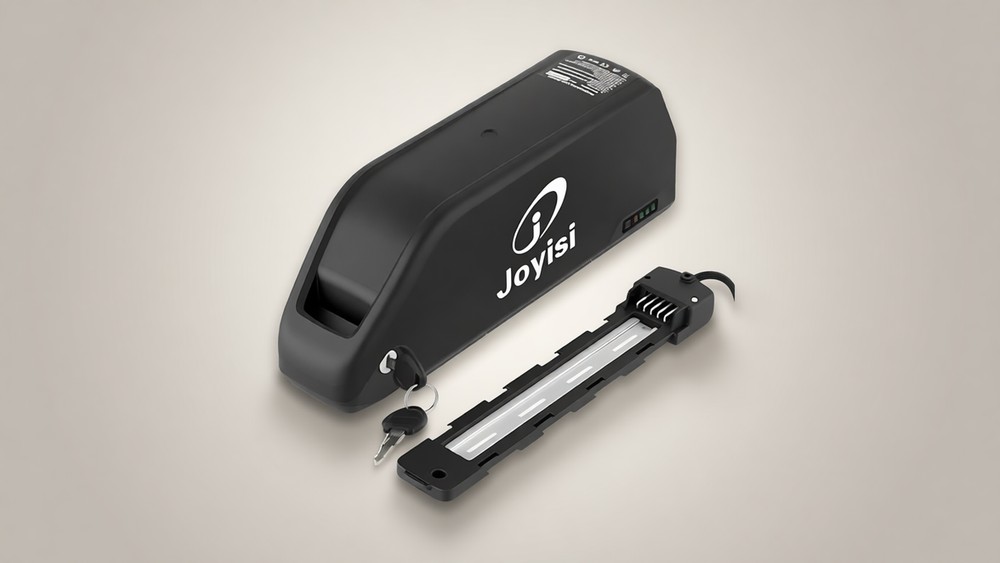
Three weights, two amp ratings, one spec sheet
What survives the noise
Start with what survives. This is a 52V pack at 25Ah, and 52 times 25 is 1,300Wh.
The model number is R049-6, the pack measures 14.5 by 3.7 by 6.1 inches, and the charger is 58.8V at 3A. The spec table promises a one-year warranty. Those are the load-bearing facts.
What wobbles
Now the noise. The same details table gives 15.4 pounds on one line and 5 kilograms, about 11 pounds, on another. One buyer describes the pack they received at about 8 pounds, on a page whose own numbers say 11 or 15.
Three weights on one product, and no way to tell from the page which one arrives at your door.
The discharge rating wobbles too. The bullet copy says the maximum discharge current is 50A.
The details table says 40A. Both matter for different reasons, and the next part works through both. The cell claim wobbles with them: the title says L*G 21700 cells with an asterisk standing in for a trademark the seller doesn't want to write, while the bullet says LG 5000 battery cells, which reads as a per-cell figure rather than a cell name.
And somewhere in the details table the listing claims the pack works with the iPhone, which tells you how much human care the metadata gets.
None of these wobbles is fatal on its own. Together they set the tone for how to read everything else on the page, including the UL claim.
What the amp rating means for a 2000W build
The power claim is the one place this listing is more consistent than it looks. At 50A, the bullet figure, 52V works out near 2,600W of sustained delivery.
At the details table's 40A, it still works out near 2,080W. Either number sits above the top of the stated 100-2000W motor band, so the claim that this pack suits a 2000W build holds under the listing's own worst case. The XT60 connector the pack ships with is rated around 60A, above both readings.
Two practical notes belong next to that arithmetic. One buyer reports the wires need soldering, or a separately bought connector crimped with a heat gun, before anything plugs in. If your controller doesn't already speak XT60, budget for that step and the adapter.
Charging takes a while. The 3A charger pushes about 176W, so a full 1,300Wh from empty takes roughly 7.5 to 9 hours. That lines up with the bullet's advice to charge for at least 6 hours, though that advice undersells the last stretch where the red light finally turns green.

The 4.3 average counts the whole Joyisi 52V family
Here is the part the rating number hides. Amazon has pooled one review thread across every Joyisi 52V pack size, and the buyers in that thread name the pack they actually bought: an 18Ah LG pack, a 19.2Ah Tesla-cell pack, a 20Ah pack. The October 2025 reviewer says outright that they ordered the 18Ah and can't tell why the 25Ah listing shows up as their purchase.
So the 4.3 from 41 is a brand signal, not a verdict on this pack. It says something about Joyisi's cells, support and chargers in general.
What the thread does establish is a clean record on purchase confirmation: all fourteen written reviews we captured carry it, and not one five-star is anonymous.
The most-endorsed report is the July 2022 five-star, whose owner has ridden a 19.2Ah sibling hard enough to log 44, 41 and 42 miles on its first three charges behind a 1000W mid-drive. The biggest recent build report is a July 2026 five-star fat-tire conversion at 2000W that still had roughly 40 percent left after two hours of riding.
The criticism cluster is small and specific. One buyer with a 20Ah sibling has compared it against an 18Ah pack and found the bigger number delivering less range, with a charge time fast enough to feed their doubt about the rated Ah. Another reports a Tesla-cell pack that ran about two and a half years before range decline set in.
Roughly 22 percent of all ratings sit at three stars or below, an unusually heavy three-star band for the category, and the pool-sharing means nobody can pin that band on any single pack.
The one long-term report matches normal lithium aging
The January 2026 three-star deserves its own look because it is the only long-term report in the thread. The owner has watched a Tesla-cell sibling lose half its range at around the 2.5-year mark, and after the seller sent a BMS to repair the pack, still rated it three stars instead of one.
Set that timeline against the industry norm rather than a marketing promise. Battery University's BU-808 notes that manufacturers specify consumer lithium-ion at 300 to 500 full discharge-charge cycles, that a full-depth NMC cell manages about 300 cycles before it holds just 70 percent, and that fade is gradual rather than a cliff, with laboratory packs falling to 73 to 84 percent of where they started after 250 full cycles.
A heavy rider who cycles a pack every day or two lands near that 2.5-year decline without anything being defective. One or two weak cells can accelerate it, as that owner suspects theirs did.
The practical takeaway is boring and it works. Meter the pack's range in the first month so you have a baseline. Favor partial charges, since depth of discharge is the biggest lever you control.
And keep expectations anchored to the one-year warranty in the spec table, which is the class norm, rather than to the lifetime technical support line, which is a promise nobody can audit.

Mounting, keys and the small print that bites
A 14.5-inch long pack weighing somewhere between 11 and 15 pounds does not mount itself, and the reviews are oddly detailed about this part.
One buyer reports the mounting plate arrives attached to the battery and takes real force and some understanding to dislodge, which sounds silly until you're the person hunting for a missing part that was there all along. Another describes the install as annoying given the size of the mount and where the screw slots sit.
Two reviewers steer toward the same fix: the Grin Technologies double-bob mount, because most bikes don't fit the water-bottle bracket this pack expects. One of them says order it at the same time as the battery. That's cheap cover against a weekend stuck in the garage.
Then there are the keys. One buyer received a set that did not match the lock, toured half a dozen locksmiths, learned the key type is not commonly copied, and finally had a locksmith re-key the lock to fit.
The seller had offered to ship a new battery, which is decent support behavior, but a key you can't copy is a real failure mode on a pack with a locking mount.
Frequently Asked Questions
Is the UL 2271 claim checkable? Partly. The listing says the battery is certified to UL 2271 but publishes no certificate number. Certification to that standard is real for some ebike batteries, and you can search UL Product iQ yourself for the company and model. No number on the listing means the claim stays unverified until you run that search.
Will it actually run a 2000W motor? The arithmetic says yes. At the bullet's 50A, 52V delivers about 2,600W, and even at the details table's 40A it delivers about 2,080W. Both sit above the top of the stated motor band, and the XT60 connector is rated above both.
How long does a full charge take? Roughly 7.5 to 9 hours from empty on the included 58.8V 3A charger, since it pushes about 176W into a 1,300Wh pack. The listing itself says at least 6 hours, and the red-to-green light change is the honest signal.
Is the 4.3-star rating about this exact pack? No. Amazon shares one review thread across the Joyisi 52V family, and reviewers name 18Ah, 19.2Ah and 20Ah packs in it. Treat the score as a brand signal. The fourteen written reviews we captured all carry purchase confirmation, which is the trustworthy part.
What range should I expect? No reviewer gives a figure for this exact 25Ah pack. By the class figure of 15 to 25 watt-hours per mile on moderate pedal assist, 1,300Wh works out to roughly 50 to 85 miles, and full-throttle riding near 30 watt-hours per mile lands in the low-to-mid 40s. Typical ebike ranges span a wide band, and Wikipedia's electric bicycle article reflects the same 25-to-75-mile spread for ordinary packs. A 1,300Wh pack sits above the middle of it.
Compare the field before you commit on the battery comparison table, or browse Joyisi ebike batteries on Amazon to check today's stock. Our Joyisi 52V 20Ah review covers the lighter sibling in the same family.