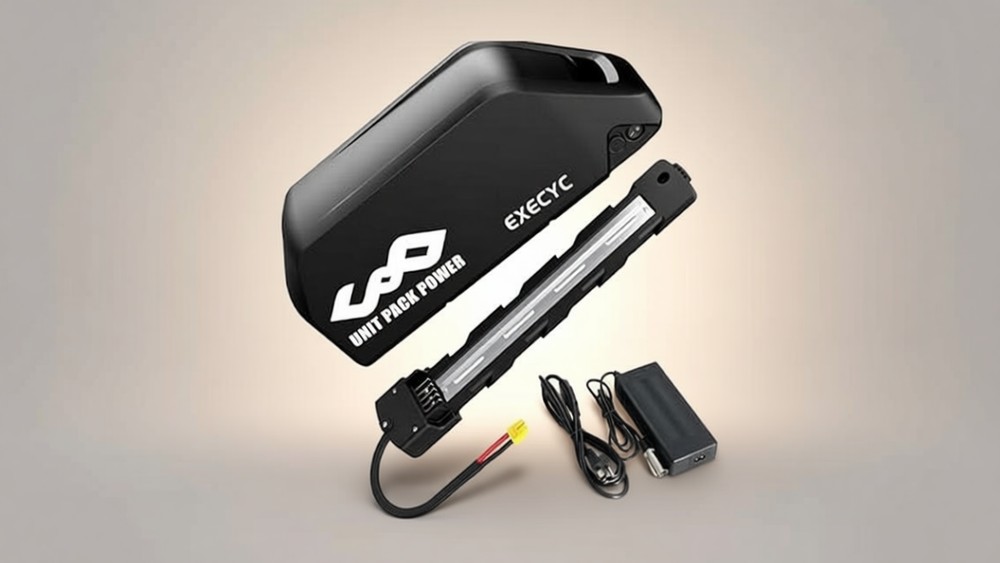
What makes a 50 amp BMS unusual on a Hailong style 48V pack? Most batteries using this form factor will have a maximum amperage capacity of either 25 amps or 30 amps. The EXECYC 48V 20Ah features a 50 amp smart BMS with Genuine LG 5000mAh 21700 cells and is UL2271 certified. To get all those components together in one budget unit is quite rare.
This battery is mounted into a standard Hailong type housing featuring a mounting bracket that utilizes the same water bottle screw holes as most frames do. Compatible with most controllers via an XT60 connection, this 50 amp BMS allows for sustained high discharge rates on 1500W motors without tripping protective circuitry.
Specs and Build Quality
The EXECYC 48V 20AH employs Genuine LG 5000mAh 21700 cells in a Hailong housing. Larger than the traditional 18650 size, 21700 cells generally offer greater energy density and lower internal resistance. Also, the fact that LG is a tier-one manufacturer lends greater assurance regarding the cycle life of these cells when compared to generic cells.
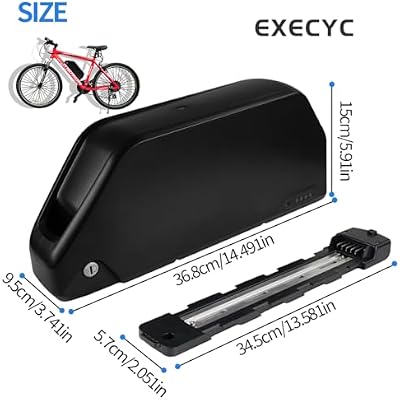
The length of the battery is 365 mm. Its width is 90 mm and height is 127 mm. Weighing in at approximately 4.5 kg (approximately 10 lbs), this is standard for a 48V 20AH Hailong battery.
A 50 amp smart BMS is more advanced than the simple protection board used in most low-cost batteries. The 50 amp continuous rating equates to approximately 2400 watts of peak output. Thus, the EXECYC 48V 20AH should be able to handle both 1500W and 1800W motors. Most 48V 20AH packs available at this price point feature a BMS capable of handling up to 25 amps or 30 amps, and thus are overwhelmed by anything above 1000W. That makes a real difference for riders running higher-power hub motors or mid-drive setups where sustained current draw is the norm rather than the exception.
UL2271 certification indicates compliance with safety standards applicable to light electric vehicle batteries. In this price segment, this is rarely seen outside of packs developed by manufacturers such as Rad Power, Bosch, and others.
Design Aspects
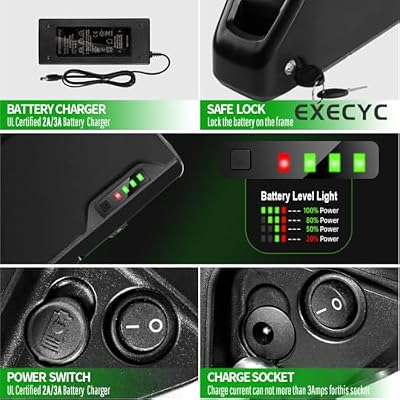
An incorporated locking and unlocking mechanism secures the battery to the frame-mounted bracket. Integrated USB port facilitates the charging of accessories like phones during extended ride sessions. The on/off switch and LED indicator provide additional tools to minimize stand-by consumption.
Mounting bracket attaches to the most common mounting system utilized in the industry, the water-bottle screw hole style. Discharge port consists of five pins, typical for this form-factor. The battery is easily removable for charging purposes, yet secured firmly onto the bicycle while riding.
BMS Performance and Protection
Smart BMS employed in this design protects against over-charge, under-discharge, over-current and short-circuits. Generally speaking, smart BMS units tend to perform superior cell-balancing functions than their passive counterparts, potentially increasing overall life of the pack.
Real world mileage achievable from this battery is heavily dependent upon how aggressively the user chooses to utilize his or her bike. With a typical average consumption rate of approximately 20 wh/mile on a 750W hub-motor equipped bike, users may achieve distances ranging from approximately 45 to 48 miles. On a 500W mid-mounted bike employing pedal assist, users may realize distances ranging from approximately 55 to 65 miles based on terrain usage and rider weight. Commuters who stick to paved roads and moderate assist levels can confidently expect the higher end of this range.
Riders facing steep grades or running higher power levels will see numbers closer to 40 miles. The battery comparison list at /ebike-batteries/ shows how the EXECYC's range and price stack up against similar capacity packs.
As previously stated, the inclusion of a 50 amp BMS makes this battery an excellent candidate for utilization in higher-power configurations. As a reference example, a 1500W motor drawing 31 amps at 48V maintains ample margins below the current limits established by the smart BMS. Furthermore, the smart BMS can also accommodate brief bursts of power above the nominal value of approximately 2000W without invoking protection mechanisms.
Target Audience
The EXECYC 48V 20Ah addresses a very specific area of need among e-bike enthusiasts: utilizing genuine LG cells combined with high-current smart BMS technology in a standard Hailong case without having to pay premium brand prices.
Not recommended for individuals requiring more than 960Wh of battery capacity to support extended ultra-long range days, individuals with non-standard battery trays, or the tightest budget constraints. See the battery comparison table to compare this pack with other 48V options.
Frequently Asked Questions
What Differentiates a "Smart BMS" from a Standard BMS?
Generally speaking, smart BMS units tend to provide superior cell balancing capabilities and often include enhanced monitoring capabilities in addition to potential Bluetooth connectivity or configuration options.
Will This Battery Fit My Rad Rover or Lectric XP?
That depends entirely on the mounting bracket. Since the Hailong case mounts to water bottle screw holes, if your bike has two such screw holes spaced exactly 64mm apart, then there is a good chance the bracket will fit. However, Rad Rover and Lectric use proprietary mounts, so check your tray dimensions carefully.
Does the UL2271 Certification Make Any Difference?
Yes. UL2271 is a safety standard specific to abuse testing for light EV batteries. Not many budget ebike batteries carry it.
What Connector Does This Use?
XT60 connector. This is typical for most ebike controllers and conversion kits designed by BAFANG. If your controller needs a different connector type, adapters are widely available.
How Long Does It Take to Fully Charge This Battery?
Using a standard 2-amp charger, a full charge of approximately 10 hours will be required for a full recharge on a 20Ah pack. A 4A or 5A charger cuts that to 4 to 5 hours. Many aftermarket chargers work fine with this battery as long as they use the correct connector and voltage profile. If you need faster charging, look for a charger that supports at least 5A output to get closer to the 4 hour mark. This is especially useful for commuters who need to top up during the workday.
Does This Battery Have Bluetooth App Support?
No. The listing does not mention Bluetooth monitoring or battery app support. This is a standard smart BMS with no wireless connectivity. If you need Bluetooth battery monitoring, those packs typically cost significantly more for comparable capacity and build quality.
The 50A BMS is the quiet selling point here. Mid-drive builds and heavier riders pull harder on acceleration, and a 30A-limited pack will cut power right when you need it. With headroom like this, the limiting factor becomes your controller, which is exactly where you want it.