Budget intercom families keep splitting into pack rungs, and the rungs do not always price the way a shopper expects. The Chtoocy X10 family is the clearest case we have found. There is a single-unit listing we reviewed in April, and beside it sits a two-pack at nearly the price of two units and a half.
A rider equipping two helmets usually assumes the pair saves something. On this family it costs something, and the record behind both listings is the same seventeen-rating pool, so the decision between the rungs is pure arithmetic plus whatever the pair page adds.
We scraped the two-pack listing and both review sorts signed in, re-verified the single's price live the same day, and compared the rung against our intercom comparison table. What follows is the pair math, what the two-pack page itself adds, what the shared record has grown since the single's review, and the one group order in the record that shows exactly how the pair can go wrong.
The verdict up front. The two-pack X10 at 99.99 works out to 50.00 per helmet against the single at 42.99, so the pair costs 7.01 more per unit than buying the single twice. The hardware and the record are the same on both rungs.
The pair is a convenience purchase, and on this family it is the expensive kind.
The ladder, and a pair that saves nothing
Amazon's own variant data settles what the family contains. Two rungs: B0GCPX4C7G for 1 Pack, B0GCQMTM1M for 2 Pack.
The single sold for 42.99 when we reviewed it in April, and it still sells for 42.99 today, verified on the live page while this article was being written. Two singles therefore cost 85.98.
The two-pack asks 99.99. That is 14.01 more than two singles, or 7.01 extra on every helmet, about a sixth of the single's price again. Compare the THETREE X10 family, where the two-pack and two singles cost the same to the penny and the pair decision is only about convenience.
The Chtoocy rung economics run the other way, and nothing on the two-pack page explains the premium.
The comparison table's per-rider metric needs a caveat here. Dividing 99.99 by the claimed ten riders prints 10.00 per rider, which reads like a mid-table figure.
But the box holds two units, not ten, so the honest buyer figure is the 50.00 per helmet. The per-rider number on a pack listing assumes the pack fills the group claim, and no evidence in this record comes close to a group of ten.
One record behind two doors
Both rungs print the same numbers: 3.8 stars from 17 ratings, with 41 percent five-star, 23 percent four, 23 percent three, no two-star band at all, and 13 percent one-star. Amazon pools ratings across a variant family, so a buyer of either rung is reading one shared record through two pages.
Our review of the single dissected that record in detail: seven purchase-badged texts, five of which hit a snag, three smooth unverified texts that read like the listing itself, and a histogram that jumps from content to unhappy without passing through the middle. That analysis still holds and this article does not repeat it.
What has changed is the size. The single's review worked from ten texts.
An eleventh now sits underneath them, dated January 28 2026, carrying no purchase badge and one helpful vote. It describes a weekend crew whose rides feel more coordinated, with natural voice tone and a connection that gets back on track on its own.
The vocabulary is the listing's vocabulary, and it joins the unverified group rather than changing it. The badge count now reads seven purchase-badged texts of eleven.
What the two-pack page itself adds
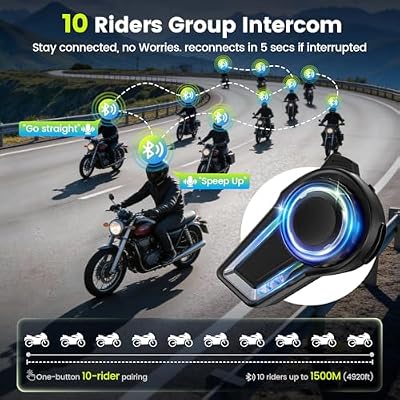
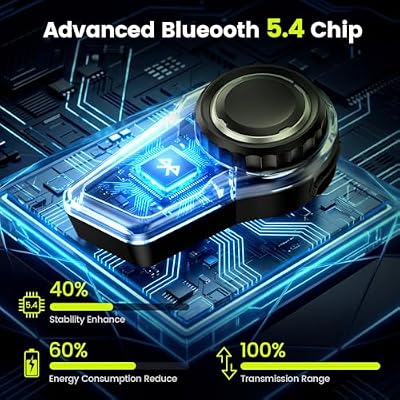
Most of the two-pack page repeats the single's claims word for word: ten riders in one group, Bluetooth 5.4 under a Qualcomm name, a 1500-meter claim between any two riders, 30 hours of talk time, IP65 against rain. That 1500-meter figure deserves its usual caution. Standard Bluetooth manages about 10 meters and roughly 100 in the best case, and Bluetooth 5's long-range modes top out near 400 meters, so the claim rides on the vendor's own range modes and open terrain rather than on the standard (Wikipedia). Nobody in the record has measured a distance. The details that belong to this rung alone are few but useful.
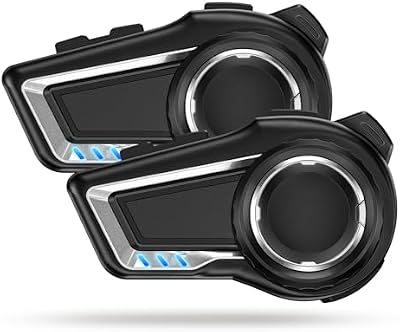
One rung difference is genuinely new on this page. Number of Items reads 2, which settles the box count the way the ladder does.
The certification row names ANATEL, the Brazilian regulator, with the model number X10, the same oddity the single's review documented on a US-market listing. The details table adds a 2-hour charge time. The warranty row is the same 2-year manufacturer coverage.
One term worth naming appears in bullet six of both rungs. The listing promises a 30-day money-back guarantee alongside the support team. On a record this snag-heavy, a stated return window is worth more than any bullet about sound, and a buyer of either rung gets it.
The page also carries the promise the record has already tested. Bullet one says the connection re-pairs within 5 seconds after any interruption so the conversation never drops.
The verified August owner has described the opposite: reconnecting the intercoms after using Bluetooth is a headache that should be one click. The single's review documented that complaint, and the two-pack page still sells the five-second answer to it. Nobody in the record has measured the reconnection time.
The group order that came back
The clearest warning in this record is also its most direct test of the pair decision.
A July owner rode with a group of seven who all ordered the X10 for one trip. The music quality was amazing, that owner writes, but the intercom sound was not good enough to settle for, even at the price. The units came back one by one, every friend returning for the same reason.
Seven buyers, one ride, zero keepers. That is the downside case for equipping a group with this hardware, and the pair rung concentrates it: the two-pack is the natural form for that kind of group order.
Around that account, the purchase-badged faults repeat what the single's review found. An April owner has reported the microphone running quiet on phone calls, with people on the other end barely hearing him, while the music stays loud.
A February owner had a clip piece break during installation. The October one-star text describes a broken mic on the first order and a replacement that arrived speaking Chinese, with language instructions that did not work and a support call that ended in frustration. The single's review covered the same broken-mic territory, and the newest text shows the pattern has not closed.
Who the pair still fits
The honest case for this rung is narrow and real. Two riders who have read the single's review, accepted its risk profile, and want matching units arriving together can buy the pair and use the 30-day window as the safety net. The premium buys one order, one delivery, and two units of the same firmware generation, not a discount.
Everyone else has a cheaper route to the same hardware: two singles at 85.98. A rider equipping a group that rides together every weekend should not start here at all. The comparison table prices proven units per rider, and the cheapest way into this family remains the single rung.
For the opposite rung economics, the THETREE X10 single sits in a family where the pair saves nothing but also costs nothing.
Frequently asked questions
Is the two-pack cheaper than buying two singles?
No, and it is not close. Two singles cost 85.98 at the single's current price of 42.99.
The two-pack costs 99.99, which is 14.01 more for the same two units, a premium of about a sixth on every helmet. The pair's advantages are one order, one delivery, and matching firmware, not money.
Does the ten-rider group mode actually work?
No purchase-backed text confirms it. The largest group any badged owner describes is three people on dirt bikes, and the one large group order in the record returned everything. A smooth unverified text claims trouble-free group talk with more riders than the system's own maximum allows, which is exactly why the single's review treats the unverified group with caution.
Can the X10 pair with other intercom brands?
The listing claims it works with other intercom systems and pairs with various headset brands.
Almost nobody in the record has tested the claim. One Spanish-language owner has noted the mesh range still needs validating on the road, and no text describes a successful cross-brand link. Treat universal pairing as a claim, not a feature.
What is the 30-hour battery claim worth?
There is no test of it in the record. The only battery signal from a badged owner is that the battery lasted decently on day trips, with no number attached. The details table's 2-hour charge time is the one battery figure a buyer can plan around, and a full charge before every ride is the sensible habit on hardware with no owner-measured endurance.