Cefito's 48V 10Ah pack was built for one job: dropping into a downtube bracket on a commuter whose original battery has died. At the cheap end of the shelf, it carried 480 watt-hours, and the word budget followed it everywhere, including our own headline from August 2026.
The listing is gone now, and the Amazon page returns a Page Not Found error, so nobody can buy this exact pack or watch its rating develop. What's left is a frozen record, and it's an interesting one, because the numbers kept in it pull against each other.
A rating sat below 4 stars. Its price per watt-hour sat above the brand's own bigger pack. Budget on paper, and a record that argues with it.
Below, the charge time gets recomputed from the charger the listing shipped with. Range gets scaled from an independent anchor instead of the old article's estimate. And the fit question, which is the one that actually decides a replacement purchase, gets answered from the recorded connector set rather than guesswork.
The Cefito 48V 10Ah downtube replacement pack was a budget pack whose record argues with its label. The price per watt-hour ran above the brand's own 13Ah pack, and the rating the listing carried sat below 4 stars on a sample too small to trust in either direction.
The parts that hold up are the ones a replacement buyer cares about: the recorded connector set, the bracket fit, and a charge time whose math settles a question the old article never noticed it had.
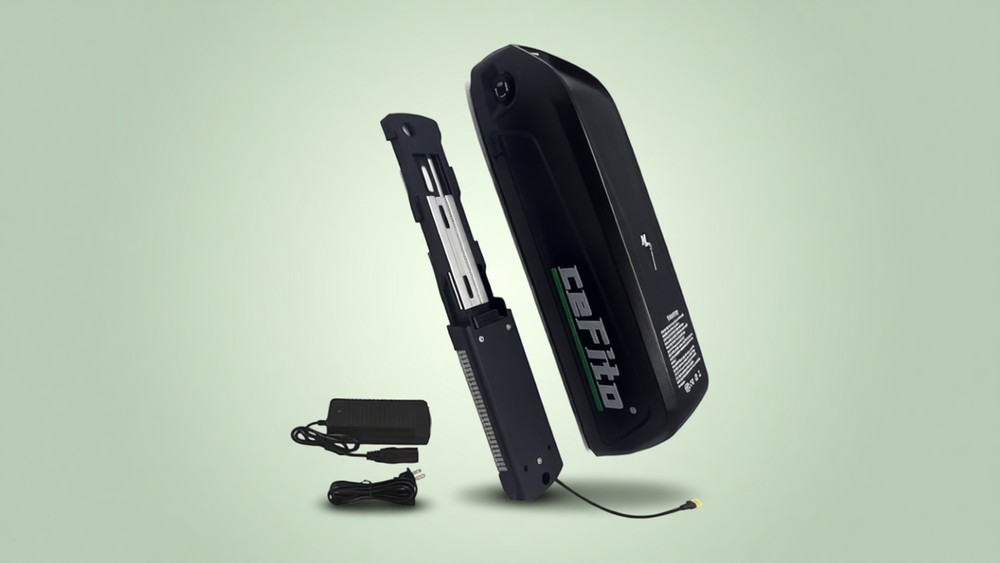
A Budget Label Against the Price-per-Watt-Hour Record
At 0.29 per watt-hour, this was the worst figure in the Cefito rows we track. The brand's 13Ah folding pack, rebuilt in our cefito 48V 13Ah review, holds 30 percent more energy for 21 percent more money and lands at 0.27.
When the bigger sibling beats the smaller one per watt-hour, the small rung exists for one reason only: a buyer whose bracket and budget fit a 10Ah pack and nothing else.
That's worth stating plainly because the old headline called it budget and the number disagrees. Across the 324 batteries we track, this figure sits just inside the expensive third. It was cheap in absolute terms, which is what the eye sees at the shelf, and expensive per unit of energy, which is what the rides cost.
Cheap absolute price still buys something real. For a bike that rides five miles each way, a 480Wh pack is not a compromise, it's correctly sized, and paying per-watt-hour premiums on capacity you'll never drain is its own false economy. The label was wrong about value and roughly right about the buyer.
What Five Ratings Can and Cannot Say
The record holds a 3.9 average from 5 ratings, captured in August 2026. Our dataset row kept no rating at all, so the number exists only in that one snapshot, frozen. It's the only pack in this rebuild stretch whose recorded rating sits below 4.
What does a sub-4 average on five ratings actually measure? Almost nothing, and the arithmetic shows why. One unhappy buyer among five drags the average below 4 on its own.
One happy buyer swings it to 4.75. The difference between those two worlds is a single purchase, so the average is a coin with a slight dent, not a verdict. Five ratings also say nothing about aging, which is the question that matters on lithium packs, since cells fade over years and a three-month snapshot can't see it.
The checks that matter more than the average
With a window this small, read the individual reviews instead of the mean, on any listing like this one. Look for what failed and when: capacity complaints in the first months point at overstated labels, while failures after a year point at cells or the BMS.
Check whether the negative reviews share a cause, because one loose connector reported five times is a design fact, while five different complaints are five different bikes. And weight any review that names a specific measurement, like a metered charge, above one that names a feeling. That checklist survives this listing's death, because it works on the replacement field too. Our Topone 36V 11Ah review walked the same checklist on another small record, one that sat even lower at under 3 stars.
The Charge Math Picks One of the Old Answers
The pack shipped with a 2A charger, which the record states plainly. Arithmetic on a 10Ah pack gives a five-hour floor from near-empty: ten amp-hours divided by two amps. There's no rounding that helps and no faster charger recorded.
Here the old article contradicted itself, and the math settles it. The body said a 2A charge takes about five hours, which matches the floor exactly. Its FAQ said three hours or longer, which fails: three hours on a 10Ah pack would take a 3.3A charger, and this one shipped with 2A.
The five-hour figure stands, the three-hour figure goes, and the contradiction matters because it's the difference between plugging in overnight and plugging in at lunch.
Five hours is overnight-shaped. A pack on the charger after dinner is ready before breakfast, and a commuter who rides in the morning never feels the speed. The pain arrives on a two-ride day, when a drained lunchtime pack is not ready again until early evening.
Buyers in that pattern want a 3A unit, and the record never said the listing offered one.
Fit: a Downtube Bracket, T-Plugs, and No Controller
The recorded fit profile is specific, which makes it useful. The pack mounts to a generic rectangular downtube bracket area, not to a proprietary mount and not to a rear rack system, so a bike with a rack-mounted pack needs a different family entirely.
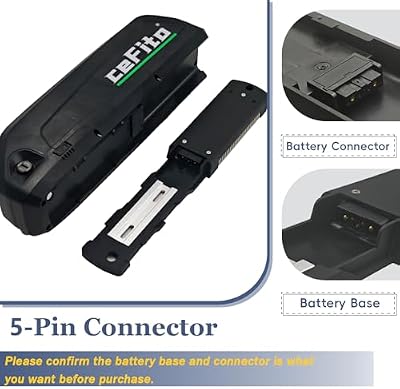
The discharge side runs a T-plug, with an XT-60 to T-plug adapter in the box, which covers the two most common controller connectors of that class. The base plate carries a five-pin connector, and the box shipped without a controller, so the five-pin side only matters to a bike whose original system already speaks that language.
One year of warranty came with it, recorded in the old article's FAQ. That's the standard term for budget brands, neither generous nor skimpy, and on a frozen listing it's now a historical note rather than a promise anyone can claim.
What to measure before ordering a replacement
A dead downtube pack is replaceable, and the measurement list is short. Measure the bracket footprint and compare it against the replacement's listed case, because generic does not mean universal.
Photograph the old pack's discharge connector and match it, or price the adapter at the same time as the pack. Check whether the bike's system expects the five-pin base plate, since that's the connection most likely to strand an otherwise-correct purchase. Do all three and the replacement field, which currently includes a wide 48V 10Ah selection, becomes sortable instead of a gamble.
Range at Half the Anchor
At 480Wh, this pack carries half the capacity that independent range guides use as their reference. The em3ev 48V 20Ah guide puts a 960Wh pack at 30 to 40 miles on pedal assist and 50 to 65 with generous pedaling. Scaling by half gives 15 to 20 miles on full assist and 25 to 33 with generous pedaling.
The old article claimed 25 to 35 miles depending on terrain, and the honest read is that its band overlaps only the top of ours.
A flat route with a light rider pedaling hard reaches the old number. A hilly commute at full assist does not, and would land near the low teens. Plan around 15 to 20 for a mixed commute and treat anything above 25 as a pedaling-dependent bonus.
For a five-mile-each-way commute, the scaled band covers a full day with margin to spare, which is the use this pack was built for. The range only becomes a problem on the days the bike is asked to be something else.
FAQ: Replacing a Dead Downtube Pack
Can I still buy this exact pack? No. The listing returns a Page Not Found error as of November 2026, and the record is frozen. The replacement field for the same spec sheet is the current 48V 10Ah selection, and the fit checklist above is how to sort it.
Will a pack like this fit my bike? Only if your frame carries a generic rectangular downtube bracket area and your pack mounts that way. Bikes with rear-rack or proprietary mounts need a different family. Measure the bracket before ordering, because universal is a marketing word, not a dimension.
What connectors did it use? A T-plug on discharge, an XT-60 to T-plug adapter in the box, and a five-pin connector on the base plate. The five-pin side matters only if your bike's original system expects it, since no controller came with the pack.
How long does a charge take? Five hours from near-empty on the recorded 2A charger. The old article's three-hour figure fails the arithmetic, since three hours would need a 3.3A charger. Overnight charging is the design pattern here.
What kind of cells did it hold? The old article recorded standard 18650 cells as the manufacturer's stated spec, which was typical for packs at this price. Lithium-ion cells of that class generally deliver 400 to 1,200 full cycles before capacity fades toward 80 percent, per Wikipedia's lithium-ion battery overview, so the cell grade matters more over years than the label.
How does it compare to the 13Ah Cefito? Per watt-hour, the 13Ah pack wins at 0.27 against 0.29, and it holds 30 percent more energy for 21 percent more money. Choose the 10Ah size only when the budget or the bracket leaves no room for the bigger case.