The 1440Wh BtrPower 30Ah LiFePO4 at a recorded 319 and 22 cents per Wh was the value case in its class, and the ASIN is now retired with no web archive, so this article is the decode of what the recorded data and the brand's live family line can still establish. The 16S1P dual label and the 58.4V controller check are the substance. Builders who verify before they order win here.
16S1P decoded: one pack, two voltage labels
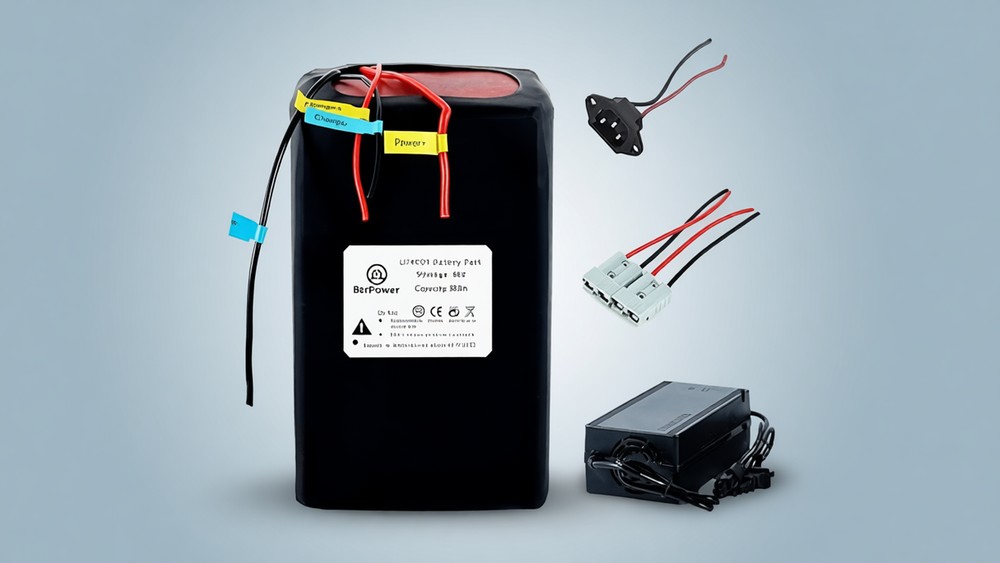
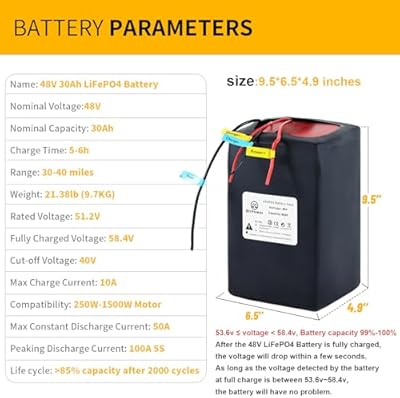
The brand's current listing explains the trick its whole family uses: a 16S1P build is why the same pack carries both 48V and 52V labels. Sixteen cells in series at 3.65 volts full reaches a 58.4V ceiling, and the pack settles to about 3.35 volts per cell after charging. That arithmetic is why the labels look contradictory and aren't.
The trap sits in the controller. A strict 48V unit often caps at 54.6 volts, the full-charge ceiling of a 13-cell lithium-ion pack, and 58.4 volts exceeds it. If your controller can't take the peak, it might fault at full charge or shut down mid-ride with plenty of energy still in the cells. Most modern controllers overlap both chemistries, but the check is five minutes and saves the bike.
The verification takes five minutes with a multimeter. Charge the pack fully, read the voltage at the discharge leads, and compare it against the highest voltage your controller's manual accepts. Some cutoffs are configurable, and a settings change turns a strict controller into a compatible one. If the limit is fixed below 58.4V, pick a different pack.
Why does a strict controller care about the peak at all? The BMS cuts charging at the cell level, but the controller sees the full pack voltage across its input every time the pack is full. Parts inside the controller are rated to a voltage with a small margin, and repeated exposure above that rating cooks them slowly or trips a protection circuit at once. A pack that charges fine but faults the controller at full charge is the classic symptom of this mismatch.
The chemistry math: what 1500+ cycles buys
The brand claims 1500+ cycles for its LiFePO4 polymer soft-pack cells, against the 500-1000 band where standard NMC packs fade. Run one full cycle daily and you get four to five years before the rated fade arrives. The cells are also incombustible by chemistry, which matters on an external box that lives in a bag or on a rack in the sun.
Heat is the other half of that safety case. LiFePO4 handles high summer temperatures with a wider margin than NMC, and a rack-mounted pack sees the worst of it: direct sun, hot asphalt, and no frame mass to sink heat. For riders in hot climates, that chemistry margin is not a spec-sheet nicety. It is the difference between a pack that ages and a pack that swells.
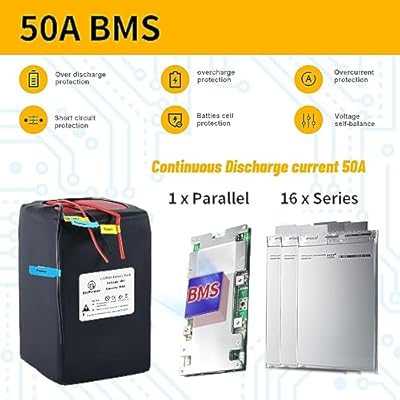
The shallow-discharge bonus comes free with a pack this size. Short rides rarely pull 1440Wh below half, and cells that live between half and full age slower than cells cycled to empty. The 50A BMS on the family line covers about 2400W of steady draw at 48V, which is headroom over any 1500W motor, with short-circuit, overcharge, and over-discharge protection.
The flat discharge curve carries a practical benefit too: the voltage stays high through most of the discharge, so the bike doesn't feel weaker as the day goes on. You get the same assist at mile sixty that you felt at mile ten, until the pack is genuinely low.
What 1440Wh actually buys you in miles
The pack holds 1440 watt-hours, but only about twelve hundred and twenty-four are usable, because cells deliver roughly 85% of their rating in real riding. At fifteen to twenty-five watt-hours per mile of light pedal assist, that's between forty-nine and eighty-two miles. Throttle-heavy riding at thirty to forty Wh per mile drops the band to thirty-one through forty-one miles. Hills, rider weight, and cold weather pull both numbers down.
Buying after the retirement takes one extra step: the brand's current family line continues the same construction claims, with the 25Ah size at 239. Check the spec images for the exact size you order, because the family spans 25 to 40Ah and the dimensions change with capacity. The wrapped box ships with tagged discharge and charge leads, so measure your rack, bag, or bracket before ordering.
The range plan also changes with the size you pick. The 30Ah math above gives the 49-82 mile band, but the 25Ah size divides every number by 1.2, landing near 41-68 miles pedal assist. The 40Ah size stretches the band to 65-109 miles. Write down your real weekly miles first, then pick the size whose band covers a week of riding plus a margin, and you will never need a midweek charge.
Who should buy it, and who should spend differently
Buy it if you're building a cargo bike, trike, or scooter around an external mount, you've verified the 58.4V cutoff, and you want cycle life at a per-Wh price NMC can't match. The recorded 22 cents per Wh made this family the price floor of the LiFePO4 class.
Skip it if you need a battery that hides in a downtube or shark frame, if your controller is strict on high voltage, or if you ride weekly and would never reach the cycle crossover that pays for LiFePO4. A pack that rides in the rain all year also deserves a look at how you will shield it, since these boxes are water-resistant rather than sealed for a pressure wash. The dual-label sibling covers the same family from its 48V/52V label, the 50Ah big brother serves extreme range, and the battery table sorts the whole field by price per watt-hour. Check the current 48V 30Ah listings for what's live today.
Frequently Asked Questions
Is this battery 48V or 52V?
Both labels describe one 16S1P pack that reaches 58.4V at full charge. The number that matters is your controller's high-voltage cutoff, which must accept 58.4V.
How much range can I expect per charge?
Between 49 and 82 miles with pedal assist, or 31 to 41 miles on throttle alone, from the 85% usable rule and standard consumption bands.
What chemistry and cycle life does it use?
LiFePO4 polymer soft-pack cells with a brand-claimed 1500+ cycles, which is about four to five years of daily full cycles before rated fade.
What died with the old listing?
The charger inclusion, connector type, and review pool can't be verified now, because the ASIN is retired and no web archive captured the page. Confirm those details on any current listing before you buy.
Where can I buy this battery now?
The BtrPower storefront and the current family listings carry the same construction. Confirm the size, BMS rating, and bundle contents on the spec images at checkout.