Shopping the value tier of the 48V market means meeting the same battery more than once. BtrPower sells a 48V 15Ah LiFePO4 pack with a 40A BMS and a 3A charger, and the company keeps it on three separate listings at once. The star records disagree between the shells, the pages borrow text from each other, and nothing on any of the three tells you which one to order.
This review covers the newest of the three listings, the one with the biggest rating record.
On our battery comparison table it sits in the cheapest fifth of the 324 packs we track by price per watt-hour, which is a claim no listing can make about itself. The hardware underneath checks out on almost every number it prints. One row on its own spec card argues with the row above it, and that row is the charger.
The BtrPower 48V 15Ah battery is a 720 watt-hour pack, and 720 is what 48 times 15 gives, so the headline math holds before anything else does. What follows is the decode: which listing deserves the order, which printed numbers survived the check, and which one you should confirm on arrival.
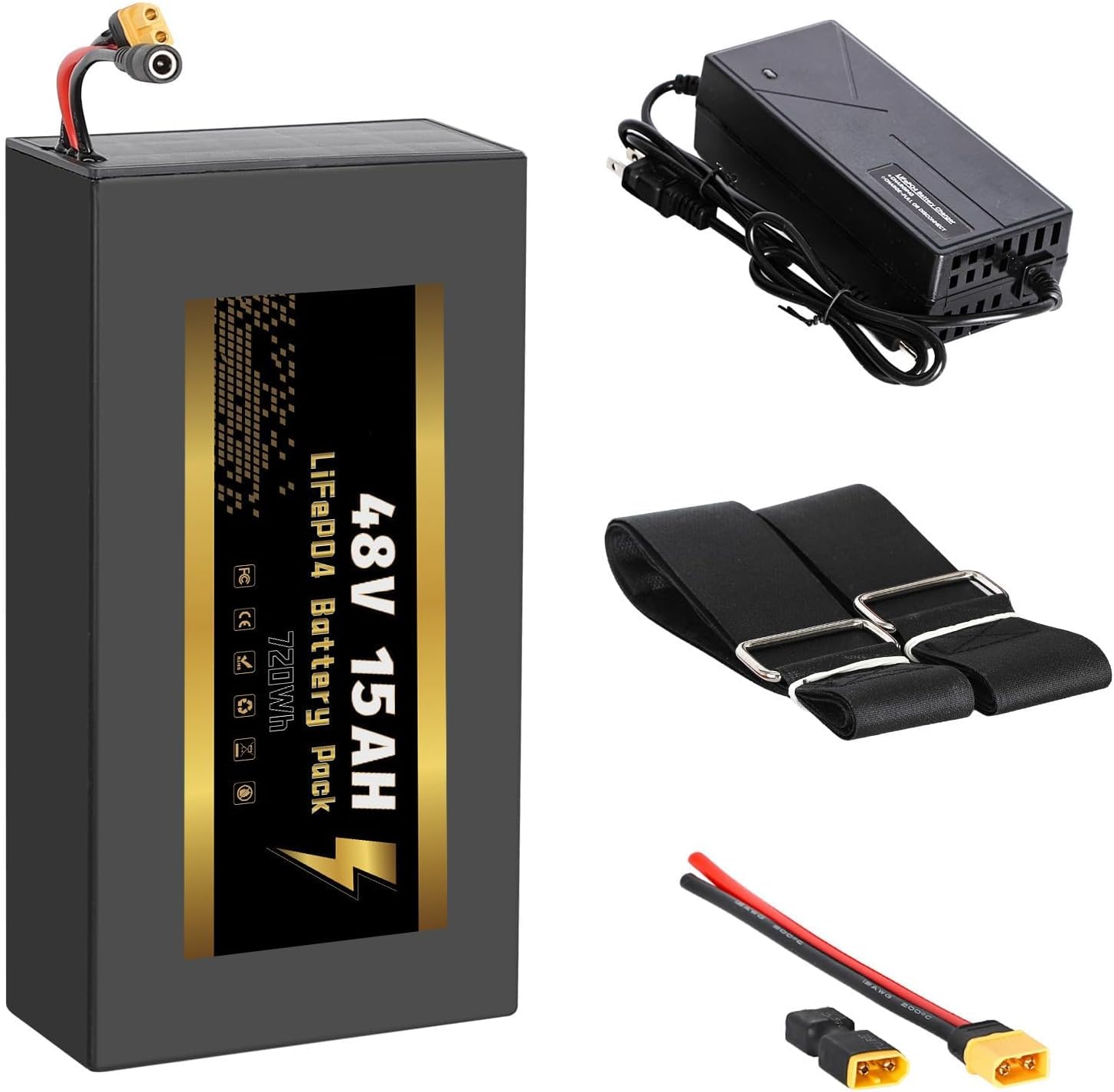
Three listings, one spec point
The same 48V 15Ah LiFePO4 spec point sells on three BtrPower pages right now. The oldest shell lists at 135.00 and carries 2.8 from 3 ratings.
A second shell lists at 139.00 with 5.0 from 6 ratings and an Only-13-left line. This newest shell lists at 139.00 with 4.2 from 13 ratings.
We have reviewed the other two shells already: the 5.0-from-6 twin and the 135.00 original. Same brand, same board, same charger, near-identical bullets. The hardware is the same story told three times, and the records split because each shell collects its own buyers.
Which shell gets the order is a judgment about evidence, not hardware. This one carries the biggest record of the three, 13 ratings against 6 and 3, and its 4.2 score is the most tested number in the family.
A perfect score on six ratings is thinner evidence than a 4.2 on thirteen. The 135.00 shell undercuts the other two by 4.00 and currently carries the roughest record. You are picking which record you trust, because the pack underneath does not change.
The star widget on this shell prints 4.2 from 13 global ratings, the largest count in the family.
I want to be plain about a limit: the written-review side of this listing could not be read for this article, because Amazon's review pages only render for signed-in sessions and the tooling for those was down at review time. So this part of the review can weigh the score's size, not the words behind it.
What the number itself says is limited but real. Thirteen ratings is enough that a 4.2 is not one disappointed buyer's revenge or one happy buyer's favor. It is the shape of a product with a genuine spread of outcomes, which is what most budget packs produce.
The 5.0 on the twin shell's six ratings cannot say that yet, whatever it turns out to be later.
Treat 4.2 from 13 as a reason to read the listing harder, not as a verdict. The listing's arithmetic is the strongest evidence available here, and it passes.
The spec card checks out, except the charger row
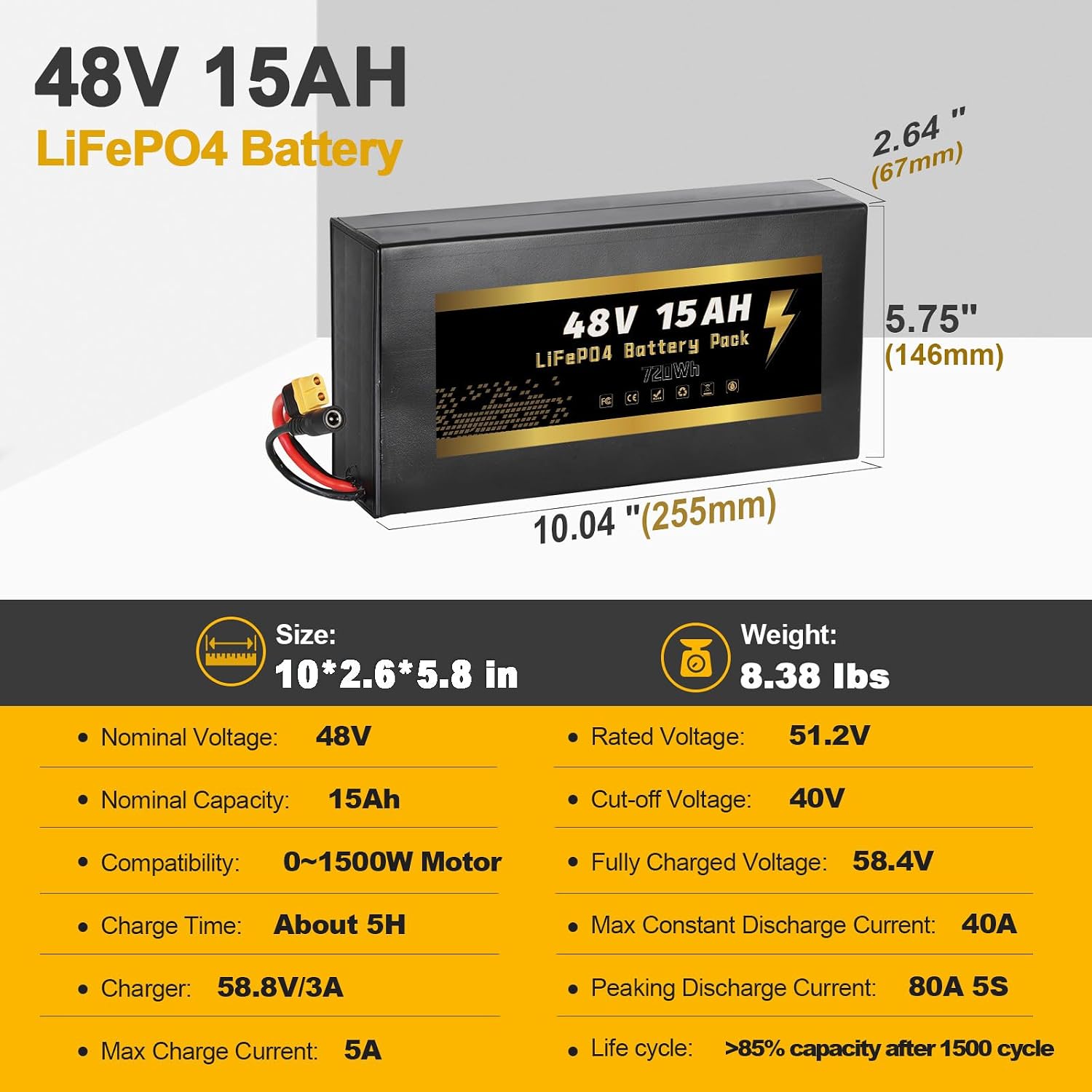
The gallery card on this listing prints the full electrical picture, and nearly all of it survives arithmetic.
A 16-cell LiFePO4 pack runs 3.2 volts per cell nominal, so 16 x 3.2 gives the printed 51.2V. It charges at 3.65 volts per cell, so 16 x 3.65 gives the printed 58.4V. It cuts off at 2.5 volts per cell, so 16 x 2.5 gives the printed 40V.
All three voltages agree with the chemistry, which is rarer on these listings than it should be.
Then the charger row reads 58.8V/3A, and the same card says the pack is fully charged at 58.4V. Those two numbers cannot both describe this pack. The 58.8 figure is what 14 cells times 4.2 volts gives, which is the nickel-manganese-cobalt template number.
The card's own chemistry rows are LiFePO4 through and through, so the charger row reads like copy carried over from the brand's NMC ladder.
The practical reading: the pack's numbers are right and the charger row is the copy-paste error, the same direction most spec-table faults run.
But a charger is a physical object that arrives in a box, so confirm it on arrival. A correct LiFePO4 charger for this pack prints 58.4V. If the box carries a 58.8V unit, ask the seller before plugging in, because 0.4 volts of overcharge on every cycle is not nothing.
The power and weight numbers hold
The 40A board against a 0-1500W motor claim is the honest direction for once. Forty amps at 48 volts is a 1,920W ceiling, and a 1500W motor draws about 31 amps at full tilt, comfortably inside the board. The card adds an 80A peak rating for 5-second bursts, which covers the startup surge a hub motor asks for.
Most listings this month print the opposite arrangement, a big BMS number over a motor claim the board cannot feed.
The charge-time claim is honest in a way that deserves notice. Fifteen amp-hours at 3 amps is a 5-hour refill floor, and the card says about 5H.
Listings almost always claim below the floor. Claiming the floor exactly suggests somebody did the division before writing the card.
The weight closes too. The card prints 8.38 pounds, which is 3.80 kilograms, and 720 watt-hours over 3.80 kilograms lands near 0.19 kilowatt-hours per kilogram at pack level. That sits in the middle of the band mass-produced packs actually reach, once case, board and wiring take their share. Nobody is asking you to believe in chemistry nobody ships.
The ladder around the 15Ah row, and the cycle claim
This listing is one shell of a family that runs from 36V to a 72V 80Ah monster, and the ladder's own labels do not scale the way you would guess. The 15Ah row carries the 40A board and the 0-1500W ceiling.
The 18Ah row beside it carries the same 40A board but caps at 0-1000W. The 25Ah-and-up rows move to a 50A board. The listing's own comparison table prints different motor ceilings for different rows, 0-1500W against 0-2000W, so the family does not share one number.
Read the row, not the brand. If you match a battery by BtrPower's family reputation, you can buy the 18Ah shell expecting 1500W and get a 1000W ceiling. The 15Ah row here is the cheapest entry in the ladder and, on this shell, one of the better values in our whole table.
The cycle-life claim sits on the card too: above 85 percent capacity after 1,500 cycles. The Wikipedia lithium-ion battery article expects a lithium-ion battery to lose around 20 percent of its charge over 1,000 to 2,000 cycles at room temperature. A promise of 85 percent remaining at 1,500 cycles sits inside that window, which fits everything else this card prints: mid-range claims, not inflated ones.
BtrPower 48V 15Ah FAQ
How far does one charge actually go?
The listing claims 15 or more miles without pedaling. Fifteen miles on 720 watt-hours is 48 watt-hours per mile, which sits at the heavy end of throttle-only consumption, so the claim is modest rather than optimistic. Pedal assist stretches the same charge well past that, commonly toward double, because your legs carry part of the load.
Does the charger ship in the box?
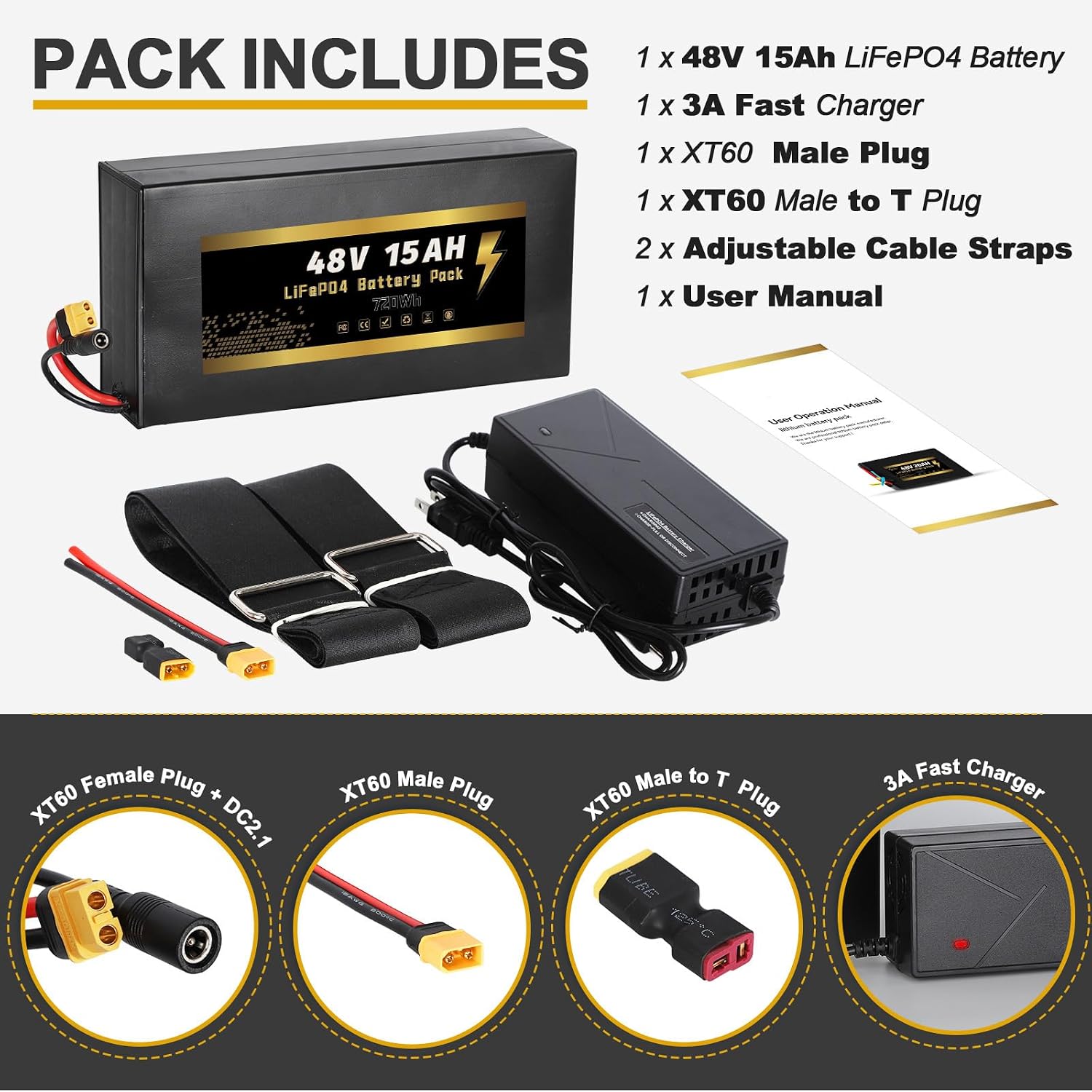
The box list says yes: battery, 3A charger, XT60 plug, XT60-to-T adapter, straps, manual. Confirm the voltage printed on the charger itself when it arrives. A 16-cell LiFePO4 pack wants 58.4V, and the card's 58.8V row is the one figure on this listing that contradicts its own chemistry.
What motors can it run?
Anything from 250W to 1500W at 48V or 52V, per the title and the card. The board ceiling is 1,920W, so a 1500W motor draws about 31 amps and holds headroom for surges. Check that your controller's discharge connector matches the XT60, or plan on the included T-plug adapter.
Is the 1,500-cycle claim believable?
It is a mid-band promise, which is the believable kind. The reference literature expects a lithium-ion battery to reach 1,000 to 2,000 cycles before it holds only 80 percent of its charge, and this card claims 85 percent at 1,500. Nothing here asks you to believe a number the chemistry cannot reach.
Which shell deserves the order
Order this shell if you want the family's biggest record and accept its middling 4.2. Order the 5.0-from-6 twin if you weight the score more than the sample size, knowing its stock line reads Only-13-left. The 135.00 original saves you 4.00 and currently carries the roughest record of the three.
Whichever shell you pick, the hardware is the same 720 watt-hours with honest arithmetic, and the one check that matters is the same: the charger's printed voltage against 58.4. The comparison table keeps the live price-per-watt-hour position for this pack in its specs box, so you can see where it lands today.