Budget ebike batteries have a type: the dual-label pack. It says 48V on the title, 52V on the sticker, and 51.2V on the cell math, and all three numbers describe one pack. Most listings never explain that, and the buyer finds out at charge time, when the voltage reads higher than the bike expects.
The BtrPower 48V 18Ah LiFePO4 was one of those packs, sold at a price that sat near the bottom of the per-watt-hour table. Then the brand left the market. Both listings are dead, and the second pack from this line vanished in the same month as the first.
The spec sheet it left behind is still worth reading. It shows what a cheap 16S LiFePO4 listing actually is, what the charger asks of your controller, and why a soft pack changes the way you mount it.
Here's the label decode, the wiring plan, and the gap between what the price promised and what the proof showed.
The BtrPower 48V 18Ah LiFePO4 is the second pack from this brand to leave the market, and a search for the brand now returns nothing.
What remains is the recorded spec sheet, and it deserves a close read: a dual-label 16S LiFePO4 pack that sat in the cheapest fifth of everything we track per watt-hour, built as a soft pack with an XT90 discharge plug. This page serves holders of the pack and anyone sizing a cheap 16S listing against their controller.
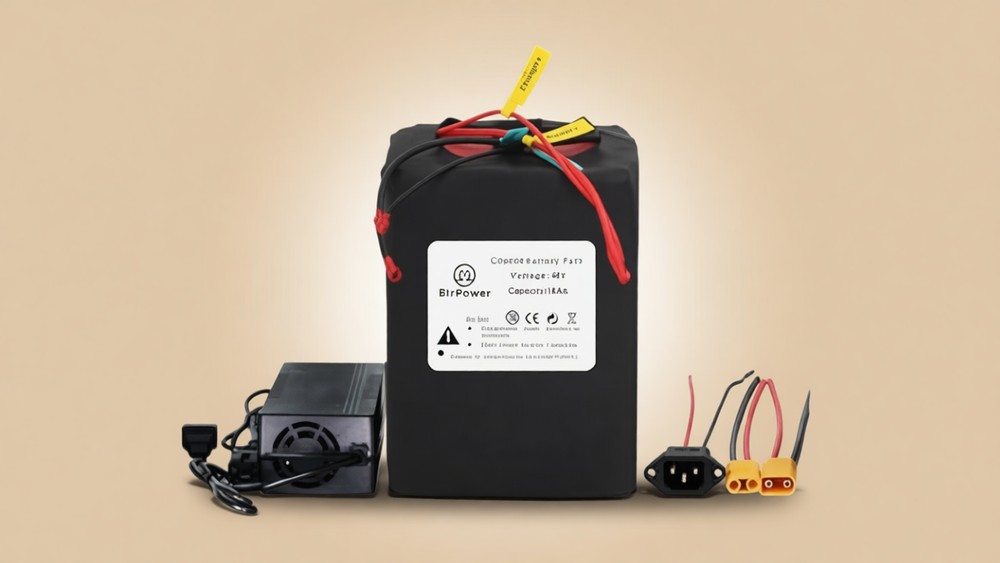
The label says 48V, the cells say 51.2V
The box lists a 48V pack, and the sixteen LiFePO4 cells inside run at 51.2V nominal, which the listing's own images confirm. That gap is worth real energy: 48 times 18 is 864Wh on the label, and 51.2 times 18 is about 920Wh in the pack. The label understates the pack by roughly 56 watt-hours, which is most of a typical budget 36V pack's whole capacity.
The 48V and 52V labels describe the same 16S LiFePO4 pack. A true 52V lithium-ion pack is a 14S NMC build that tops out near 58.8V for a different reason, and confusing the two is how controllers get matched to packs they can't handle. One chemistry, one pack, three numbers on the listing.
Check your controller before the 58.8V charger
The included charger pushes each cell to 3.675V at full charge, just above the 3.65V maximum the voltage chart gives for LiFePO4. The BMS guards the top, but leaning on it every single day wears the pack faster than charging to a gentler voltage.
The bigger check is your controller. A standard 48V lithium-ion pack tops out at 54.6V, and this one sits about four volts higher at 58.8V, which presses on the margin of controllers built around 63V-rated capacitors. Read your controller's maximum input voltage before connecting, because the gap is thin and it's the electronics that pay for getting it wrong.
The listing's own application check asks for a 48V controller rated 40A or less and motors from 250 to 1000W. The 40A board at 51.2V is about 2048W of continuous headroom, well above the 1000W motor ceiling, so the BMS is not the limit here. The voltage window is.
A soft pack with an XT90: plan the box and the wiring
This is a soft pack: pouch cells in a black cover, 10.5 by 5.3 by 3.6 inches, and 11.68 pounds. No hard shell means you supply the battery box or bag, and the fit check matters more than it would on a cased pack, because the cover protects against scratches, not crushing.
The wiring needs planning too. Discharge runs through an XT90 plug, though the listing's caption calls it an Anderson connector, and the photo shows an XT90.
Charging uses a separate 3-pin port. Both facts belong in your plan before the pack arrives, because adapting the wiring on a soft pack means handling the cells directly.
Cheap per watt-hour, thin on proof
The price story was the best thing about this pack: it sat in the cheapest fifth of everything we track per watt-hour, which put real LiFePO4 capacity at the bottom of the market.
The evidence story was the weak side. The cycle claim, 85 percent capacity after 1500 cycles, is a brand number with no owner measurement behind it, and the review pool doesn't fill the gap: the written reviews share a page with every size in the line, several name 20Ah and 60V packs rather than this one, and 4 of the 10 texts are unverified one-liners.
That split matters more on a dead listing than a live one. A live listing earns trust as owners pile in over time, and this one left the market with the proof still owed. What the confirmed buyers did say was positive: no problems across the first 20 charge cycles, a pack that arrived at the right voltage, and a rider who modified the connectors to fit their build.
The honest read: the price was real, and the proof never arrived. If you're holding one, what you paid still looks good against today's class, and the battery table shows what the 48V LiFePO4 class charges now.

If a cheap 16S listing appears, here's the read
The same brand's 25Ah pack left the market in the same window, which tells you how these exits go: the line fails together, not one ASIN at a time.
When the next cheap 16S listing appears, the recorded sheet for this pack is the template. Check the label math against the cell count, check your controller's input window against the charge voltage, price the charger as a separate component, and weigh the cycle claim by whether anyone has measured it.
The 25Ah sibling's decode covers the larger pack from the same line, and the battery table is where the live class prices out today. If a re-listing shows up at the old price, the checklist decides before the sticker does.

FAQ: the 16S watt-hour gap, the 58.8V controller window and the case you supply
Is the BtrPower 48V 18Ah LiFePO4 battery still available?
No. The original listing is dead, the successor listing is dead, and the brand has stopped appearing in search. Any listing that reappears under this name is a re-listing, and it should pass the checks in this piece before you trust it.
Will this battery work with my 48V controller?
Only if your controller accepts the charge voltage. The pack fills to 58.8V, about four volts above a standard 48V lithium-ion pack, and some controllers are built around a tighter window. Check the maximum input voltage in the controller's specs first.
How many watt-hours does the battery actually hold?
About 920Wh measured at its 51.2V nominal rating, against 864Wh on the label's 48V math. The sixteen cells in series are why the two numbers differ.
How long does it take to charge this battery?
About six hours on the included 3A charger, which matches the 18Ah capacity. The same charger tops each cell at 3.675V, a hair above the standard LiFePO4 maximum, so a gentler charger is kinder to the pack.
Does the battery come with a hard case?
No. It's a soft pack in a black cover, 10.5 by 5.3 by 3.6 inches and 11.68 pounds, and you supply the box or bag. You can see the current 48V LiFePO4 class on Amazon if you're comparing cased alternatives. The smaller 48V 16Ah sibling from the same line went through a mid-run case change, which is worth knowing before you match dimensions.