Anyone who has priced an ebike battery knows the pattern. The cheap packs are generic lithium-ion with a fat cycle-life claim and a thin warranty. Name brands charge twice as much for the same watt-hours.
Somewhere in between sits the promise of lithium iron phosphate, the chemistry that trades some energy density for thermal stability and longer cell life.
The BtrPower 48V 15Ah LiFePO4 lands at the bottom of that in-between, and its listing makes you work for the truth. Its title advertises four packs at once, 48V, 52V, 15Ah and 20Ah, while the bullets describe one. A perfect-looking 4.7 rating rests on five ratings and four one-line reviews.
And the seller's claim that this pack can perfectly replace four 12-volt lead-acid batteries comes with a charging caveat the word perfectly does not carry.
The decode is worth the work, because the pack underneath the noise is more coherent than most budget listings manage. What follows: what the 16S1P wiring actually means for your controller, what the chemistry claims get right and where they oversell, and what four sentences of review record can and cannot confirm.
The BtrPower 48V 15Ah LiFePO4 is one pack wearing two voltage labels, and the wiring explains why. Sixteen LiFePO4 cells in a single series string charge to 58.4V, which reads as a high 48V pack or a low 52V pack depending on what your controller expects.
On price per watt-hour it sits in the cheapest fifth of the packs we track, so the price is the strongest thing about it. The proof behind it is not: a 4.7 average from five ratings, four one-line reviews, a three-month return window, and chemistry claims that oversell a genuinely good cell type.
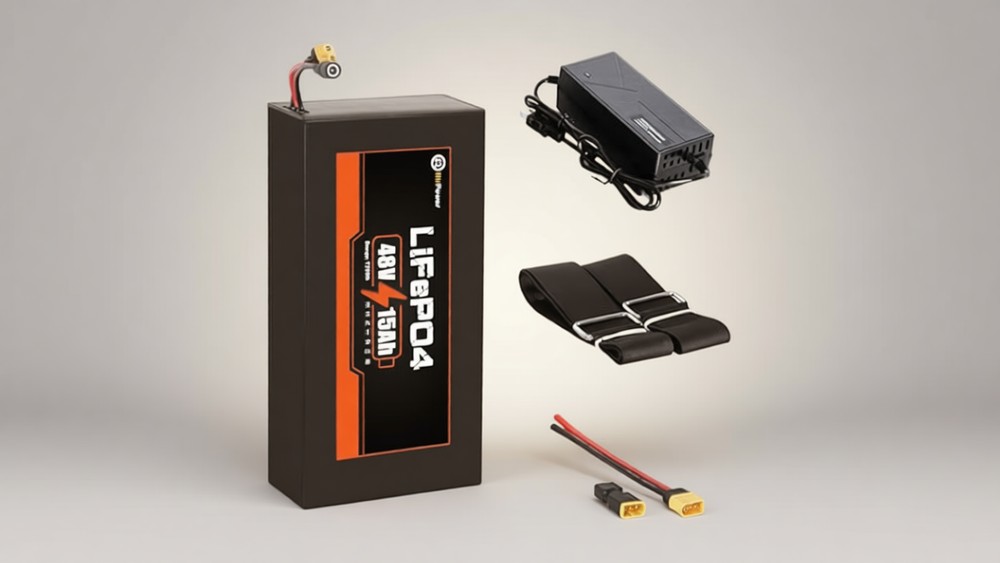
A title that sells four packs, bullets that sell one
The title names four products at once, but the bullets pin this ASIN to one. 15AH appears six times across the bullets, and the 20AH figure appears only in the title. That is a variant-family title, the same pattern the Hailong packs carry, and it matters because the star record on the page is pooled the same way.
The line that does the real work is the seller's own: the 48V 15Ah battery equals the 52V 15Ah battery because the connections are 16S1P. One string, sixteen cells in series, one cell deep. That single line turns a confusing dual label into a coherent spec.
The proofreading tells you how much care the listing got. The word battery arrives as "B attery" six times in the bullets, seven with the title.
The service bullet promises "3Months F-ree R-eturn" and "12Month-Service". The details table lists the recommended use as the number 1. None of it changes what is in the case, but it tells you nobody proofread the page, so check every spec against your own numbers.
One string of sixteen cells, two labels
The 16S1P decode is the real spec decision. Sixteen LiFePO4 cells in series at 3.2V a cell is 51.2V nominal, and at the 3.65V full-charge voltage the string tops out at 58.4V. The listing's own window agrees: it calls 53.6 to 58.4V the 99 to 100 percent zone.
A 48V controller sees a pack that charges high, and a 52V controller sees a normal one, so both labels describe the same wiring.
Capacity math works out both ways. At the 48V label it is 720Wh.
At the chemistry's own 51.2V nominal it is 768Wh. Both figures come from the listing's statements, and the difference is the label, not the cells.
The number to check before buying is your controller's maximum voltage. A controller with a hard limit near 48V or 50V may never see a full charge on this pack, or may cut out long before the 58.4V top.
The power side needs no such caution: 40A at 48V works out to about 1920W, about 2048W on the 51.2V reading, over a 0 to 1500W motor window, so the ceiling sits above everything the title promises.

Four sentences are the whole review record
Four written reviews exist, all four carry purchase confirmation, and all four are one-liners. A great battery with even better customer service. Exactly what was ordered.
The best battery ever owned. Easy to install. The best-battery line is the 4-star, and it carries the only helpful vote on the page.
The star record does not add up on its own terms. Five ratings cannot produce the 71 and 29 percent split the histogram shows, because that needs at least seven. The star record is pooled across the title's variant family, so the 15Ah pack you would receive has never been rated on its own.
What the record confirms: orders arrived and installs went easily. What it cannot: range in miles, capacity held over time, or how the seller handles a problem, beyond one buyer's warm note about service.
What the chemistry claims get right, and what they oversell
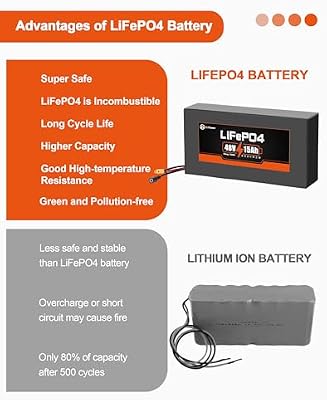
LiFePO4 is the more thermally stable consumer lithium chemistry, and against lead acid it delivers a higher cycle count and more than twice the capacity. On that ground the listing's chemistry choice is sound.
Then it oversells. "Incombustible" and "will not explode or catch fire" are guarantees no cell carries, and the listing cites no test behind them.
The 1500-cycle claim cannot be dismissed with the 300 to 500 cycle norm the way a generic lithium-ion claim can, because that norm is for cobalt-based cells. It still has no third-party test behind it, and the warranty behind the claim runs months, not years.
The range claim is the honest one. "20+ miles without pedaling" sits inside the arithmetic: a 720 to 768Wh pack at the 20 to 40 watt-hours per mile throttle-only riding consumes lands at 20 to 38 miles. The lead-acid swap claim needs one addition.
Lead-acid systems apply a float charge that lithium chemistry cannot tolerate, so a swap into a 4x12V setup needs an LFP-appropriate charger and a working BMS, not just the same wires.
Cheapest-fifth value with a three-month backstop
This pack sits in the cheapest fifth of the batteries we track on price per watt-hour, and the live position renders in the specs box. That price is the strongest fact on the page.
The backstop under it is thin. Three months of free returns, then twelve months of service, set against a 1500-cycle claim. The BtrPower 25Ah LiFePO4 carries the same warranty shape, so the pattern is the brand's.
Buy it if you are replacing four 12V lead-acid batteries and own or will buy an LFP charger, if your controller is rated at or under 40A, and if the 10 by 5.8 by 2.6 inch case fits your tray. Wait if you need owner proof of range or longevity, because four one-liners are not that. You are buying chemistry and price here, not a track record.
Frequently Asked Questions
Why does the battery have both 48V and 52V labels?
Because it is one 16S1P string. Sixteen LiFePO4 cells in series sit at 51.2V nominal and charge to 58.4V, so the same pack reads as a high-charging 48V battery or a low 52V battery. The seller says exactly this in the bullets.
What motor size does the 40A BMS support?
The 40A BMS works out to about 1920W at 48V and about 2048W at the 51.2V nominal, over a stated 0 to 1500W motor window. Pair it with a controller rated at or under 40A, as the bullet advises.
Is the 20-mile range claim accurate?
It is conservative. A 720 to 768Wh pack at the 20 to 40 watt-hours per mile that throttle-only riding consumes works out to 20 to 38 miles without pedaling, so "20+" sits inside the honest band. Assisted riding stretches it further.
Is a charger included with the battery?
The page never says. There is no package list and no charger mention anywhere on the listing. By amp arithmetic, a 15Ah pack fills in about seven and a half hours on a 2A charger and about five hours on a 3A unit, and an LFP pack needs an LFP-profile charger.
What does the warranty cover?
Three months of free returns or replacements, then twelve months of service. That is a short backstop next to a 1500-cycle claim, so any defect will show up inside the return window or not at all.