BtrPower has been on our table before, and this new listing gives the brand a second storefront for hardware we already know. The BtrPower 48V 15Ah LiFePO4 battery sells at 139.00 with the 3A charger included, and it sits in the cheapest tenth of everything we track on the battery table. Its sibling listing, the one we reviewed in October, sells the same case at 135.00 without naming a charger at all.
I pulled both pages apart and OCR'd the gallery cards. The twin decode matters this time for an unexpected reason: the two listings' star records have split, and the split tells you which page to trust with your order.
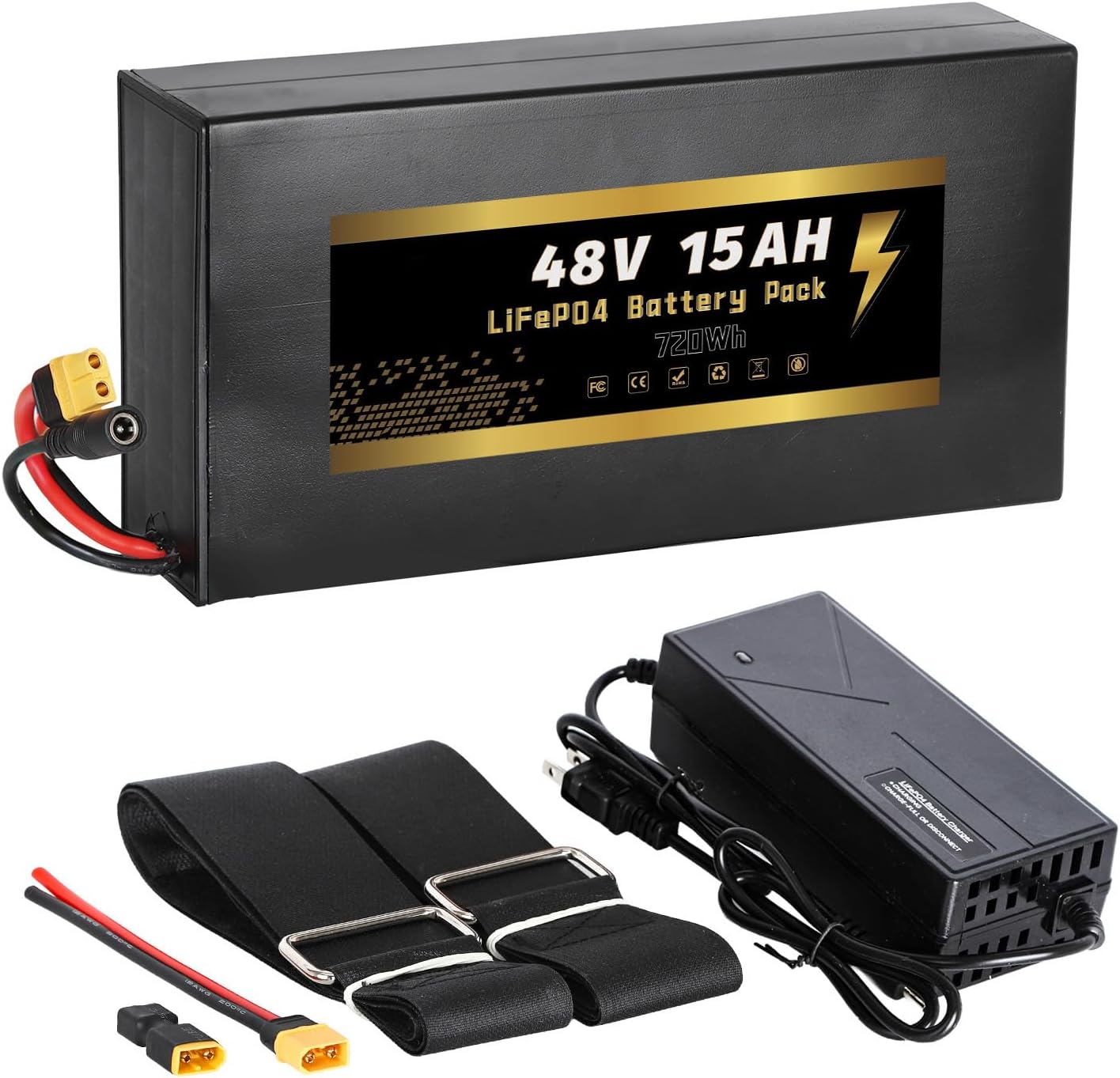
Two Listings, One Template
The two pages are one product wearing two labels. The brand-story bullets match word for word, down to the grammar mistakes. The case size matches at 10 by 5.8 by 2.6 inches. Both print a 40A BMS and a 0 to 1500W motor bracket, and both carry the same three-month return and twelve-month service language.
The differences are small and legible. This page costs 4.00 more and puts the charger in the box list. The sibling names its cell wiring, 16S1P, in a bullet where this one leaves the configuration to the voltage figures on the card. And the two listings sit in different Amazon categories, Sports and Outdoors here against Automotive there, which tells you how loosely these get filed.
The star split is the real difference. This page prints 5.0 from six ratings. The sibling printed 4.7 from five when we reviewed it, and it now prints 2.8 from three. Same hardware, same seller template, and one page's record slid while this one grew. Small records move fast in both directions, which is the whole lesson of this tier.
The Variant Ladder Is the Honest Part
This title sells five amp-hour options at once, 15 through 30Ah plus a 72V unit. Most listings leave you to guess what the bigger variants cost in current. This one prints the whole ladder in the bullets, and the ladder is the most honest thing about the page.
Every 15 to 20Ah row carries the 40A board. The 25Ah and up rows step to a 50A board, and the charger amps step from 3A to 5A with them. The motor brackets shift with the boards, though not in a straight line: the 15Ah row claims 0 to 1500W while the 18Ah and 20Ah rows print 0 to 1000W, and the 50A rows run from 0 to 1500W up to 0 to 2000W. That is a coherent family on the current side, and it lets you pick by your controller rather than by the biggest number in the title.
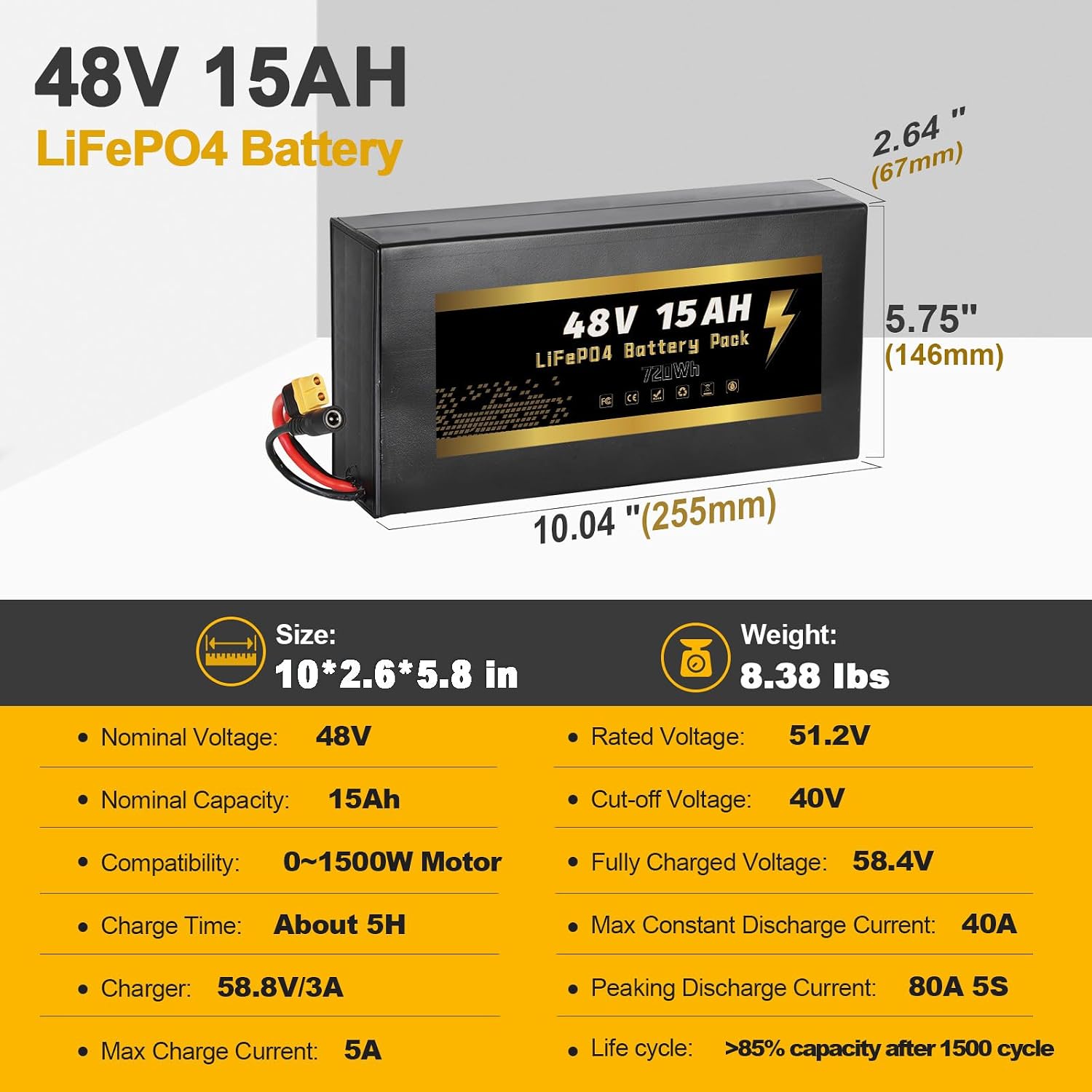
For this 15Ah pack the math checks. The card's rated voltage is 51.2V, so a 1500W motor draws about 29A, comfortably inside the 40A board, whose ceiling at that voltage is about 2,000W. The board is not the constraint. Your controller's current rating is, and the fitment bullet says so directly: controller at or under 40A, motor 250W to 1500W, case that fits your tray.
One caution travels with the ladder. The 72V row in the same bullet block is a lithium-ion pack, not this chemistry, so don't carry its 0 to 3600W bracket over to the 48V rows. Each row stands on its own printed numbers, which is exactly why the ladder deserves credit.
Where the Claims Hold
The charge claim is exact, which almost never happens at this price. Fifteen amp-hours at a 3A charger works out to a five-hour floor before the taper phase, and the card says about 5 hours. The HAYAEnergy 20Ah pack we decoded last week rounded below its own floor. This listing did the arithmetic honestly.
The range claim leans the honest direction too. The bullets promise 15-plus miles without pedaling, and 720 watt-hours at a full-throttle 20 to 25 watt-hours per mile carries a rider 29 to 36 miles. A listing that under-promises its own chemistry is rare enough to note twice in one season.
The cycle claim sits inside what the chemistry delivers. Better than 85 percent capacity after 1,500 cycles is not a brave number for lithium iron phosphate. Wikipedia's lithium iron phosphate overview describes the chemistry surviving thousands of cycles, and the trade it makes for that life is energy density, which brings us to the one claim on this page I'd argue with.
Two Chemistry Claims on One Page
The title and the card sell lithium iron phosphate, and the voltages back them up. Sixteen cells in series give 51.2V rated, 58.4V fully charged and a 40V cutoff, which is textbook LFP wiring and why the included charger prints 58.8V. Your old 48V lithium charger, the 54.6V kind, will connect and fill nothing.
Then the brand-story bullet credits advanced LG Polymer Soft batteries, and that is a different chemistry family. LG's polymer cells are lithium-ion pouch cells, the energy-dense chemistry LFP trades away. Both sentences cannot describe the cells in this box.
The practical reading is the one that matters for a buyer. If the cells are what the title says, you get the long cycle life and the heat tolerance and you accept a heavier pack. If they're what the brand story says, the 1500-cycle promise weakens. The listing never prints a weight, so you can't even run the density check that settles this on other packs. Ask the seller which chemistry is in the box, and weigh the pack when it arrives, because that single number would tell you more than the whole brand story.
What the Six-Rating Record Can Tell You
Five-star averages on thin records are common in this tier, so 5.0 from six ratings is a weak signal in either direction. The written reviews never loaded for my scrape, so I can't quote an owner, and the best-seller rank around 120,000 in Sports and Outdoors says the listing sells steadily but not in volume.
The sibling's slide is the more useful datum. A record that read 4.7 in October now reads 2.8, and while three ratings is too few to conclude anything, the direction is a reminder that a star average on a young listing is a snapshot, not a verdict. Order from whichever page you like, but let the return window carry your risk rather than the star count.
Value is where this pack genuinely stands. Between the ladder's printed current limits, the exact charge math and the honest range claim, this listing does more arithmetic right than most of its tier. The chemistry contradiction and the wordless record are the two open questions, and the sibling review covers the 16S1P wiring decode in full if you want the deeper cut.
Frequently Asked Questions
Is this the same battery as the cheaper BtrPower 15Ah listing?
Every printed spec matches: same case size, same 40A BMS, same 0 to 1500W bracket, same warranty language, same brand-story bullets word for word. The differences are price, the charger in the box list, and the star records. Treat them as one product on two pages and order on price and trust.
Will my old 48V charger work?
Almost certainly not. This is a 16S lithium iron phosphate pack that charges at 58.4V, and most 48V lithium-ion packs charge at 54.6V. The included 58.8V charger is the correct shape for this wiring. Check any spare charger's label for its output voltage before you connect it.
What size motor can this pack run?
The card approves 0 to 1500W, and the electrical math agrees: a 1500W motor draws about 29A at the pack's 51.2V rated voltage, well inside the 40A board. Match your controller's rated current to the 40A limit and the motor size takes care of itself.
What should I check when the box arrives?
Three things. The chemistry question, by asking the seller directly which cells are inside. The weight, which the listing never prints and which would settle the density question on arrival. Then a metered ride inside the three-month window, because the capacity you receive is the one number this page never promises in public. The listing is where that clock starts.