Most 52V packs make you decode their real cell count yourself, because sellers round voltages to whatever the title needs. That is why this Zlvwem 52V 15Ah pack caught my attention: the page prints its own charging spec, 58.8V at 2A, and that number is arithmetic you can check. It passes, which is rarer than it should be in this price band.
What the page does not give you is any independent evidence. The pack carries a perfect five-star record built on two ratings, and those two ratings belong to six different shells at once, because Amazon pools them across the whole variant family.
The details table even prints a model number for a different pack than the one this page sells. This review is a listing decode: I will check the paperwork, settle which motor window is real, verify the charge arithmetic, weigh the weight claim, and close with the fit question that decides this purchase more than any spec does.
The paperwork belongs to a sibling shell
The first thing a careful buyer notices is the model row. The details table prints 36V20Ah as the model number, on a page selling a 52V 15Ah pack.
That is not a rounding choice, it is the wrong variant's paperwork, the kind of template slip that happens when a seller clones six listings from one parent and forgets to update the rows. It does not tell you the pack is bad. It tells you nobody has proofread the page, which changes how much weight every other printed claim can carry.
The rating record has the same problem. The page shows 5.0 from 2, and when I pulled the 48V 10Ah sibling from the same family, it printed the identical two ratings and the identical sales rank.
Six shells share one record: 36V and 48V and 52V packs from 10 to 20 amp-hours, all wearing the same two stars' worth of evidence. Read that 5.0 as a statement about the family's first two customers, not about the 15Ah pack. Nobody I can quote has ridden this specific shell, because the written reviews behind the record were not reachable while I worked.
The motor windows all agree, once you find the real one
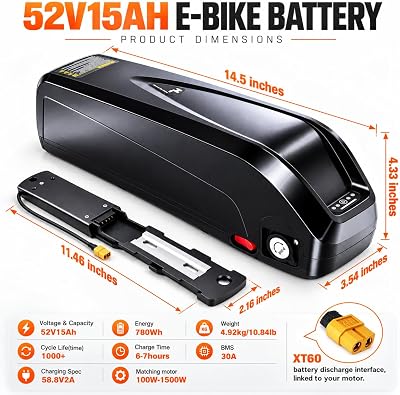
The title and first bullet say this pack drives motors from 200W to 1000W. The specification card says 100W to 1500W. Those look like a contradiction, and listings in this band usually are, but here the arithmetic resolves it instead of breaking on it.
The 30A BMS at 52V tops out at 1,560W. A 1000W motor draws about 19A, comfortably inside. The card's 1500W ceiling draws about 29A, just inside the board with almost no room to spare.
So both windows are true, and they describe different things. The card states what the board can physically deliver, and the title states what the seller recommends you actually attach.
That is a coherent pair, and it is the same structure I found on the 48V 20Ah sibling from the same factory family. If you attach a 1000W motor, you get the board's full protection margin. If you attach 1500W, the BMS runs at 96 percent of its rating on every hard climb, which I would not plan on for daily hill work.
Correct charge math, and a claim that rounds the wrong way
The charging spec is where this listing earns some trust. 58.8V divided by 4.2V per cell, the standard maximum charge voltage for ordinary lithium-ion, is exactly 14 cells in series, which is precisely what a real 52V pack is. Nothing on the page contradicts that count.
The BMS protections list covers the usual eight faults, and the connector is an XT60 with a 5-pin discharge port, a combination you should check against your bike before ordering, because 5-pin ports are not universal.
The charge-time claim is the one place the arithmetic bends. The card says 6 to 7 hours. The pack holds 15 amp-hours and the charger delivers 2A, which sets a floor of 7.5 hours before the taper that slows the final stretch.
The claim rounds below its own math, the same fault I flagged on the twin listings from the HAYAEnergy decode. Expect a real charge to take most of a working day, and plan your overnight charging around that rather than around the card.
A weight that closes, at a mid-table price
The specification card prints 4.92 kilograms, about 10.8 pounds, for 780 watt-hours of capacity. That works out to roughly 0.16 kilowatt-hours in each kilogram of finished pack. Ordinary lithium-ion cells store 0.16 to 0.30 kilowatt-hours per kilogram according to Wikipedia, and a finished pack always lands below the cell figure once you add the case, BMS and wiring.
So the printed weight needs high-density cells with very light packaging. It is tight, and I would still weigh the box on arrival, but unlike some listings in this band the number is not impossible, and the direction of the claim is the honest one.
On value the pack is ordinary, and the page does not pretend otherwise. At about 26 cents per watt-hour it sits close to the middle of our full battery table, which tracks more than three hundred packs by that measure.
The cycle claims are the aggressive part: the card says more than 1,000 cycles and the bullet says the pack holds 80 percent of its capacity after 800, both at the very top of the 400 to 1,200 cycle band the chemistry generally delivers. Those are targets to be suspicious of until an owner meter confirms them, and with two pooled ratings there is no owner meter yet.
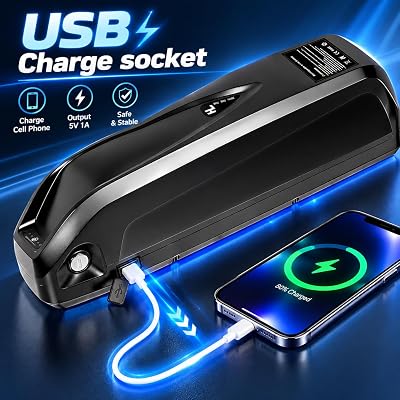
One genuine feature separates this pack from the generic. A 5V USB port lets you charge a phone off the pack, and it sits next to the keyed lock and a power switch, which is a small thing until your phone dies twenty miles from home.
Frequently Asked Questions
Will it fit my bike?
Measure two things before ordering. The pack mounts to a water-bottle-style bracket on the frame, so you need bottle mounts or the willingness to attach the base plate, and your motor's discharge connector must match the 5-pin port or you will need an adapter.
What motor suits this pack?
Plan around the title's 1000W figure, which draws about 19A and leaves the 30A BMS a full protection margin. The card's 1500W ceiling is physically possible but runs the board at 96 percent under hard load.
Why does charging take longer than 7 hours?
The pack holds 15 amp-hours and the charger supplies 2A, which is a 7.5-hour floor before the taper. The card's 6 to 7 hour claim rounds below its own arithmetic.
Can I trust the five-star record?
Treat it as a family record, not a pack record. Six shells share the same two ratings, and the model row on this page belongs to a different variant. There is no owner evidence specific to the 15Ah shell yet.
Measure the mount before you measure the value
The printed evidence here is better than the price band usually gets: charge math that closes to the cell, three motor windows that resolve instead of colliding, and a weight claim on the honest side of plausible.
What is missing is everything a rating record normally supplies, because the two ratings belong to six shells and the paperwork belongs to one of the others. If your frame takes a bottle mount, your controller speaks 5-pin, and your motor sits at or under 1000W, this is a coherent mid-priced pack with a real USB port.
Order it with the expectation that the cycle-life claims are unproven, and let the scale on arrival be the first review that actually exists.