Half helmet buyers already know what they are giving up. Nobody orders a skull cap by accident, and nobody expects the coverage of a full face in a shell the size of a bowl. The real questions are quieter ones, about fit, about what actually arrives in the box, and about whether a budget shell would hold up on the day it matters.
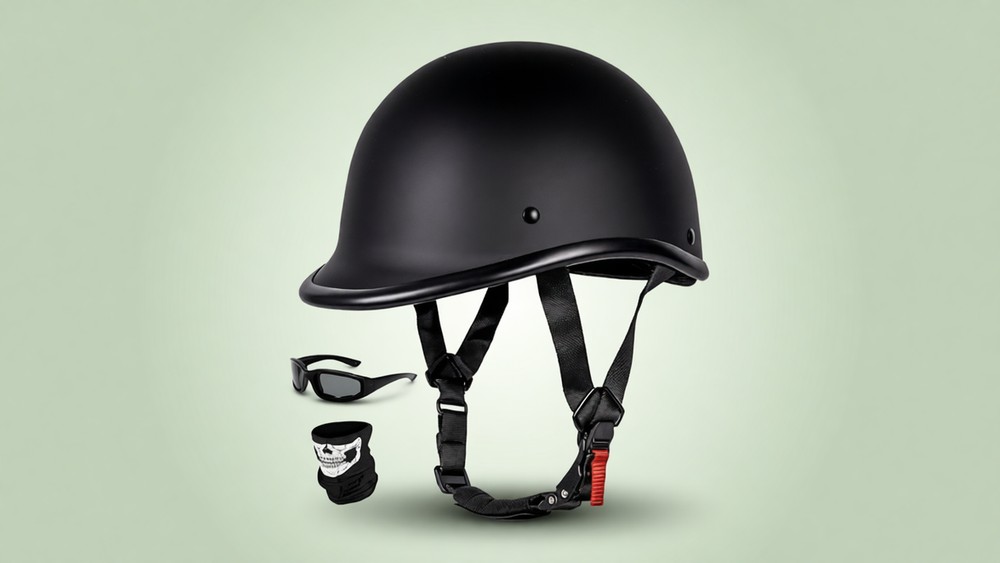
The Yesmotor sits at 45.99, in the cheaper third of the 257 helmets we track, and it sells the look harder than the protection: low profile, vintage lines, no mushroom head. The listing bundles goggles and gloves with the shell, which is a lot of kit for the money if it all shows up.
The owner record is large for a helmet this cheap, and its most detailed text is a crash report. This review walks through what that text does and does not prove, where the listing disagrees with its own spec table, and what the half helmet type asks a rider to accept.
The Yesmotor low profile half helmet carries a 4.6 rating from 763 ratings when checked, with a DOT approval claim, an ABS shell over an EPS liner, and a quick-release buckle. It is a style purchase that happens to carry a safety label, and the difference between those two things is where this review spends its time.
A crash report sits at the center of a cheap helmet's record
The rating stood at 4.6 from 763 ratings when I checked, with 78 percent of them at 5 stars and 3 percent at 1 star. The 10 written texts in our sample are all 5-star and all carry purchase confirmation, which is a happier sample than the histogram behind it, so the written record skews positive and the quiet majority holds the complaints.
The text other buyers have endorsed is the one that describes a crash. A rider's husband was run off the road and jumped from the motorcycle onto the asphalt at about 40 mph, the helmet held up with minimal damage, and the family reports they will buy only this brand from here on. One person has found that text helpful, which makes it the record's most-endorsed.
It is worth being precise about what that story proves. One helmet, one impact, one outcome, reported by a grateful family weeks later. It tells you the shell can survive a real ejection. It does not tell you the rate at which they fail, and no other text in the sample describes an impact at all.
The gaps are the usual ones for fresh gear. No owner reports wind noise at highway speed, long-term shell condition, or how the included goggles and gloves survive a season of use. The newest text is October 2026 and the oldest in our sample is September, so the record is weeks old, not years.
The minimum coverage the law allows, worn on purpose
A half helmet covers roughly half of the head, an open-face shape with no lowered rear and no chin bar, and it is the minimum coverage generally allowed by law in the United States, per Wikipedia's motorcycle helmet page. That is the type this is, and no amount of vintage styling changes it.
The number worth sitting with is the chin-bar one. Studies summarized on that page found major impact to the chin-bar area in about 35 percent of crashes, which is the region a full face helmet covers and this one does not.
A half helmet also loses most of its protection when the strap is not fastened, so the quick-release buckle is not a convenience feature, it is part of the safety case.
I would not read the crash report as a rebuttal to any of that. One rider jumped at 40 mph and walked away with a scuffed shell, which is a genuinely good outcome. It is also one data point, and the type's coverage limits are structural, not a matter of luck.
The mushroom look, and the riders who came to lose it
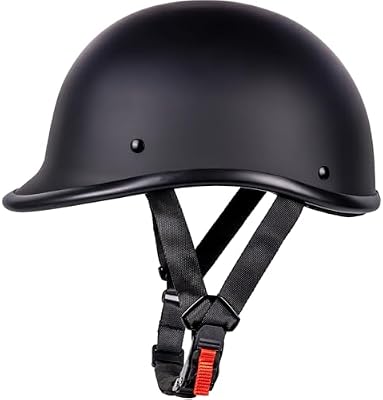
Style is the honest reason this type exists, and the record says so without prompting. Two separate owners volunteer that it does away with the awful mushroom head look, one calls it a true low profile, and another says it is the coolest looking and best fitting helmet they have ever worn. These are riders who wanted the silhouette and checked the fit second.
The listing aims the same direction, pitching a skull-cap shape for cruiser and bobber riders. Where the record adds something is comfort: one owner reports that for the first time they actually enjoy riding with a helmet on, which says more about why people skip helmets than any spec line does. A helmet you wear beats a better helmet that stays on the shelf.
At 1.98 pounds the weight is close to nothing, and that is the other half of the bargain. Less shell means less mass on your neck in stop-and-go traffic, and it also means less material between your head and the road. Both facts are true at once, and the buyer decides which one leads.
What arrives in the box, and what the spec table admits to
Here the listing argues with itself. The bullet copy promises the kit comes ready with riding goggles and gloves, everything for the road in one box.
The spec table on the same page lists Included Components as one word, Helmet. Both cannot be the full story, and one owner confirms glasses arrived with theirs, so the accessories are real, at least sometimes.
The safe approach is to treat the goggles and gloves as a bonus and the helmet as the purchase. If the accessories matter to your budget, check the box contents with the seller before ordering rather than after.
Fit is the strongest agreed point in the record. One owner calls the fit guide accurate, another says it fits great as described, and one praises how easy the straps are to adjust. Nobody in the sample reports a sizing complaint, which is unusual for a helmet sold online.
The padding is removable and washable per the listing, and the quick-release buckle earns a specific mention of its own.
DOT approval, and what the label does not measure
The listing claims DOT approval, which in the United States is a manufacturer self-certification against the FMVSS 218 standard rather than an independent test, per Wikipedia. The same page notes the DOT standard does not require chin bar testing, which for a half helmet is the region that never existed anyway.
The practical step costs nothing. Look for the DOT sticker inside the shell on the day it arrives, because that marking is what the certification claim rests on, and a helmet without it is not street legal in the states that require one.
On value, 45.99 sits in the cheaper third of the helmets we track by price. That price buys the look, the light weight, a large and so far positive owner record and a DOT label. It does not buy coverage, and no helmet at any price in this shape does.
Frequently Asked Questions
Is it really DOT approved?
The listing says yes, and DOT is a self-certification, so the check is on your end: look for the DOT sticker inside the shell when it arrives. If it is missing, the helmet does not meet the standard the listing claims.
Does it come with goggles and gloves?
The bullet copy says the kit includes both. The spec table says the box holds a helmet, and one owner confirms glasses arrived with theirs. Treat the accessories as possible rather than promised, and confirm with the seller if they are part of why you are buying.
How is the fit?
One owner calls the fit guide accurate and another says it fits great as described, with no sizing complaints in our sample. Measure your head, follow the guide, and expect the straps to need a small adjustment on day one.
Is a half helmet safe enough?
It is the minimum coverage generally allowed by U.S. law, with no chin bar over an area that takes major impact in about 35 percent of crashes. One rider's 40 mph ejection ended well in this helmet, and that is one outcome, not a test result. Riders weighing protection first should look at full face or modular shapes instead.
Will it give me the mushroom head look?
Two owners say the opposite, that it does away with the mushroom look, and another calls it a true low profile. Head shape varies, so the honest answer is that the record is unanimous but small, and the fit guide is the place to start.