Silver fish replacements are a patience purchase, because you are hunting a shell that matches a bay your bike's maker has probably stopped thinking about. The VODIPOWER 36V 15Ah battery plays in that gap with a 30A board, a keyed lock and an LED charge light, and at first glance the spec sheet reads like a decent deal.
Two things on this page made me look twice. The review record has not moved since our first article covered this pack at the end of August, and the price per energy sits at the wrong end of our table. Both change what this pack is worth, so they lead this review.
A review record frozen since March
The whole record is two texts, both posted on March 30, both five stars, and neither carries a purchase badge of any kind. The first says the battery fits the bike perfectly and the owner's old bike is running again. The second says the install took under five minutes, align the pack with the groove, push until it clicks, highly recommended.
That's everything. No bike model, no mileage figure, no capacity measurement, no complaint, and no helpful votes on either text. Our August article described a two-review record with both texts at five stars, and two months later the count is still two. Nothing new has landed, good or bad, in about sixty days.
I read both texts as template-shaped rather than earned. Same-day posts, no purchase badge on either, and the second one reads like the listing's own install bullet retold in a hurry. That doesn't prove anything bad happened, and plenty of real buyers write one line and move on, but a record like this carries almost no weight in either direction. You are buying this pack on its spec sheet and its return window, not on the word of its owners.
For expectation-setting on range, since no owner gives a figure, the usual spread for pedal-assist riding runs 25 to 75 miles per charge depending on assist level, terrain and rider input, and Wikipedia's e-bike article sketches that spread. This pack sits small on our table, so plan around the low end of that band if you lean on the throttle.
What the listing commits to
The seller handle is hzsryamz and the model number is HZS-YY-36V15AH, so the storefront and the model share the same three letters. That is the seller's own listing rather than a random reseller on top of someone else's stock, which is worth a little when a warranty claim comes up. The warranty itself runs three months, which is the short end of anything we have covered this month, where one-month and three-month terms mark the floor and a year or more is normal.
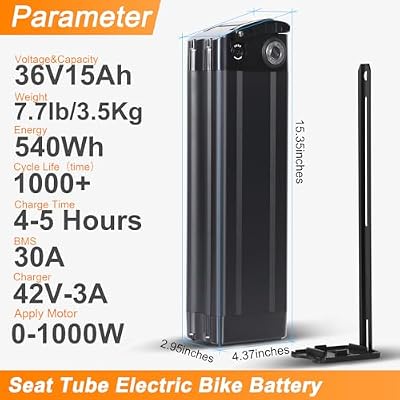
The spec rows agree with the title on the things that matter: 36 volts, 15 amp-hours, a 7.7 pound weight printed twice, and case dimensions of 15.35 by 2.95 by 4.37 inches. The title says the pack suits 250W to 1000W motors and the bullet says 0 to 1000W, a small disagreement that doesn't matter much because the honest ceiling sits above both, which the next section covers.
Two template scars are worth knowing before you buy. The second bullet appears twice word for word, so the listing has five bullets where four carry information. And the charger ships with no amp rating anywhere on the page, so no charge-time floor can be worked out from the listing. A 15 amp-hour pack needs hours on a typical 2A charger and less on a faster one, but the page doesn't tell you which one you get, so ask the seller before you order rather than guessing after.
The power math holds
The 30A board is the headline spec here, since cheap 36V silver fish packs usually carry a smaller board. The math behind the claim checks out in the rare honest direction this month. Thirty amps across 36 volts is a 1080W ceiling, and the largest motor the listing claims, 1000W, draws about 28 amps at full tilt, so the claim sits inside the ceiling with a little room left. A 250W commuter motor draws about 7 amps and barely tickles the board.
That is not how most listings this month have behaved. We have covered packs where a 20A board sat under a 1000W claim that needed 21 amps, and one where a 30A board faced a 1500W claim that needed 31. Those listings promise power their own spec sheet cannot deliver. This one promises less than it can deliver, and the controller rule on the page, no more than 30 amps and 36 volts, matches the board exactly.
The board itself claims the four usual guards: overcharge, over-discharge, over-current and short circuit. That is the minimum set any lithium pack should carry, and Wikipedia's lithium-ion battery article explains what each guard prevents and why cell voltage management matters over a pack's life. None of it is tested by the record, which brings us back to the frozen review pool, but nothing on the page argues with itself on the electrical side.
Weight, fit and the case
The printed weight survives the check, which is rarer than it should be. Seven point seven pounds is about 3.5 kilograms. A 540 watt-hour pack needs roughly 1.8 to 3.4 kilograms of bare cells at the standard 0.16 to 0.30 kilowatt-hours per kilogram energy band, and 3.5 kilograms for the whole assembly fits that budget with room left for the case, the board and the wiring at any point in the band. Some listings we have weighed this month printed a weight that could not physically hold the chemistry they claimed. This one holds together, so treat the figure as real rather than decorative.
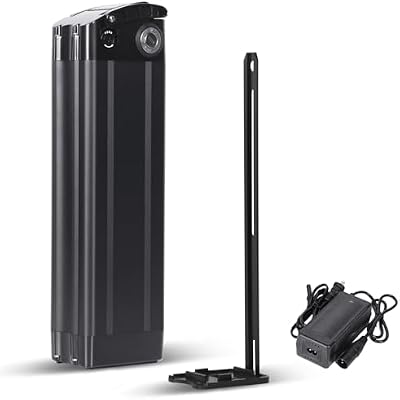
The shell is the long thin silver fish shape, 15.35 inches end to end, and it mounts to the seat tube on a base plate. The listing tells you to measure the base plate and the discharge connection points before ordering, and you should, because the 4-pin port is the whole fitment question. If your bike ran a 36V silver fish pack with four pins, this is a direct swap in voltage, mount and connector. If your cables end in something else, no amount of case-fit helps.
Two small features do real work here. The keyed lock on the base plate means the pack stays on the bike when you walk away from it, which matters if you park in public, and it also means you can't casually pull the pack to charge it indoors. The LED strip on the case gives you a rough charge read without a meter. Neither is fancy, both are the features people actually use on a commuter.
What the energy costs
Here is the part our first article got wrong, and I want to correct it plainly. That piece called this pack a budget buy, and the price per energy says otherwise. At 199.99 for 540 watt-hours, you pay about 37 cents per watt-hour, which lands among the most expensive of the 301 packs we track on our comparison table. The live rank renders in the specs box on this page, so check it there as prices move.
You are paying for shape, not for energy. A 36V pack in this long silver fish format is scarce now, and if your frame bay only accepts this shape, the premium buys you a working bike instead of a shelf queen. That is a legitimate reason to pay, but it should be an informed one. If your frame can take a more common hailong or shark shell instead, the table will show you packs with far more energy for the same money.
Add the three-month warranty to the price and the value question gets sharper. A short warranty on a house-brand pack with a frozen two-line review record means the spec sheet is doing all the trust work, and the spec sheet is honest but thin. The 36V Yose Power pack we rebuilt costs more per energy still, so this is not the worst 36V deal on the board, but nothing about the price makes it a bargain.
Common questions about the VODIPOWER 36V 15Ah
Will it fit my bike?
Measure three things before ordering: the seat tube bay length against 15.35 inches, the base plate bolt pattern, and your controller connector against the 4-pin discharge port. The listing itself tells you to check the base plate and connection points, which is the honest version of a fitment claim. If your bike ran a 36V four-pin silver fish pack, this drops straight in.
How far will one charge take me?
No owner on the page gives a mileage figure, so the honest answer comes from the energy math and the usual band. 540 watt-hours is a small pack by current standards, and pedal-assist riding typically runs 25 to 75 miles per charge across pack sizes, so expect the lower half of that band with moderate assist and less if you ride throttle-heavy or hilly. Cold weather cuts it further.
Should I trust a pack with two reviews?
Treat the record as absent rather than negative. Both texts landed the same day in March, neither shows a purchase badge, and neither says anything measurable, so they neither support nor indict the pack. What you can lean on instead is the honest power math, the plausible weight, the seller's own listing with a three-month warranty, and Amazon's return window. Ask the seller about the charger's amp rating before you order, and if the answers come back slow or templated, that tells you something the review count never will.