Modular helmets used to be the expensive corner of the market. The flip-up chin bar, the inner shield, the hinge hardware, all of it sat behind prices that made a budget rider think twice. That corner has moved, and a full flip-up front can now cost about what a basic full-face did a few years back.
Cheaper does not mean simpler, though. At the bottom of the range the labels blur.
One page will call the same helmet a motocross dirt bike lid and a modular street helmet, and the spec table will not always say which one is in the box. The visors, the hinges and the warranty all become questions the listing answers loosely.
This walks through what the page claims, what the ten most recent owner texts actually cover, and where the price sits against everything else we track.
The VEVOR MD-809 sits in the cheapest fifth of the 257 helmets we track on our comparison table, and that is the strongest fact on its page. It carries a 4.6 average from 171 ratings, with 81 percent of them five stars and only 2 percent at the bottom, so the crowd is not quietly unhappy with it.
The written record is thin, though, and it has one fault line. Ten owner texts with words on them span exactly one month, from mid-September to mid-October 2026. Nine carry five stars, and the tenth, a four-star text, reports screws working loose inside the first month.
Everything else on the page, from the visor fittings to the hinges, has almost no owner coverage at all.
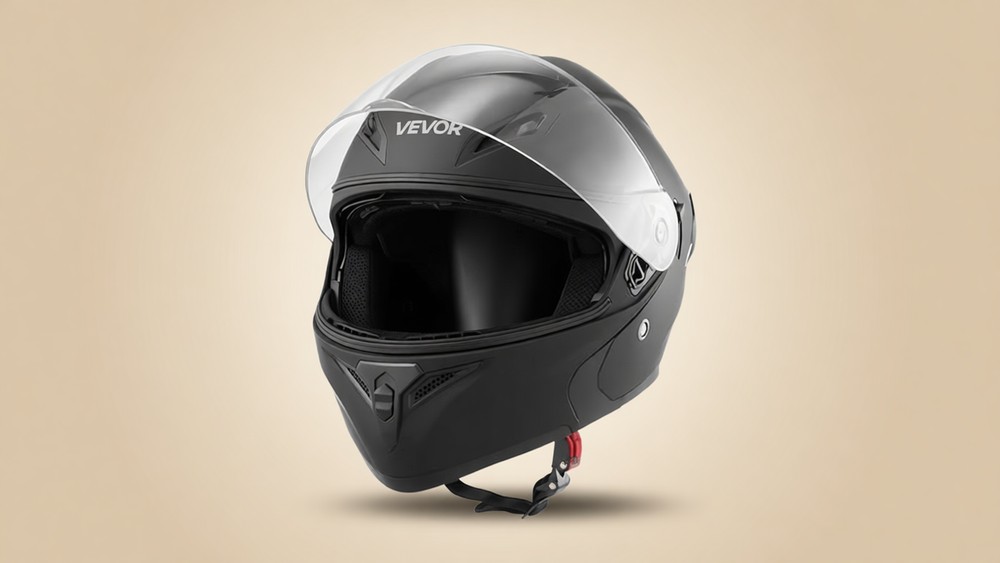
One helmet, two identities on the same page
The listing cannot decide what it is selling, and a buyer should settle that question for themselves before ordering.
The title calls it a motocross dirt bike helmet with a large clear visor. The type-name row calls it a modular motorcycle helmet. Our own comparison data files it under modular, and the most detailed owner text backs that filing up.
That owner describes the entire front of the helmet, chin guard included, swiveling up for easy entry and exit, and says the motion feels smooth with no wiggle from the hinges. That is a flip-up street helmet, full stop. A motocross helmet normally expects goggles, a peak, and a fixed chin bar with no street visor at all, and this box ships none of those things.
The distinction matters because the two categories answer different problems. If you search for a dirt bike lid because you ride trails, the visor fittings and the hinge on this one are extra hardware you never wanted. If you want a flip-up front for fuel stops, conversations and glasses, the motocross wording on the title is just marketing drift, and the chin bar is the whole point.
The chin bar itself deserves the category context. About 35 percent of crashes show major impact in the chin-bar area, which is the coverage a full-face or modular front adds over an open face, and estimates reviewed on Wikipedia credit helmets with roughly a 69 percent cut in head-injury risk and a 42 percent cut in death risk for crashed riders (Wikipedia, Motorcycle helmet).
A flip-up front that locks solid, like the one described above, is what turns that coverage into something a budget lid can honestly claim.
The dirt-bike wording has a real cost
Not a safety cost, a shopping one. Anyone who orders this expecting motocross gear is buying the wrong tool, and anyone who wants a modular street helmet may never find it, because the title puts it in the wrong searches. Checking the type-name row, not the title, is the habit that saves the return trip.
The one critical text is about screws
Nine texts in ten say some version of good value and comfortable, so the record's only fault line deserves its own section. One owner reports that within the first month, under normal wear, screws start coming undone, and their suggestion is to apply thread locker to every screw before the first ride.
That report is specific, and it is the kind that matters on a modular helmet. A flip-up front carries more hardware than a one-piece shell: hinge pivots, a latch, visor fittings, all of it held by small fasteners. The category's own guidance makes the same point from another direction, because a helmet is only as protective as the parts that hold it together, straps and hardware included.
Nothing in the other nine texts contradicts the report, and nothing repeats it either. One text is not a pattern, but the owner's fix is cheap and takes minutes, and the practical version for a buyer is simple: check the screws after the first few weeks of riding, and keep thread locker on the shelf.
The rest of the record leans on comfort and sturdiness. Owners have called it comfortable, sturdy, easy to get on, and good-looking for the money. The most detailed one praises how the hinge moves.
None of that is surprising for a helmet at 4.6 from 171 ratings, but none of it is a long-term durability signal either, because the whole record is a month old.
Two visor stories from the same box
The visor fittings are where the listing says least and the owners disagree most. The spec table's included components row lists a helmet and a manual, and nothing else. The visor story comes from the owner texts, and the two most detailed ones tell it differently.
One describes a choice of two visors, an outer clear one and an inner shaded one. Another describes a built-in sun visor plus a separate shaded main visor to swap in place of the clear one. Those are two different arrangements, and the page does not settle which one ships.
Both accounts agree that a shaded element is part of the package, which is rare at this end of the price range and worth having. A buyer who cares which arrangement they get should look at the listing photos before ordering, or ask the seller, because the spec table will not answer it.
One more caveat from the same record: an owner says the blue on the page is brighter than the real thing, and the actual color is closer to a matte slate blue. Nobody mentions the visors' optical quality, good or bad, and that silence is worth knowing before you buy.
Nobody mentions wind noise, and the record is short
The gaps in this record are the things a buyer most wants to know. No text mentions wind noise either way, even though the listing bullet claims the vents reduce it. Modular helmets sit in the wind stream differently from one-piece full-faces, so the silence is a real gap, not a formality.
No sizing consensus exists. Only one owner describes fit at all, and that rider sat in the middle of the recommended size range and found the helmet slightly tighter than expected. That is one data point, not a trend, but it is the only fit signal on the page, so a buyer between sizes should plan on the return window.
No crash reports appear anywhere, which is normal and good, but it also means the DOT claim has no owner evidence behind it, only the listing's bullet and the style row that reads helmet-DOT. The practical check for that claim has always been the sticker on the shell itself, because a label on a product page is not the certification.
The record's age deserves its own word. Ten texts spanning one month, resting on 171 ratings, is a young signal for a helmet whose hinges and latch are the whole product. One text is also a used-like-new purchase that arrived smelling of smoke, which says something about marketplace condition handling and nothing about the helmet itself.
Flip-up convenience at the bottom of the price range
At 47.90 when checked, this helmet sits in the cheapest fifth of everything we track, and the live position renders in the specs box on this page because the field moves on every data refresh.
VEVOR's own one-piece full-face sits below this one in our data, and that VEVOR full-face sibling is the honest alternative if a fixed chin bar would do the job.
What does the price not buy? The listing page carries no warranty row at all, which is worth weighing at checkout, because other helmets in our data state a one-year cover openly. The shell is ABS where dearer modulars move to composite shells.
And the record is too short to prove the hinges last, which is the one durability question a flip-up buyer actually has.
The DOT claim appears on the lead bullet and the style row, and the US minimum for a street-legal motorcycle helmet is FMVSS 218, the standard that claim points at. A buyer who wants more than a page label can check the DOT sticker on the shell when the box arrives.
The honest framing for a decision: a rider who wants a flip-up front mainly for fuel stops, conversations and eyeglasses gets one here for a fraction of what the established brands charge, with a young but positive owner record and one hardware report to check. A rider who keeps a helmet for years and cares about finish, warranty paper and proven hinge life should weigh a used premium modular instead, because the price gap buys exactly those three things.
Check the current VEVOR MD-809 price on Amazon.

Frequently asked questions
Is the VEVOR MD-809 a dirt bike helmet or a modular street helmet?
Both words appear on the listing, and the hardware says modular street. The type-name row says modular, our comparison data files it under modular, and the most detailed owner text describes the chin guard swiveling up on solid hinges. A motocross rider expecting a peak and goggles will not find them here.
Does it hold a DOT rating?
The lead bullet claims DOT approval and the style row reads helmet-DOT, which points at the FMVSS 218 minimum for street-legal helmets in the US. No owner text mentions the rating either way, so the practical check is the DOT sticker on the shell itself when the helmet arrives.
Does the sizing run true?
There is no consensus to report. One owner, sitting mid-range in the recommended size, found it slightly tighter than expected. That is the only fit signal in the record, so a buyer between sizes should keep the return window in mind rather than trusting the page.
Does it come with a shaded visor?
Owner accounts say yes, but they describe two different arrangements: one says an outer clear visor plus an inner shaded one, another says a built-in sun visor plus a shaded main visor to swap in. The included components row lists only the helmet and a manual, so the listing photos are the better source for which one you will get.
Is there a warranty?
The listing page carries no warranty row at all, which is unusual and worth weighing at checkout. Other listings in our data state a one-year cover openly. Nobody in the owner record has mentioned warranty service either way.