A 52V 20Ah pack is a big tank, and the tier that sells 1040Wh is split down the middle.
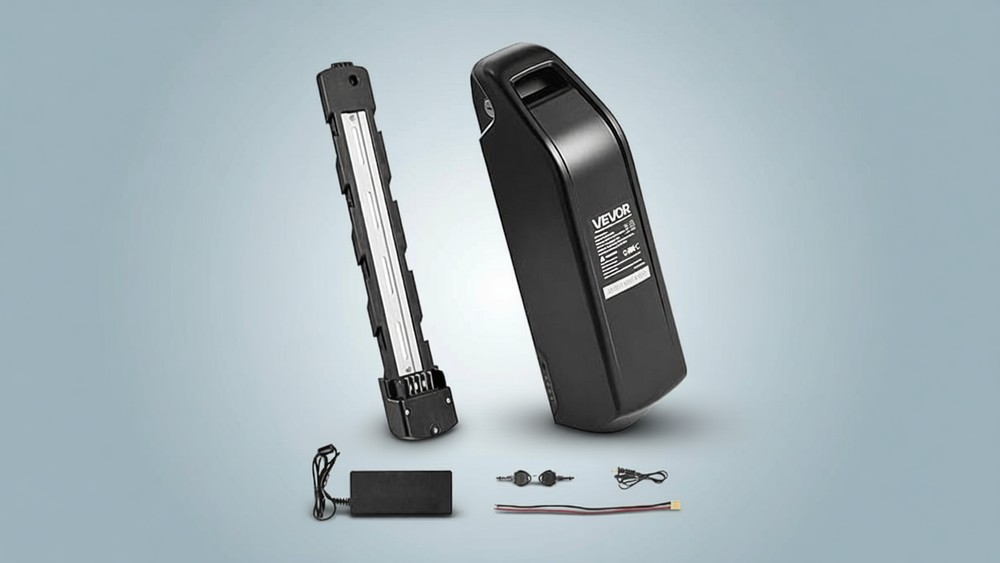
Four generic listings sell the same watt-hours at a 0.14 per watt-hour floor. The VEVOR sat at 0.25, roughly 78 percent more per unit of energy, and the premium bought a named brand plus the extras: a USB charge port, a key lock, a 3A charger in the box, a discharge socket.
The board story was clean, which is rare in this tier. A 40A BMS at 52V holds 2080W continuous, and the title's 1500W motor claim draws 28.8A at nominal, leaving an 11A reserve. Charging holds up too: 20Ah at 3A is a 6.7-hour floor, inside the old 6-to-7-hour estimate.
Now the listing is dead, so the brand premium can't be checked against a page anymore. What remains on record: the dimensions, 14.76 x 4.92 x 3.78 inches, the 58.8V charger rule, and the range arithmetic an honest 1040Wh pack owes you.
What the premium bought in a split tier
The 52V 20Ah tier runs from 0.14 to 0.37 per watt-hour across the packs we track, and the floor of it is crowded. Varstrom lists the same 1040Wh at 149.66, Lithium Hellas and Fryzonix at 149.99, and a no-name row sits at 149. All four sell the identical energy figure the VEVOR sold, at about 56 percent of its per-unit price.
So what did the extra cost cover? Not more energy, and not an audited cell. The honest list is short: a brand with consistent spec sheets across a wide product line, the USB charge port, the key lock, the 3A charger shipping in the box, and the discharge socket the title names.
Our row carries no rating for the pack, and the old article never cited one either, so the record freezes empty: no buyer verdict on file, and now no page to check one against. On price the pack sat close to the middle of all 324 batteries we track, and the live position renders in the specs box on our battery comparison table.
Two siblings in the same tier bookend it: the Ransyri at 0.24 and the Viset at 0.28, both rebuilt from dead listings in their own right. The VEVOR's 0.25 sat between them, which is the fairest one-line summary of the price: mid-tier for the tier, priced above the generics for a name and a feature set.
The extras, priced honestly
The USB port is the most useful extra and the least measurable. A full phone charge draws about ten watt-hours, one percent of the pack, so the range cost is real but trivial, and the old article's word that you won't notice it holds.
The key lock matters more than it sounds on an external box pack, because a strap-on pack without one walks away. But a key lock is not theftproof, and a determined thief with tools defeats it. For long parking, the pack comes off the bike, which the detachable design supports anyway.
The board math and the charge floor
The old article got its arithmetic right, which deserves saying plainly because most dead listings leave worse behind.
A 40A BMS at 52V nominal holds 2080W continuous. The title's top claim, a 1500W motor, draws 28.8A at that voltage, so the board carried about an 11A reserve over the claim. Peak draws on hills and hard acceleration fit inside that headroom, and the board was never the pack's weak point.
The controller side carries the real compatibility condition. A 52V pack needs a controller and display rated for it: the low-voltage cutoff on a strict 48V controller can misread the pack and either strand you early or drain the cells too low. The em3ev 52V buyer guide walks through that cutoff gotcha, and it applies to every pack in this tier, not just this one.
Charging runs on the same arithmetic. The pack's 20Ah at the included 3A charger sets a 6.7-hour floor from empty, before the tail while an onboard balancer evens the cells out. The old estimate of 6 to 7 hours survives that floor at its top end, one of the few charge claims in this campaign to survive contact with division.
Any replacement charger has to state 58.8V output, because a 52V pack is 14 cells in series and a 54.6V 48V charger never fully charges it.
Range, corrected
The old article told readers to expect 30 to 50 miles per charge with flat terrain and pedal assist at the top. That band blends two riding regimes and lands below either honest one.
The em3ev range anchor puts a 0.96kWh pack at 30-40 miles on throttle alone and 50-65 on light pedal assist, and scaling those figures to 1040Wh gives about 32-43 miles on throttle and about 54-70 on light pedal assist.
The practical reading for a replacement buyer: if your old 1040Wh pack delivered 60-plus miles on easy assist, that was the pack working as designed, not an anomaly. Hills, cold and a heavy throttle hand pull both figures down together.
Replacing a pack you can still measure
Most dead-listing rebuilds end with a fit problem, because the dimensions died with the page. This one keeps its body measurements on the record: 14.76 by 4.92 by 3.78 inches, which makes a like-for-like tray match possible in a way the Gofaro and Meaycoty rebuilds couldn't offer.
The form-factor row says Other, an external box with a discharge socket and no named mount, so the mounting hardware was always the buyer's problem: straps, a plate, an adapted bracket.
The replacement order runs: measure the old pack's tray against those figures, match the discharge connector on the controller side (the batterydex connector guide covers the types, and they don't interchange), match the charge port, then buy a charger stating 58.8V. Weight was never recorded. The complete-pack density band puts a 1040Wh box pack near 5 to 5.8kg, so treat that as an expectation for planning a mount, not a spec.


With the listing dead, current 52V candidates live in the tagged searches: 52V 20Ah ebike batteries and the broader 52V lithium pack field. More replacement candidates are in the review archive.
FAQ: the cutoff set for thirteen cells, the charger that stops short of full and the tray measurements the next order needs
Can a 52V pack run on a 48V controller?
Not safely. The controller's low-voltage cutoff is set for a 13S pack, and a 14S pack at full charge sits at 58.8V, which the controller and display both have to accept.
On a strict 48V controller the state-of-charge reading goes wrong in both directions, and over-discharge damages the cells. Build or convert with a 52V-rated controller.
What charger does a 52V pack need?
One that states 58.8V output, which is 14 cells at 4.2V each. A 54.6V charger, the 48V standard, never fully charges a 52V pack and leaves it unbalanced and weak. The pack's own 3A charger was built for this chemistry, and any replacement needs the same voltage figure on its label.
How long does a full charge take?
About 6.7 hours from empty at 3A, before the tail while the cells even out, which matches the old 6-to-7-hour estimate at its realistic end. Charging overnight covers it with room to spare.
What range should 1040Wh deliver?
About 32-43 miles on throttle alone and 54-70 on light pedal assist, using the em3ev per-mile anchors scaled to the pack's size. A 15-mile round-trip commute fits twice over inside even the throttle figure.
Is the listing coming back?
No sign of it. The page returns Page Not Found as of our November check, with nothing behind the URL. A replacement hunt runs through the tagged searches above, with the old pack's tray dimensions and connector as the checklist that matters.